loading


Product
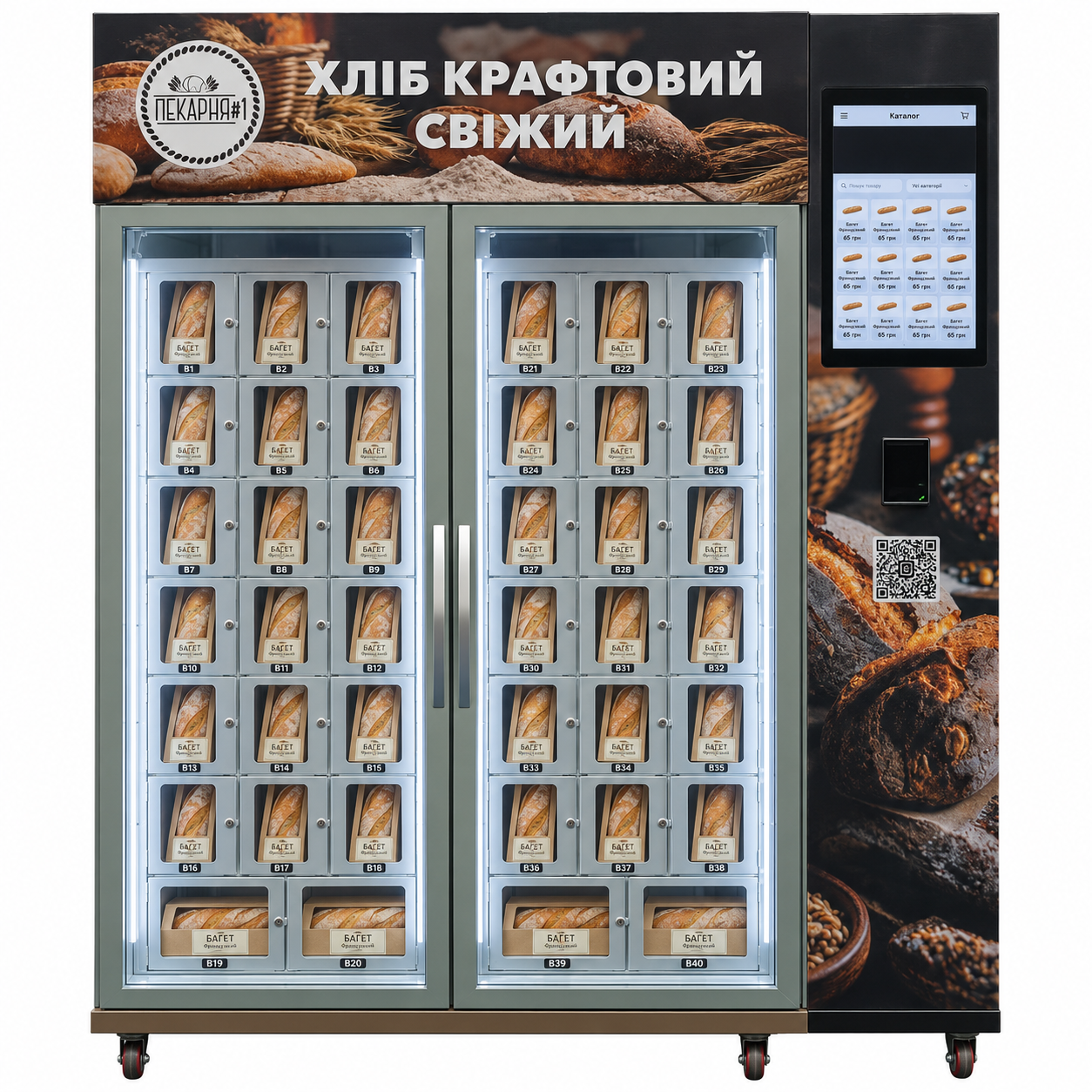
Front view of a refrigerated baguette locker vending machine with two glazed outer doors, individual bread compartments and a right-side product screen.
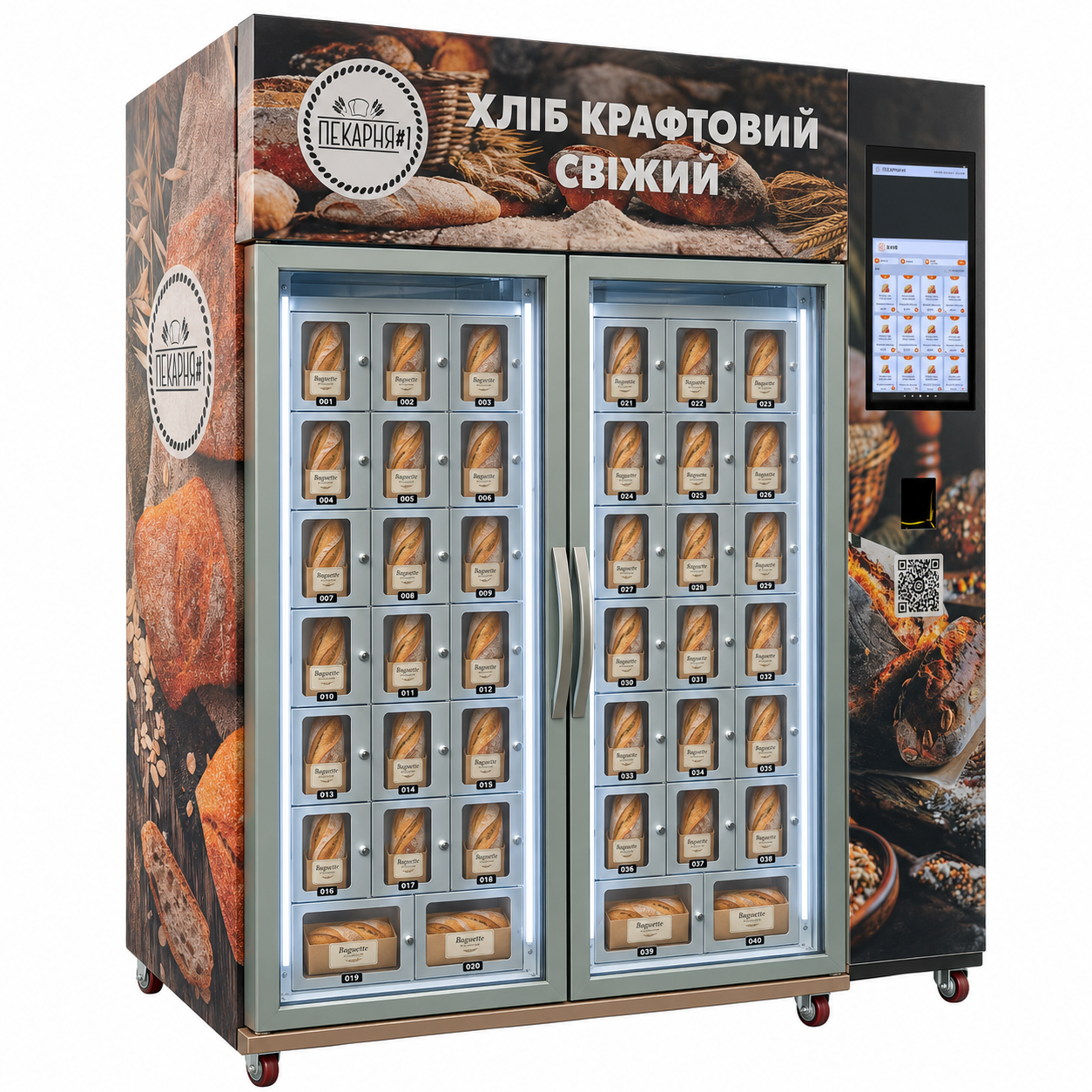
Left-angle view of a refrigerated bread locker vending machine with artisan bakery artwork, upright baguette compartments and wider lower lockers.
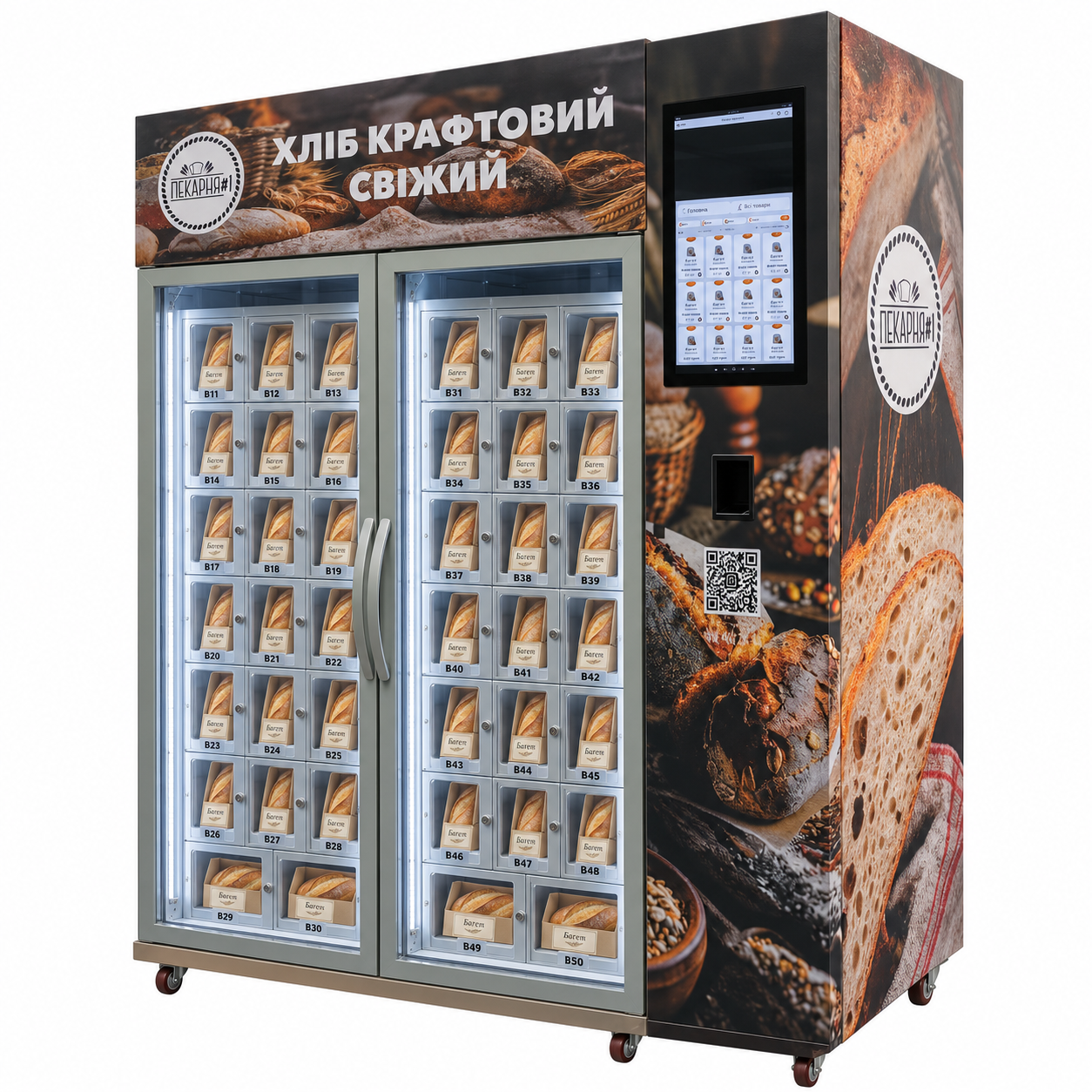
Right-angle view of a refrigerated baguette vending locker showing the portrait catalogue, reader area, bakery graphics and glazed compartment display.

Refrigerated Baguette Locker Vending Machine

Bring packed bread closer to customers, with individual lockers and connected retail tools.

THE ARTISAN BREAD DEPOT

Your bakery. One more place to buy.

This refrigerated baguette locker vending machine concept brings packed bread into a separate-compartment retail format. The supplied views show two glazed outer doors, upright bread spaces, wider lower compartments and a right-hand digital catalogue.

A practical format for long bread packs

Match each packed loaf to an approved compartment and test the full collection journey. Separate product spaces can suit a bakery assortment without relying on a common pickup bin, subject to the supplied access mechanism.

Prepare refills with useful records

Supported backend stock, sales, price and content tools can help prepare visits and review the range. Confirm compatible controls, enabled modules, connection costs and any quoted temperature or door monitoring.

Build the case from retained contribution

Estimate goods, packaging, unsold removals, payment fees, rent, route work and cooling energy. The detailed guide includes operating-contribution and batch-window calculators using your figures.

Discuss your bread packs and location ↗
5.0
design customization

    oops...!

    no product data.

    Go to homepage
    THE ARTISAN BREAD DEPOTA refrigerated locker buyer’s guide

    FROM BAKERY BATCH TO CUSTOMER HANDOVER.

    Refrigerated baguette
    locker vending machine.
    Your bakery.
    One more place to buy.

    Give customers another convenient place to buy your packed bread. Individual compartments, a glazed display and a digital catalogue bring the bakery offer into a compact sales point. Plan each load around product fit, storage needs and the margin you keep.

    What cooling data do I need? ↗Will my baguettes fit? ↗

    Refrigerated category supplied by the buyer. Technical ratings, capacity and door logic require the final configuration.

    Front view of a refrigerated baguette locker vending machine with two glazed outer doors, individual bread compartments and a right-side product screen.
    REFERENCE FRONT / Packed bread, separate spaces, a customer access sequence to verify.
    01Fit the packed loaf
    02Verify loaded conditions
    03Complete the handover
    04Measure retained contribution
    01 / BAKERY FIELD NOTES

    A refrigerated bread sales point with separate product spaces.

    Bring your bakery range closer to the customer, with separate spaces for packed bread and a clearly visible catalogue. The reference cabinet has two glazed outer doors and a right-hand control column. Confirm the refrigeration package and access sequence on the quoted model.

    DISPLAY

    Let customers recognise the bread

    The window shows upright baguette packs and wider lower compartments. Artisan-bread photography, wheat and a dark bakery wrap make the category easy to identify.

    Discuss this with the supplier +

    Check visibility, reflections and labels at the intended site.

    LOCKERS

    Test a compartment-based collection journey

    Individual product spaces give this concept a different retail layout from a common-drop snack cabinet. For a suitable configuration, retrieval can be designed around a selected compartment rather than a shared pickup bin.

    Discuss this with the supplier +

    Ask how the customer accesses the selected space through the outer door, whether only the purchased compartment unlocks, and how the outer and inner doors are monitored.

    CONTROL

    Put choice and payment in one visible area

    A portrait catalogue, a dark reader or scanner area and a printed QR graphic are visible in the control column. Their appearance does not establish local payment methods or the purpose of the QR code.

    Discuss this with the supplier +

    Confirm screen size, touch support, languages, provider, currency and merchant account.

    Get the configuration schedule ↗Inspect all three views ↗
    02 / BAKERY FIELD NOTES

    Fit the loaf, the packaging and the handover.

    A baguette can fit diagonally in a picture yet be awkward to remove from an actual compartment. Use the complete retail unit, not a bare-loaf estimate. The wider bottom spaces shown should be approved separately from the upright spaces.

    MEASURE

    Use filled-pack dimensions

    Include loaf length, width, height, paper bag, film, seal and any label that projects. Different recipes and batches can vary enough to matter.

    Discuss this with the supplier +

    Send actual packed samples, including the longest and widest normal production examples.

    COLLECT

    Keep the retail presentation intact

    A locker arrangement can be useful for long products when the approved collection process avoids an unsuitable common-drop route. It does not automatically prove zero impact, no handling damage or a particular protection rating.

    Discuss this with the supplier +

    Run repeated real purchases and inspect crust, shape, seals and pack condition.

    LOAD

    One saleable unit per stock rule

    Specify whether a locker contains one loaf, one multipack or another complete retail offer. A customer buys the described unit; filling a compartment with several independently priced items requires a supported transaction and stock method.

    Discuss this with the supplier +

    Match SKU, compartment, quantity, price and photo.

    03 / BAKERY FIELD NOTES

    Refrigeration needs a product-specific plan.

    Refrigerated storage is part of this requested product category. The images alone do not establish setpoint range, cooling capacity, temperature uniformity, defrost method, refrigerant, energy use or recovery time. Ask for these on the exact model and match them to your bread and packaging.

    PRODUCT

    Choose the storage condition for the actual bread

    Cooling is not a universal promise of better texture or longer life. Crust, crumb, fillings and packaging can respond differently.

    Discuss this with the supplier +

    Confirm whether this offer is a plain baguette, a filled bread product or another recipe.

    VERIFY

    Measure the loaded cabinet, not just a display value

    A controller reading is useful, but it does not by itself prove the condition at every product position. Loading, ambient conditions and outer-door opening can affect the operating pattern.

    Discuss this with the supplier +

    Ask for the configured setpoint limits, sensor locations, loaded temperature checks, door-open recovery and alarm logic.

    RESPOND

    Decide what happens when cooling is interrupted

    An alarm is only useful if someone receives it and knows the action to take. Connectivity, sensors and software modules determine which events can actually be reported remotely.

    Discuss this with the supplier +

    Agree local and remote indications, notification channels, who responds and the product disposition procedure based on verified food guidance.

    Connect storage with batch planning ↗Ask for measured refrigeration data ↗
    05 / BAKERY FIELD NOTES

    A backend that supports the next useful action.

    Prepare refills from stock records, review sales before changing the range, and update supported prices and product content without a visit made only for that task. Confirm which WEIMI backend functions, sensors and account permissions come with your machine.

    AVAILABILITY

    Know which compartments need attention

    Supported stock records can help prepare a refill and avoid journeys made only to inspect the cabinet. The useful count distinguishes available goods, sold goods and operator removals.

    Discuss this with the supplier +

    Demonstrate a sale, access event, refill and correction.

    MENU & REPORTS

    Keep product facts and prices aligned

    Supported content tools may let an authorised operator update photos, quantities, descriptions and prices. Product-level reports can show which offers move when transaction states are clearly defined.

    Discuss this with the supplier +

    Change a price, verify acknowledgement on the unit and complete a real purchase.

    CONDITIONS

    Confirm the actual cooling and door integration

    A remote temperature graph, door alarm or sales inhibition may be valuable, but each needs compatible hardware and enabled software. The supplied pictures do not show those records or prove their availability.

    Discuss this with the supplier +

    List sensors, update frequency, alarm thresholds, channels, recipients and lost-connection behaviour.

    Manufacturer: general remote-management functions ↗
    Manufacturer: general backend overview ↗

    Demonstrate the operating tasks ↗
    06 / BAKERY FIELD NOTES

    What does a sold bread pack leave behind?

    Use the actual retail unit, not a loaf price from the illustration. The owner earns revenue from goods sold, while retained contribution depends on bread, packaging, waste, payment, venue and the operating route.

    Your operating contribution planner

    Use one SKU or a consistent unit average, in one currency and tax basis. Include packaging and inbound costs. Monthly fixed costs should include route work, software, connectivity, site costs and refrigeration energy on a measured or documented basis. This unit model assumes one pack per payment.

    Enter your figures, then calculate. No sales assumptions have been filled in.
    Per sold unit

    Price − landed goods cost − percentage charges − other variable cost = unit contribution.

    Per month

    Sold units × unit contribution − fixed running costs = monthly operating contribution.

    Check possible batch remainder ↗
    07 / BAKERY FIELD NOTES

    Load to the saleable window, not just empty spaces.

    An available compartment is not a reason to overproduce. Compare a proposed batch with expected demand and the product-specific removal cutoff. This tool is planning arithmetic, not a food-safety decision.

    Batch window and possible remainder

    Run this for one SKU and batch. Remaining product life is measured at loading under the required storage conditions. Buffer days are your chosen removal margin before the relevant date. The tool does not recommend shelf life, predict sales or extend a printed date.

    Enter your figures, then calculate. No sales assumptions have been filled in.
    Revisit validated storage ↗
    08 / BAKERY FIELD NOTES

    Price, capacity and refrigeration belong in one quote.

    The pictures establish the bakery theme and visible layout. They do not establish one reliable compartment count: numbering and arrangements vary across views. Use the final production drawing and your approved packs for capacity and access decisions.

    Model and final layout +

    Model ID, final compartment arrangement, usable capacity by approved pack, dimensions and weight.

    Product fit +

    Internal/opening dimensions per compartment type, permitted pack orientation, loading and retrieval tests.

    Access sequence +

    Which doors open, lock logic, customer sequence, sensors, closure state, failed access and service override.

    Refrigeration package +

    Setpoint range, cooling duty, refrigerant, sensor locations, defrost, condensate handling and maintenance.

    Loaded performance +

    Loaded temperature checks, stated ambient conditions, door-open recovery, monitoring and measured energy use if available.

    Screen and payment +

    Panel size/touch/languages, provider, local methods, account, currency, fees, settlement and refunds.

    Power and installation +

    Voltage, frequency, rated load, plug/grounding, ventilation, service clearance, handling and securing instructions.

    Connectivity and backend +

    Compatible controls, enabled modules, roles/logs, stock rules, exports, sensors, data costs and renewals.

    Service and commercial scope +

    Itemised quote, freight, setup, training, parts/labour/shipping, exclusions, spares and renewal charges.

    Turn the schedule into tests ↗Prepare the quote request ↗
    10 / BAKERY FIELD NOTES

    Give the operator a practical service route.

    No fixed warranty or response commitment was provided. Ask for written coverage and a handover that explains customer exceptions, compartment faults and cooling issues separately.

    TRAINING

    Teach the routine on the delivered system

    The operator needs to load approved packs, record batches, inspect doors/seals, update availability, review a sale and recognise an alarm. Receive guides and have a trained backup person perform the tasks.

    Discuss this with the supplier +

    Confirm training language, sessions, follow-up, safe operator checks and escalation channels/hours.

    COVERAGE

    Separate parts, labour and attendance

    Refrigeration, locks, electronics, payment and software can have different support responsibilities. A parts warranty is not automatically an on-site service commitment.

    Discuss this with the supplier +

    Request duration, exclusions, claim evidence, labour/freight responsibility, recommended spares and availability after warranty.

    Complete the acceptance record ↗
    12 / BAKERY FIELD NOTES

    Approve a working operation, with records.

    Use these marks to organise witnessed checks and documents. They stay only on this open page and do not certify the cabinet. Save actual temperatures, measurements, videos and results with the order.

    0 of 6 checks marked. Marks stay only on this open page.

    14 / BAKERY FIELD NOTES

    Send the bread pack and the operating plan.

    A useful quotation answers product fit, cooling duty, customer access, running costs and service together.

    What to send

    • Country, currency, site and delivery access.
    • Filled bread-pack photos, measurements and weights.
    • Verified storage guidance and loading condition.
    • Batch, removal and refill plan.
    • Payment, remote tasks and alarm requirements.
    • Training and support expectations.

    What to request

    Final drawing, model sheet, pack/access tests, refrigeration data, enabled modules, recurring charges, commissioning and written service scope.

    Request a configured quote ↗

    Manufacturer FAQ ↗

    Return to the cabinet ↗Review the cost basis ↗
    A useful sales point begins with a controlled routine.

    Based on the buyer’s refrigerated-locker description and reference images. Confirm specifications, enabled software and service in the written order. Tools use your inputs and do not predict sales, certify food safety or guarantee returns.

    Back to top ↗
    Contact us now for a quotation
    We endeavor to give the most attentive service along with exceptional quality and value to every customer who purchases from Weimi. If you have any questions about your order, please feel free to contact us.
    Related Products
    Customer service