loading


Product
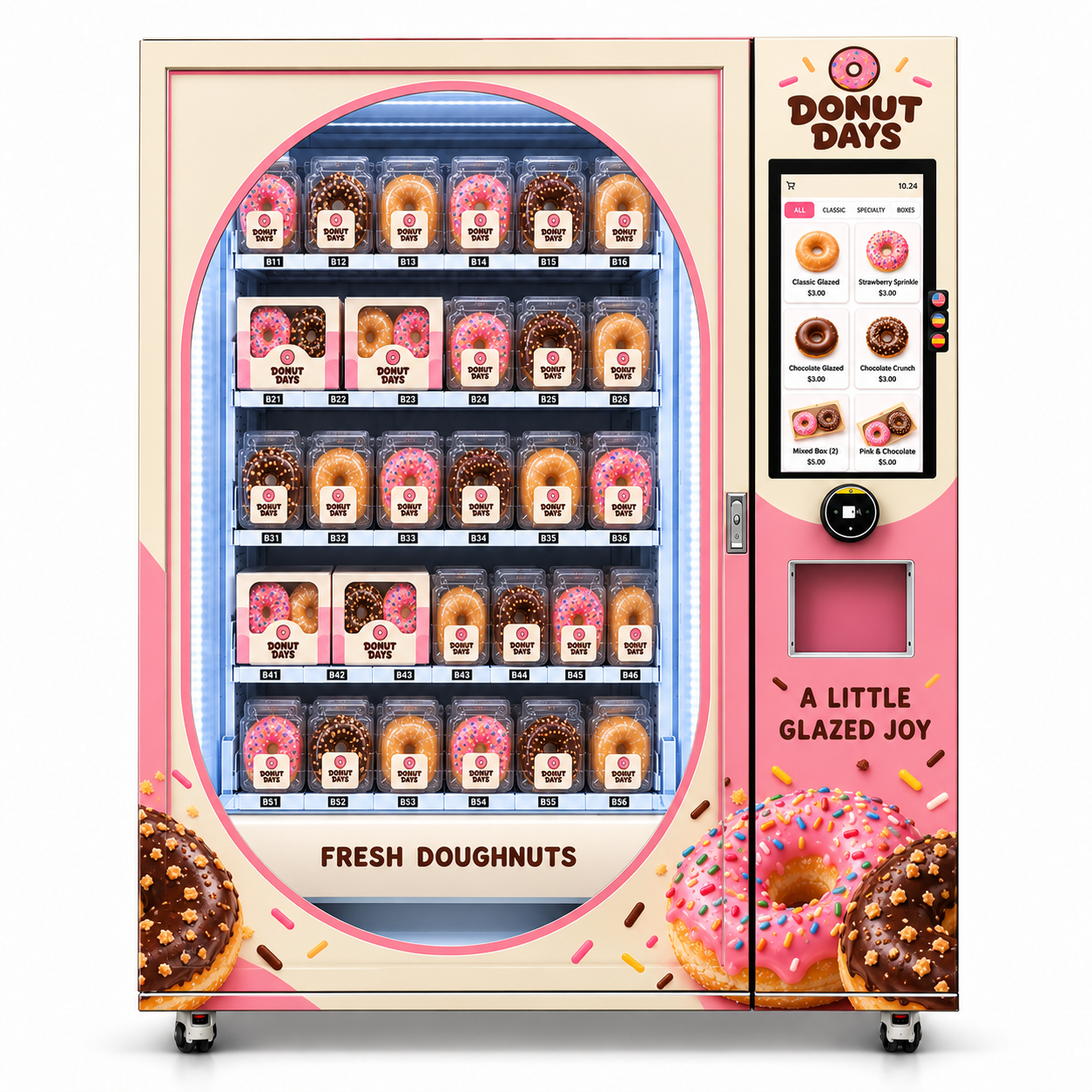
Front view of a cream and pink donut vending machine with an illuminated oval product window, packaged doughnuts, portrait screen and pickup opening.
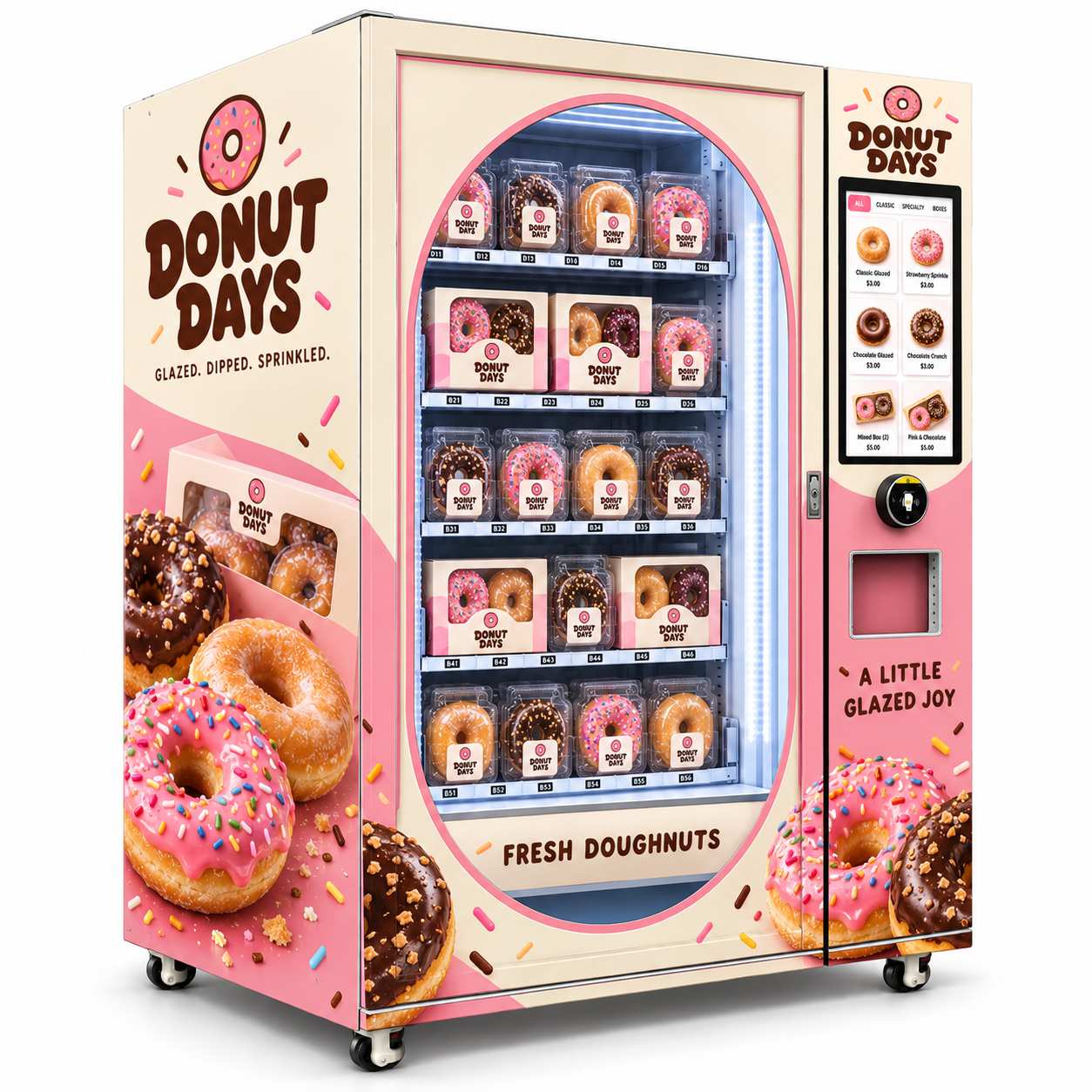
Left-angle view of a donut vending machine with DONUT DAYS side artwork, individually packed doughnuts and boxed pairs behind the display window.
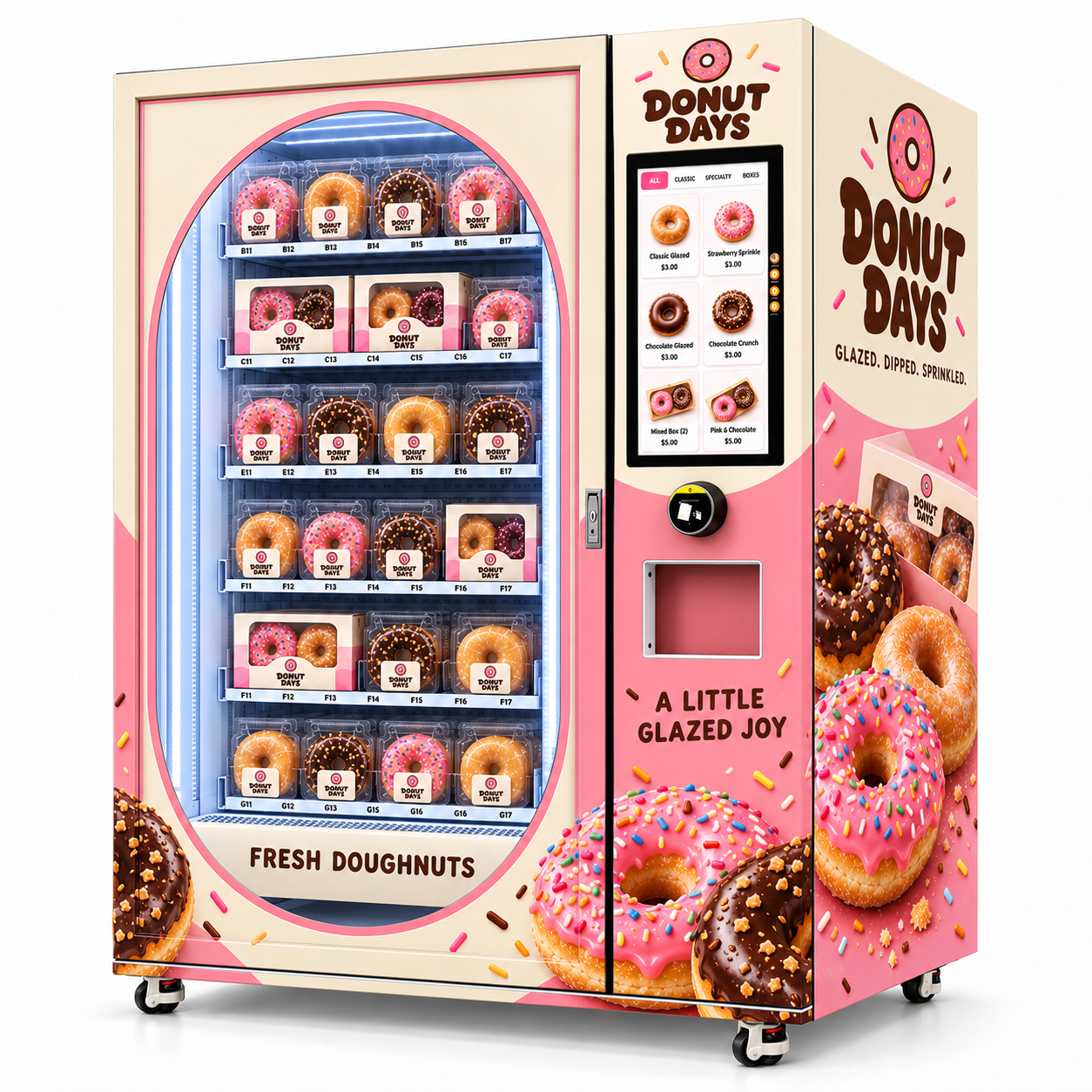
Right-angle view of a cream and pink donut vending machine showing the product screen, round payment reader, collection opening and sprinkle graphics.

Donut Vending Machine | Packaged Doughnuts & Remote Tools

A sprinkle-themed donut storefront with pack checks, remote tools and practical cost planning.

PACKAGED DOUGHNUTS / A PRACTICAL RETAIL EDITION

A sprinkle of personality.
A clear operating plan.

The reference donut vending machine pairs a cream-and-pink cabinet with DONUT DAYS artwork, sprinkle graphics and an illuminated product window. A portrait menu, round reader and collection opening occupy the right column. Individual clear packs and windowed pair boxes are shown as retail formats.

01

Test the complete pack

Check filled-pack dimensions, closures, orientation, quantity and retrieval. Inspect glaze, toppings and pack condition after repeated delivery. Visible shelves do not identify the hidden mechanism or prove universal compatibility.

02

Match storage to the recipe

Obtain the product storage guidance and remaining life at loading. Confirm any required environmental equipment in the quote. Plan batch rotation and removal cutoffs. Stock records do not establish expiry tracking, and the images do not show baking, heating or refrigeration.

03

Count what stays after costs

Confirm enabled remote stock, sales and catalogue tools, account rights and fees. Use actual goods, packaging, waste, payment, venue and route costs. The detailed page includes four buyer-input tools: operating contribution, single-pack versus box mix, batch window and refill capacity.

Discuss your doughnut packs ↗ Manufacturer FAQ ↗
5.0
design customization

    oops...!

    no product data.

    Go to homepage
    DOUGHNUT RETAIL / THE OWNER’S EDITIONPACK • PRESENT • SELL • REPLENISH

    A LITTLE GLAZE. A CLEARER BUSINESS DECISION.

    Donut vending machine.
    Built around the pack.
    Planned around the numbers.

    A cream-and-pink packaged-doughnut storefront with a visible product window and a portrait menu. Start with the customer appeal, then check the delivery condition, storage needs and real cost of keeping it stocked.

    Protect the product ↗Check the business case ↗
    01 / SHOW

    Visible individual packs and pair boxes help the offer explain itself.

    02 / VERIFY

    Test the actual filled packs and the complete transaction.

    Front view of a cream and pink donut vending machine with an illuminated oval product window, packaged doughnuts, portrait screen and pickup opening.
    REFERENCE FRONT / The artwork is a concept; the configured order supplies the specifications.
    03 / PLAN

    Connect dates, batch size, capacity and the refill route.

    04 / RETAIN

    Count what stays after goods, fees, waste and running work.

    01 / START WITH THE BUYING QUESTIONS

    What are you buying, exactly?

    This is a reference design for a packaged-donut vending machine. It gives you a visible product display and a separate customer control column. To decide whether it suits your business, connect that layout to a tested pack, a workable food-storage plan and a complete quote.

    A retail cabinet for prepared, packaged goods.

    The reference shows individually packed doughnuts and pair boxes, not production equipment. The DONUT DAYS wrap and displayed prices are illustrative. Match the final drawing, approved pack list, enabled functions and service scope to one written quotation.

    The buying shortcut +

    Start with the product samples and storage needs. Ask how the pack reaches collection, which local payment setup is supplied, what remote tasks work, what the total package costs and who supports it. Tie essential promises to a named acceptance test.

    Technical questions ↗Cost and payback ↗

    02 / THE MACHINE WALK-THROUGH

    Let the layout do useful work.

    The visible front combines stocked shelves, a portrait catalogue, a round reader, a keyed fitting and a rectangular collection opening. These parts have a clear retail role, but the actual ratings and software behaviour need to match the ordered configuration.

    Use the screen to explain quantity and flavour

    The reference catalogue shows individual flavours and boxed pairs. The screen is the right place to make the difference between one doughnut and one two-piece retail box obvious, alongside the actual price and product information.

    For you: A clear digital menu can reduce customer confusion without asking the host venue to explain the offer. Supported content tools can also make range updates easier.

    Practical test +

    Demonstrate the delivered screen, touch support, language and content fields. Match each entry to the loaded pack. Confirm whether product details can show the information needed before purchase; a screenshot does not establish the working interface.

    A simple column to test end to end

    The round reader sits beneath the screen, with collection below. It is a compact sequence for the shopper, while the operator needs a reliable match between payment, delivery and the stock record.

    For you: A clear transaction path makes acceptance testing straightforward. You can check whether a customer understands where to pay, wait and collect without relying on the artwork.

    Practical test +

    Run a local payment on the actual integration, collect the pack and inspect it. Test decline and failed delivery as well. Confirm collection dimensions and access. The reader shape and reference logos do not establish a payment provider or supported methods.

    Follow a complete sale ↗Inspect the views ↗

    03 / THE DOUGHNUT PACK LAB

    Protect the glaze as well as the sale.

    A doughnut can be delivered in the correct quantity and still arrive with smeared icing or a crushed topping. Test the complete retail pack with the actual product inside, using the configuration you intend to buy.

    Clear packs with enough headroom

    Individual clear packs in the reference keep the product visible. Their practical value depends on the actual closure, stiffness and internal headroom around the doughnut, especially where icing or sprinkles stand above the surface.

    For you: A consistent approved individual pack gives the loading team a clear unit and can help keep the customer-facing presentation aligned with the screen photo.

    Practical test +

    Measure the filled pack at its widest and tallest points, including hinges, tabs and seals. Test for lid pressure, reopening and contact with the topping. Use the filled pack, not an empty sample or an estimate from the picture.

    Different recipes can travel differently

    A plain glazed ring, a heavy chocolate coating and loose sprinkles do not behave the same way. A soft or sticky finish may make a pack more sensitive to heat, pressure or movement, even if the outer dimensions are identical.

    For you: Testing a representative difficult product can show where better packaging or a narrower first assortment is worth the cost. It protects the quality your buyer expects from the bakery.

    Practical test +

    Use the most sensitive recipes you actually plan to stock. Inspect glaze smearing, topping loss, shape and seals before and after repeated delivery. Agree what level of cosmetic damage is unacceptable rather than using “gentle delivery” without evidence.

    Ask how the pack reaches collection

    The internal transport is hidden in the reference images. Visible rows and dividers do not prove a spiral, lift, conveyor, impact rating or a particular protection system. The delivery route needs its own explanation and test.

    For you: Knowing the real mechanism lets you choose packaging based on the machine you will receive and avoids buying stock around an assumed feature.

    Practical test +

    Request the internal drawing or demonstration. Test a full position, normal mid-stock and the final units. Record position, orientation, result and collected condition. A format that fits the storage area may still catch elsewhere along the delivery path.

    Build the loading instruction ↗Match storage to the recipe ↗

    04 / FRESHNESS IS AN OPERATING ROUTINE

    Choose the goods and storage conditions together.

    Do not infer refrigeration, heating or humidity control from a bright display or food graphics. Doughnut shelf life depends on the recipe, packaging and documented storage conditions. The written machine specification needs to support the goods you want to sell.

    Get the product guidance first

    Different fillings and toppings can require different handling. Use the bakery or food supplier’s documented conditions for each retail product, then compare them with the machine environment and the site.

    For you: You can choose a suitable initial range without discovering after installation that an important recipe needs an unquoted storage system.

    Practical test +

    Request the cabinet’s operating limits and any quoted active temperature equipment, settings, monitoring and maintenance needs. If a recipe needs chilled storage, confirm that exact requirement before ordering; the render establishes no cold chain.

    Define the latest saleable point

    Count remaining product life when the goods reach the machine, not only when they leave production. Transport, preparation and stockroom time all use part of the available window.

    For you: A clear loading and removal rule can help reduce early collection trips and date-related waste. It also makes responsibility between bakery and operator easier to explain.

    Practical test +

    Record batch, applicable date marking, storage requirements and your removal buffer. Follow the product and market requirements. The tools here do not decide food safety, recommend a shelf life or extend the printed date.

    Make ingredients and quantity easy to find

    Use verified product information for ingredients, allergens, weight and any recipe claims. A customer should understand the purchased pack and see the information required in the selling market before choosing.

    For you: Accurate information supports a suitable purchase and makes it easier for the host and operator to answer consistent questions.

    Practical test +

    Check label and screen together. Do not invent vegan, gluten-free, nut-free or other claims. When a recipe, weight or supplier changes, update the product identity and content before mixing it into the offer.

    Use the batch-window planner ↗Check supported records ↗

    05 / PUT STOCK IN A SYSTEM

    A good loading guide saves more than shelf space.

    The operator needs to identify the correct product, load its approved position and leave a record that matches physical stock. Keep instructions simple enough for a trained backup person to follow.

    One retail pack. One clear loading rule.

    Identify each SKU by flavour, count, weight and pack version. Record orientation, intended position and tested usable load. Reconcile refills, test purchases, damage, removals and corrections with physical stock.

    Ask another operator to follow it +

    A trained backup person should match pack, position and screen entry without guessing from colours. Demonstrate the last unit and unavailable state. Do not infer item-level sensing, automatic dates or adjustable hardware from the render.

    Calculate a stock target ↗Test the complete routine ↗

    06 / REMOTE TOOLS THAT HAVE A JOB

    Prepare the visit before you leave.

    WEIMI describes general inventory, sales, pricing, status, content and multi-machine functions. The tools available on this unit depend on compatible electronics, enabled software, connectivity, account permissions and charges. Demonstrate the tasks you intend to use.

    Know which product needs attention

    Where supported, a remote stock view can help you prepare the next pick list and review recent sales. The useful outcome is a better decision about what to take, not simply another dashboard.

    For you: Better preparation can reduce visits made only to check the machine and make a necessary refill more productive.

    Practical test +

    Check update timing, offline indicators and the count method. Compare a real physical position with the remote record after a refill and sale. Ask whether thresholds are set per SKU or position and what happens when the data is stale.

    Keep the screen aligned with the stock

    Supported catalogue tools may allow authorised edits to product names, photos, descriptions and prices. This can help you introduce an approved recipe or box without doing every content edit at the cabinet.

    For you: A controlled update can reduce manual work and help prevent a mismatch between the pack, menu and charged price.

    Practical test +

    Demonstrate an edit and its acknowledgement on the quoted machine, then buy the item. Confirm language fields and required food-information display. Ask about failed updates and permissions rather than assuming every content function is included.

    Read quantities, exceptions and timing

    Revenue alone does not tell you which recipe to make or buy again. Product quantities and clear transaction states can support a better range plan when the reports are defined and reconciled.

    For you: You can compare sold stock with removals and understand whether a weak result came from demand, unavailable stock or a delivery issue.

    Practical test +

    Request a sample export. Trace a successful sale and a refund through the supplied records. Confirm currency, time zone, gross versus net values and whether manual actions or delivery failures are distinguishable.

    WEIMI general remote-management overview ↗
    WEIMI general backend-management overview ↗

    Include recurring fees ↗Demonstrate enabled functions ↗

    07 / MONEY LEFT AFTER THE SALE

    A strong selling price is only the beginning.

    Use the price of the complete retail pack, then subtract the costs that make it available and keep the location trading. The reference screen prices are illustration content, not a recommended price list. Use one consistent currency and tax basis.

    Single-product operating contribution

    Use one SKU or a genuinely consistent unit average. Include packaging and inbound costs in landed goods cost. Recurring route, software, connectivity and fixed venue costs belong in monthly fixed costs unless already recorded elsewhere. This simple model assumes one unit per payment.

    Enter your figures to calculate. No sales forecast has been filled in.
    The unit calculation

    Price − goods cost − percentage charges − other per-unit costs = contribution per sold pack.

    The monthly calculation

    Sold packs × unit contribution − fixed running costs = monthly operating contribution.

    Compare individual and boxed packs ↗Check likely unsold stock ↗

    08 / SINGLES & PAIRS

    Compare the two retail formats before averaging them.

    A two-doughnut box is one delivered retail unit with its own price, packaging cost and demand. Use this tool to compare individual packs and boxes while subtracting the shared monthly cost once. It does not assume a box is more profitable.

    Individual-pack and box contribution

    Enter monthly quantities as retail units sold, not the number of doughnuts inside. Combined charges include percentage payment and venue fees. This simplified comparison uses the same other per-unit cost for both formats; adjust the inputs if the actual fee basis differs.

    Enter your figures to calculate. No sales forecast has been filled in.
    Review the cost basis ↗Size the next batch ↗

    09 / THE BATCH WINDOW

    Will this load sell before your cutoff?

    A large batch can reduce a purchase cost and still be the wrong load for the site. Use the remaining product life at loading, your chosen removal buffer and a realistic demand assumption. The planner does not certify food safety or recommend storage life.

    Sale window and possible remainder

    Run this for one batch of one SKU. Days are counted from loading. The buffer is your chosen number of days before the relevant printed date when you will remove the stock. Fractional results describe demand averages; physical stock remains whole packs.

    Enter your figures to calculate. No sales forecast has been filled in.
    Keep the date routine ↗Balance demand and capacity ↗

    10 / THE NEXT VISIT

    Enough stock for demand. Enough room for the pack.

    Demand coverage and physical capacity answer different questions. This tool shows the uncapped target so an over-capacity plan stays visible. Run it per SKU and use a tested capacity, then check that the proposed stock also fits the date window.

    Refill target and capacity check

    Current stock, buffer and usable capacity are whole saleable retail packs. A pack already outside your saleable-date rule should not be counted as available. This tool does not infer machine capacity from the pictures.

    Enter your figures to calculate. No sales forecast has been filled in.
    Use the loading guide ↗Agree the service process ↗

    11 / THE SPECIFICATION SCHEDULE

    Get a quote you can compare like for like.

    Buyers searching for a donut vending machine usually need to know price, capacity, storage, payment and service. The supplied images answer appearance questions; the exact values belong to the configured technical sheet and commercial offer.

    The specification to attach to the order
    Item Reference evidence Configured answer to request
    Model and size Cream-and-pink cabinet, stock window and right control column. Model number, dimensions, packed dimensions, weight, final drawing and service clearance.
    Screen and catalogue Portrait product menu with individual and box entries. Measured panel size, resolution, touch support, languages, information fields and software version.
    Storage layout Multiple rows, dividers and labels; arrangements differ by render. One final internal drawing, position count, usable dimensions and any adjustable elements.
    Pack capacity No validated capacity or pack-load rating supplied. Usable capacity per approved SKU, orientation and position, tested full-to-last-unit.
    Delivery and collection Rectangular pickup opening; internal route is hidden. Actual mechanism, supported pack sizes/loads, pickup dimensions, detection and failure handling.
    Temperature and environment Lighting is visible; cooling, heating and humidity control are unconfirmed. Operating limits and any quoted environmental equipment, settings, monitoring and maintenance.
    Power and connection No electrical nameplate or network specification in the pictures. Voltage, frequency, load, plug, grounding, network options, data charges and offline behaviour.
    Payment package Round reader and reference logos visible. Provider, country, currency, methods, merchant account, settlement, fees and refund process.
    Remote software General manufacturer information describes management functions. Compatible controller, enabled modules, roles, logs, exports, updates and recurring fees.
    Batch and food information Packaged products and catalogue are shown; date tools are not demonstrated. Required product fields, any supported batch/date records, or the external register and rotation process.
    Access and movement Keyed fitting and castors visible. Door access, keys, safe handling, levelling/securing instructions and installer responsibility.
    Service and commercial scope No price, warranty or response term supplied. Itemised price, freight, setup, training, coverage, parts/labour/freight responsibility and renewals.
    Request an itemised package ↗Set acceptance criteria ↗

    12 / LOCATION & INSTALLATION

    Find a useful purchase occasion, then measure the site.

    A doughnut offer can fit a break, a take-away moment or a shared treat. That is a hypothesis to test at the location, not a promise that footfall becomes orders. Choose a place you can supply within the product’s saleable window.

    Look at a normal day as well as a peak

    Indoor offices, campuses, hotels and leisure venues may create a relevant occasion. Check nearby bakery offers, opening hours, holiday patterns and whether people actually stop near the proposed position.

    Site check +

    Agree venue permission, rent or revenue share, cleaning, stock ownership and customer support. Time the complete refill route. Include quiet trading periods, travel and removals in the cost review.

    Measure the full route and final position

    Confirm packed and uncrated dimensions, doors, lifts, steps, turns and unloading arrangements. At the final site, allow customer approach, collection access, service space and specified ventilation.

    Site check +

    Get the rated power, network and environment requirements. Follow movement and levelling/securing instructions; castors do not imply free movement when loaded. Complete payment, delivery and backend tests in the final position. Outdoor suitability is unconfirmed.

    Include the actual route cost ↗Confirm utilities and clearances ↗

    13 / AFTER THE DELIVERY

    Service should tell your team what to do next.

    No warranty period or response commitment accompanied the images. Ask for a written package that explains the practical handover, safe operator tasks, escalation and cost responsibilities.

    Get a usable handover and written coverage.

    Train the operator to load, rotate, reconcile stock and recognise exceptions on the supplied setup. Receive the loading guide, batch routine, keys, accounts and escalation contacts. Separate parts, labour, freight, on-site work and third-party payment/software terms.

    Questions for the service offer +

    Ask for duration, exclusions, response channels, hours, claim steps, spare parts, updates and renewal charges. Have the operator demonstrate a refill after training. Agree what evidence to send for a fault and which safe checks are allowed; internal repairs follow the trained service process.

    Complete the handover ↗Ask for written terms ↗

    15 / TURN THE PROMISES INTO TESTS

    Approve a working operation before you expand.

    Use these local marks to organise witnessed checks and documents. The counter is a planning aid, not certification. Keep the actual videos, measurements and agreement with the order.

    0 of 8 checks marked. Marks stay only on this open page.

    Finish the support handover ↗

    16 / BUYER SEARCHES, ANSWERED

    Clear answers to the common decision points.

    Use these answers with the configuration schedule and your quotation. They identify the product and its evidence without treating a reference image as a technical certification.

    Q1Does it refrigerate or keep doughnuts warm?

    Neither is confirmed. Request the configured environment and any required active storage equipment, then compare it with the documented requirements of each recipe and pack.

    Q2What is the capacity and price?

    No validated capacity or price was supplied. Ask for an itemised quote and capacity by approved retail pack. Include payment, software, delivery, installation and service when comparing the complete cost.

    Q3Will the icing stay intact?

    That depends on the product, packaging, environment and actual delivery mechanism. Inspect sensitive toppings before and after repeated tests. No measured protective mechanism or breakage performance was supplied.

    Q4Can I manage it remotely?

    WEIMI describes general management tools. Confirm compatible controls, enabled modules, connectivity, permissions, charges and the exact tasks on this machine. Batch tracking, remote release and automatic refunds need separate evidence.

    Q5How long can the doughnuts stay in the machine?

    Use verified recipe and packaging guidance, remaining life at loading and the agreed storage environment. No universal shelf life follows from the cabinet images. The batch tool is arithmetic, not a food-safety assessment.

    Q6How does the owner make money?

    Revenue comes from retail packs sold. What remains depends on goods, packaging, waste, payment, venue and operating work. Use actual costs and conservative sales inputs; no fixed return or payback period is promised.

    Ask about your own packs ↗

    17 / A USEFUL QUOTATION STARTS HERE

    Send the pack. Describe the site. Ask for the whole package.

    Your first enquiry can resolve the questions that matter to buying: will the goods work, what is included, what does it cost to operate, and who helps after delivery?

    What to send

    1. Country, currency, site and delivery access.
    2. Filled individual and box pack photos, measurements and weights.
    3. Storage guidance and remaining-life plan.
    4. Local payment and account requirements.
    5. Remote jobs, reporting and staff permissions.
    6. Refill route, training and service expectations.

    What to request

    Final model drawing, technical sheet, approved-pack testing, payment integration, enabled software, recurring charges, delivery and installation scope, training and written warranty terms.

    Request a configured quote ↗

    Read the manufacturer FAQ ↗

    Return to the product ↗Review the economics ↗
    Good product presentation needs a workable operation.

    Basis: buyer-supplied reference renderings and linked general manufacturer software descriptions. No model sheet or measured performance results were supplied. Tools use buyer inputs, not a demand forecast, food-safety approval or guaranteed investment return. Confirm final hardware, software, storage, artwork and commercial terms in the order.

    Back to the top ↗
    Contact us now for a quotation
    We endeavor to give the most attentive service along with exceptional quality and value to every customer who purchases from Weimi. If you have any questions about your order, please feel free to contact us.
    Related Products
    Customer service