loading


Product
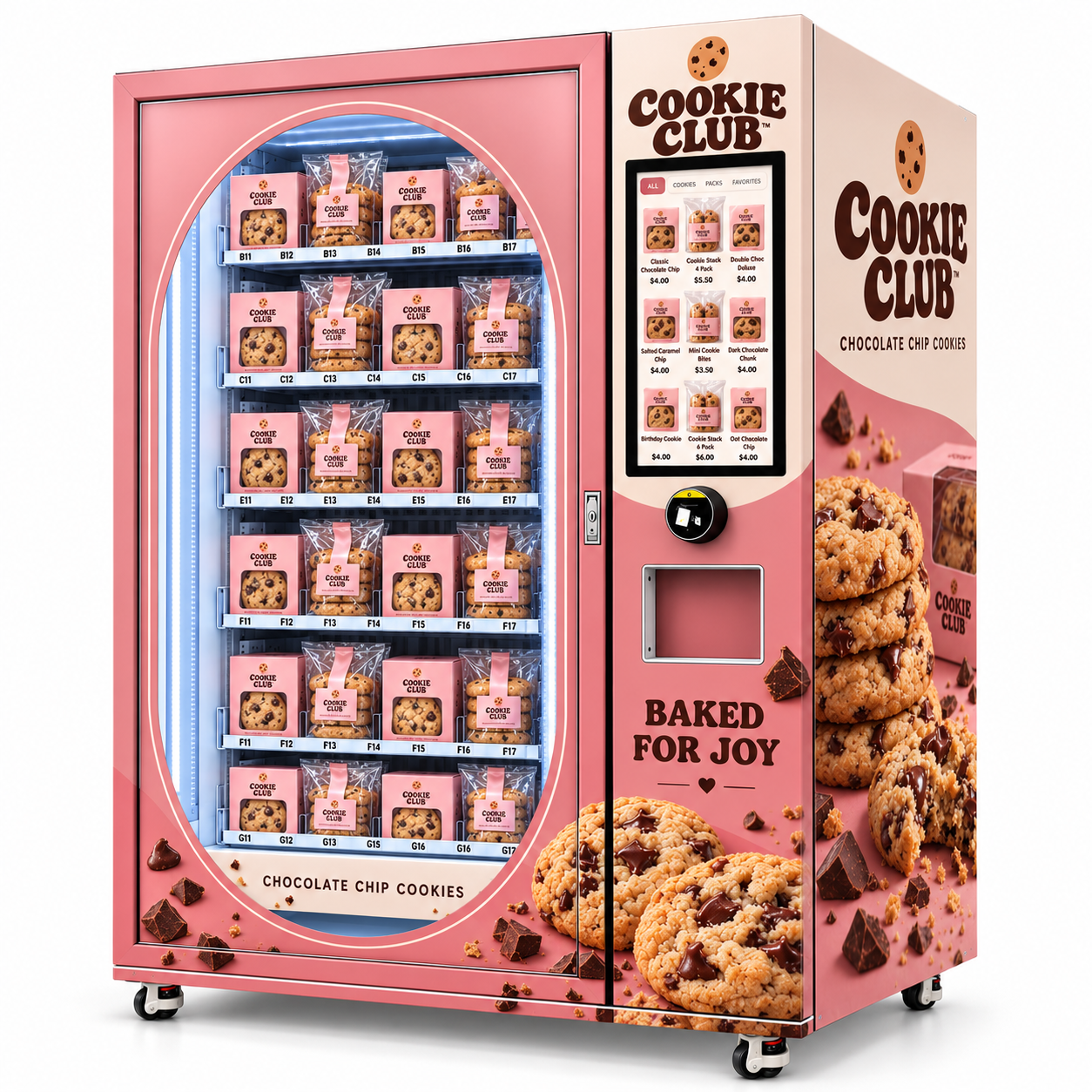
Right-angle view of a pink and cream cookie vending machine with COOKIE CLUB side graphics, product screen and round payment reader.
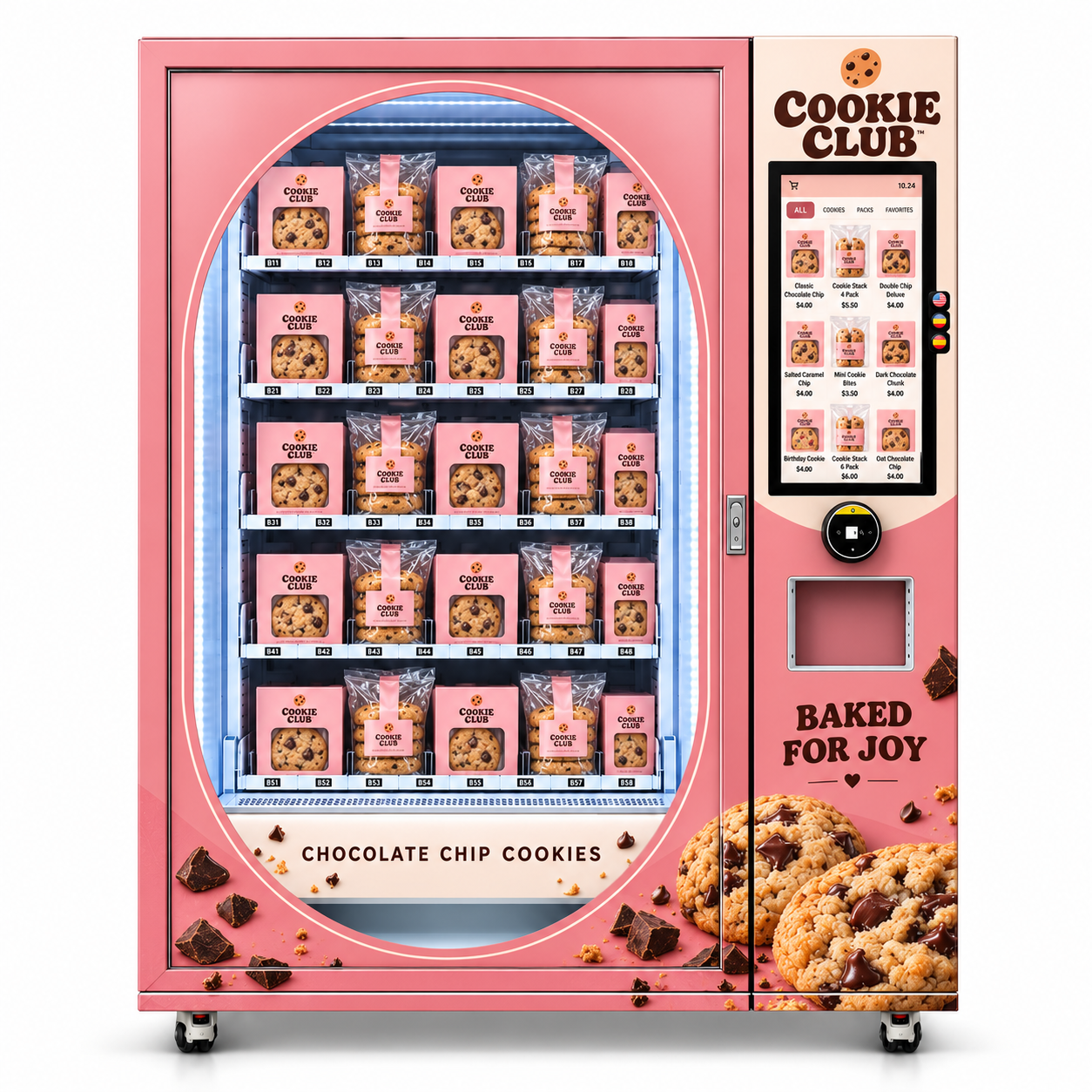
Front view of a pink cookie vending machine with an oval display window, packaged cookies, product screen and pickup opening.
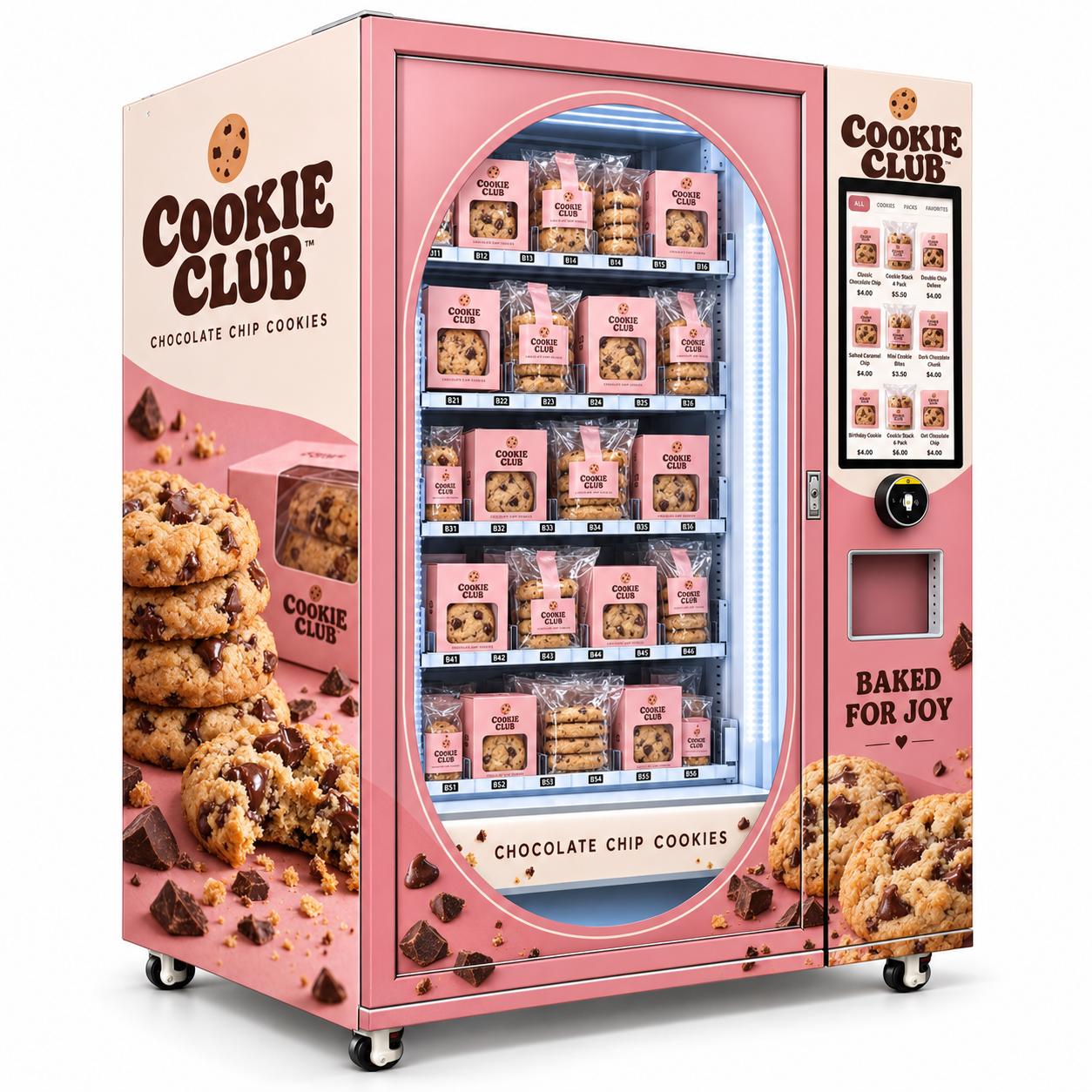
1. Left-angle view of a cookie vending machine with chocolate chip cookie artwork, illuminated product shelves and a pink oval window surround.
Right-angle view of a pink and cream cookie vending machine with COOKIE CLUB side graphics, product screen and round payment reader.
Front view of a pink cookie vending machine with an oval display window, packaged cookies, product screen and pickup opening.
1. Left-angle view of a cookie vending machine with chocolate chip cookie artwork, illuminated product shelves and a pink oval window surround.

Cookie Vending Machine | Packaged Cookies & Remote Management

A bakery-style cookie counter with visible packs, remote tools and costs you can check.

PACKAGED COOKIES / A BAKERY-STYLE STOREFRONT

Your cookie window.
Your practical retail plan.

The reference cookie vending machine shows an illuminated stock window with a pink oval surround, boxed and bagged cookies, and a separate right-hand column for the portrait catalogue, round reader and collection opening. Cream panels and chocolate-brown graphics keep the product category easy to recognise.

01

Approve the complete pack

Test your filled retail box or bag in its intended position. Check the seals, loading orientation, quantity delivered, pickup access and cookie condition. A clear view of the goods does not establish the hidden delivery mechanism or universal pack compatibility.

02

Plan stock around dates

Use the food supplier’s storage guidance and record the remaining saleable life at loading. Agree a removal cutoff and a batch-rotation routine. Low-stock records do not prove automatic date tracking, and the images do not establish baking, refrigeration or hot holding.

03

Make the numbers usable

Confirm the enabled remote tools, payment package and ongoing costs. Use actual goods, packaging, route and venue costs to judge the site. The detailed page includes operating-contribution, date-cover and refill-capacity tools using buyer inputs, without a sales or payback guarantee.

Discuss your cookie packs ↗ Manufacturer FAQ ↗
5.0
design customization

    oops...!

    no product data.

    Go to homepage
    THE PACKAGED COOKIE COUNTERRetail planning, with the crumbs counted.
    VISIBLE PACKAGED STOCKSELF-SERVICE RETAIL

    Cookie vending
    machine.
    A little bakery
    window. A real
    business plan.

    Put a focused packaged-cookie offer where people already take a break. The pink-and-cream reference cabinet brings the goods into view; the right pack, date routine and operating costs make the offer workable for you.

    Will my packs work? ↗What stays after costs? ↗

    Reference rendering shown. Baking, cooling, capacity and payment capabilities are not established by exterior artwork.

    Front view of a pink cookie vending machine with an oval display window, packaged cookies, portrait product screen, round reader and pickup opening.
    THE COOKIE WINDOW
    Visible packs · Catalogue · Reader · Collection
    01Pick a workable pack
    02Keep the dates in view
    03Refill with a purpose
    04Know what each sale leaves

    01 / A bakery window, without the counter

    Let people see the pack they are buying.

    The reference machine puts packaged cookies behind a large, illuminated display window. A pink oval graphic frames the goods, while the screen, round reader and collection opening sit in a separate right-hand column. That makes the retail offer easy to understand from a short distance.

    The goods are part of the display

    Instead of asking a shopper to imagine the pack from a tiny picture, the cabinet shows rows of boxed and bagged cookies. The cream-and-pink wrap points to the same product category. Keep the real stock tidy and the screen photos current so both parts tell the same story.

    For your business: A clear offer can shorten the decision for someone passing through a lobby, campus or shopping area. It also gives your bakery brand a visible point of sale when a staffed counter is not part of the location.

    A practical check +

    Stand at the intended customer approach and check reflections, price readability and whether the actual packs are visible. The images show internal lighting, but the lighting specification and measured performance need the final configuration.

    The screen can explain the difference

    The rendered catalogue shows cookie names, pack pictures, prices and category labels. This gives a useful place to distinguish a single boxed cookie from a stack or bite-sized pack. The supplied panel, touch behaviour and software functions still need a live demonstration.

    For your business: Clear quantities and flavour names help a customer choose the correct pack without asking venue staff. That is useful when you want a focused cookie offer rather than a general snack assortment.

    A practical check +

    Open a real item page and compare it with the loaded retail pack. Check quantity, net weight, price, language and the place where customers can find the required ingredient and allergen information before purchase.

    Payment and collection share one column

    A round reader is pictured below the portrait screen, with a rectangular collection opening underneath. This keeps the customer-facing steps together. The render does not identify the payment provider or show how products travel from a shelf to the opening.

    For your business: A straightforward layout can make the sale feel familiar: choose, pay and collect. Your operating team gets a specific transaction route to test rather than a vague promise of convenient vending.

    A practical check +

    Try the actual checkout with the intended local payment method and collect the purchased pack. Confirm the opening dimensions, supported pack sizes and the delivered software messages. Treat the collection area as a real part of the product test.

    See the specification questions ↗Open the three views ↗

    02 / Make the purchase easy

    A good sale ends with the right pack in hand.

    You are buying an operating retail point, so the customer journey deserves the same attention as the exterior. Ask for a simple demonstration that follows an actual product from screen choice to the sales record.

    01 / Know the pack.

    Match the photo, flavour, quantity, weight and verified food information to the complete loaded retail unit.

    02 / Know the total.

    Confirm price, currency, available stock and the supplied payment journey. A cart-like icon does not establish multi-item checkout.

    03 / Get the right outcome.

    Test collection, declined payment and failed delivery. Give customers a usable support route and the order detail needed to resolve an exception.

    Walk through acceptance ↗Agree the support route ↗

    03 / The pack-fit studio

    Choose packaging that works on the shelf and on delivery.

    Cookies are light, but that does not make every package easy to vend. A thin film bag, a stiff display box and a tall stack behave differently. Start with actual retail samples, including labels, seals and any trays or backing.

    Windowed cookie boxes

    The pictures show pink boxes with a clear product window. A rigid pack can make the item look giftable and easy to identify, but the box dimensions, tabs and surface friction still matter to the loading arrangement.

    For your business: A consistent approved box can simplify ordering, loading instructions and the screen photo. It may also help present the cookie as a distinct bakery product rather than an anonymous snack.

    A practical check +

    Measure the complete closed box, including any projecting fold or tab. Test the intended position at realistic stock levels and inspect corners, window film and contents after delivery. A box that fits the shelf may still catch on the route out.

    Sealed bags and cookie stacks

    The reference shows clear bags with branded bands around stacked cookies. Flexible bags can change shape and loose film can fold over or snag. The label band and seal are part of the final vendable pack.

    For your business: A tested bag format lets you sell a multi-cookie pack without assuming the cabinet can handle a loose stack. It also makes the stock unit clear to the refill team.

    A practical check +

    Use the exact filled bag, not an empty packaging sample. Record maximum and minimum thickness, the seal position and the loading orientation. Test how the pack behaves after sitting under normal stock pressure.

    Brittle goods need a condition check

    A cookie may arrive as the right product and still disappoint if it breaks badly. The internal delivery mechanism is not visible here, so no gentle-handling or drop-protection claim can be inferred from the outside.

    For your business: A condition-based test helps you compare the machine against the quality your customers expect. It can also show whether a tray, backing or different carton is worth its cost.

    A practical check +

    Inspect representative packs before and after repeated deliveries. Include the most fragile recipe you plan to sell, the last few units and the fully loaded position. Agree what level of breakage or pack damage counts as a failed test.

    Build the loading plan ↗Ask about the internal hardware ↗

    04 / Stock you can identify

    Give every shelf position a clear instruction.

    The reference views show multiple rows, dividers and position labels, but the rendered arrangements vary. Use the final configuration drawing and a measured pack test rather than counting positions from the artwork.

    The count should mean saleable stock.

    After a refill, the physical position and system record should agree. Record test vends, damaged packs, removals and corrections. A flavour name is not enough to identify a pack: use quantity, weight and SKU as well.

    Demonstrate the count +

    Trace a refill and sale on the delivered software, check the last unit and unavailable state, and agree who may correct a record. Do not assume item-level sensing or batch tracking from a dashboard.

    See the remote workflow ↗Calculate a refill target ↗

    05 / A sensible freshness routine

    Manage dates before stock becomes waste.

    The machine is a sales channel for packaged goods. Shelf life comes from the product, packaging and storage conditions, not from the pink cabinet or its lighting. Keep a practical date routine so the next refill is also a quality check.

    Know the remaining sellable life

    A long printed shelf life can shrink after transport and time in the stockroom. Decide how much remaining life a pack must have when it goes into this machine, using the product supplier’s storage guidance.

    For your business: A minimum remaining-life rule helps you avoid filling a quiet site with stock that needs an early removal visit. It also makes the bakery-to-machine handoff easier to plan.

    A practical check +

    Record production or batch information and the applicable date marking. Confirm whether the backend has batch or expiry fields; if not, use a simple external register and a repeatable physical rotation process.

    Match the environment to the goods

    Cookies with chocolate, fillings or special toppings may have different storage needs from a plain dry cookie. Sunlight, heat, moisture and packaging seals affect the product even when the cabinet is indoors.

    For your business: Choosing the right goods for the location protects the product quality you paid for and helps keep the offer consistent through the trading period.

    A practical check +

    Get the food supplier’s storage instructions and the machine’s specified operating conditions. If active temperature control is required, request the quoted equipment, settings, monitoring and evidence instead of assuming refrigeration is included.

    Put the food facts where buyers need them

    Cookie shoppers may need ingredient, allergen, weight and date information. Use verified product information and the requirements of the selling market. The screen can support a clear choice only if the delivered software displays the required content.

    For your business: Good product information helps customers make a suitable choice and gives staff a reliable answer source. It also prevents a flavour change from becoming an undocumented ingredient change.

    A practical check +

    Check the actual pack and pre-purchase information together. Do not invent claims such as allergen-free, gluten-free or vegan. If a recipe changes, update the label, listing and stock identity before mixing it into the offer.

    Use the date-cover planner ↗Assign the routine ↗

    06 / Your cookie counter, at a distance

    Use the backend to prepare the next useful action.

    WEIMI describes general inventory, sales, pricing, content, status and multi-machine management tools. The functions available on this cabinet depend on the controller, software modules, network connection and account rights in the supplied package.

    Check before you travel

    Where the package supports it, a remote view can help you see recent sales and stock records before loading the car. That is most useful when it tells you which flavours or pack sizes to bring.

    For your business: Better preparation can reduce a trip made only to inspect the cabinet and help a necessary refill visit carry the right goods.

    A practical check +

    Ask how often the records update and how a disconnected machine is marked. Compare one physical position with its remote record. Confirm whether low-stock thresholds are configurable per SKU or position.

    Change the offer with less cabinet time

    Supported catalogue tools may let an authorised user update names, pictures and prices. This can help a bakery introduce a tested seasonal pack without repeating every edit at the machine.

    For your business: A consistent screen update can reduce manual work and keep the customer-facing offer aligned with the goods you actually have.

    A practical check +

    Demonstrate a price change on the quoted setup, then verify the displayed price and charged total. Ask what happens during a lost connection and whether the system acknowledges that the machine received the update.

    Read quantities as well as revenue

    A total sales figure does not tell you which pack needs replenishing. Useful reports separate products, quantities, transaction states and any refunds so you can understand the location’s demand.

    For your business: Product-level records can help you reduce slow stock and order a more suitable mix. Exportable figures may also save time when reconciling the operation.

    A practical check +

    Request a sample report and follow a real sale through it. Confirm gross versus net amounts, currency, time zone and whether payment refunds and failed deliveries appear in separate fields.

    Budget for the remote package

    Connectivity, software subscriptions, payment services and optional modules can create recurring costs. A dashboard shown in a brochure does not establish that every function is included for life.

    For your business: An itemised package helps you compare suppliers on the work the system actually supports and the total cost of keeping those tools available.

    A practical check +

    Ask for included modules, licence terms, account quantities, updates, export options and renewal charges. Confirm which party supplies the data connection and whether any local provider account is required.

    Manufacturer overview: remote management functions ↗
    Manufacturer overview: backend tools ↗

    Test the enabled functions ↗Include recurring charges ↗

    07 / What a cookie sale leaves

    Start with contribution, not the screen price.

    The example prices in the render describe the visual concept; they are not a recommended price list. Use your actual product cost, payment terms and location agreement. This tool models one product or a consistent unit average in one currency.

    Your single-product operating plan

    Enter landed cost for one complete sellable pack. Monthly fixed costs should include the route, rent if fixed, connectivity, software and other running costs. The tool assumes one unit per payment; adjust per-order charges if your supplied checkout works differently.

    Enter your figures, then calculate. No sales assumptions have been filled in.

    The pack calculation

    Price − landed goods cost − percentage charges − other variable cost = contribution per sold pack.

    The monthly calculation

    Packs sold × contribution per pack − fixed operating costs = monthly operating contribution.

    Check possible leftover stock ↗Plan the next refill ↗

    08 / Sell-through before the cutoff

    Check whether a batch is too big for the window.

    A lower unit cost can look attractive until the batch is larger than the site can sell while you still want it on offer. This planner uses your demand assumption and remaining shelf life to compare a proposed load with a chosen removal buffer.

    Date-cover and leftover planner

    Run this for one batch of one SKU. Remaining days are measured when you load it. Buffer days are the days you choose to remove it before the relevant printed date. The result is a simple demand comparison, not food-safety approval or a stock-clearance guarantee.

    Enter your figures, then calculate. No sales assumptions have been filled in.

    Choose a removal rule you can follow

    Your team needs one clear point at which a batch is no longer offered for sale. Base that rule on the product, its date marking, storage requirements and the operating requirements of the market.

    For your business: A visible cutoff helps the refill visit become a planned quality check instead of a last-minute effort to find old stock.

    A practical check +

    Write down who checks the date, who removes packs and where removals are recorded. If the software lacks batch tracking, keep an external register tied to the physical position and batch label.

    Review the date routine ↗Put costs into the full plan ↗

    09 / The next visit, worked out

    Cover demand without forcing in more stock.

    You need enough approved stock to reach the next visit, but demand does not change the physical capacity of a position. This tool keeps an over-capacity target visible so you can shorten the interval or change the tested allocation.

    Refill target and capacity check

    Use one SKU and its approved allocation. Current stock, buffer and usable capacity are whole saleable packs. Check the product dates separately: a capacity-based target does not establish that every pack can remain on sale until the next visit.

    Enter your figures, then calculate. No sales assumptions have been filled in.

    Prepare from a current record

    Review sales and counts if the supplied remote package supports them. Pack the refill by SKU and batch, and separate new unapproved packaging from goods already accepted for this machine.

    For your business: A prepared visit can reduce forgotten items and help you carry the right flavour mix rather than a general box of spare stock.

    A practical check +

    Check when the machine last communicated. A stale count should not be treated as current physical stock. Bring the approved loading guide and a way to record removals, test sales and date rotation.

    Check the loading instruction ↗Check remaining saleable days ↗

    10 / The specification conversation

    Get the numbers behind this particular cabinet.

    A product render helps you choose the look and layout. It cannot confirm the electrical ratings, internal mechanism or usable capacity. Request these items for the exact machine and software package being offered.

    Your configured cookie vending machine
    Item What can be seen / why it matters What to confirm in writing
    Model and exterior Pink-and-cream cabinet, oval window graphic and right-side control column. Model reference, dimensions, weight, packed dimensions, finish, approved artwork and installation drawing.
    Screen and software The reference shows a portrait product catalogue with pictures, prices and category labels. Screen size, resolution, touch support, languages, product information fields, software version and update method.
    Shelf and position arrangement Multiple rows, dividers and position labels appear; arrangements differ across renders. Final internal drawing, position count, usable dimensions, any adjustable elements and supported pack arrangements.
    Usable capacity No tested product capacity was supplied. Capacity by approved SKU, pack size and orientation, with the full-to-last-unit acceptance result.
    Delivery system A rectangular opening sits below the reader in the right column; the internal route is hidden. Actual mechanism, supported size and load range, collection dimensions, delivery detection and failure handling.
    Payment A round reader is visible, with no provider or supported market confirmed. Local provider, currency, methods, account, fees, settlement, refunds, connectivity and integration version.
    Power supply No electrical nameplate or consumption data is visible in the supplied images. Voltage, frequency, rated load, plug, grounding, installation requirements and measured energy information if available.
    Temperature and storage The images do not establish refrigeration, heating or humidity control. Operating environment, ventilation and any quoted environmental equipment, settings and monitoring. Match these to the goods.
    Network and backend General manufacturer sources describe remote stock, sales and management tools. Controller compatibility, network options, offline behaviour, enabled modules, permissions, export and recurring charges.
    Access and movement A keyed fitting and castors are visible. Door access, service clearance, key handover, safe movement, levelling or securing method and installer responsibility.
    Warranty and service No written coverage or response commitment accompanied the images. Period, parts, labour, freight, exclusions, support hours, training, spares and software service terms.
    Turn the quote into tests ↗Prepare the enquiry ↗

    11 / Find a useful daily stop

    Choose a site that fits a packaged-cookie purchase.

    Look for a relevant audience, a practical refill route and a reason to buy a cookie there. Visitor volume is only one input. Observe the place and use a conservative first stock plan before treating passing traffic as sales.

    Look for a break-time occasion.

    Office common areas, campuses, hotels and leisure venues may offer a reason to buy a packaged cookie. Observe opening hours, competing offers, holiday patterns and the actual customer approach. Passing traffic alone is not demand.

    Check the site economics +

    Agree permission, rent or revenue share, stock ownership, cleaning and customer support. Time the complete refill route, including preparation. Use conservative trading days and a date-aware first load, then replace assumptions with observed sales.

    Price the actual route ↗Check the physical fit ↗

    12 / Ready for arrival

    Measure the route in and the space to operate.

    Confirm the full machine dimensions, service access and utility needs before booking delivery. The pictures show a compact customer-facing layout, but they do not establish clearances, outdoor suitability or electrical requirements.

    Measure access, then test in place.

    Confirm packed and uncrated dimensions, weight, doors, lifts, turns and unloading responsibility. Use the specified service and ventilation clearances, electrical supply and movement instructions. Castors do not establish that a loaded machine can be moved freely.

    The final-position check +

    Check glare, customer reach, collection access, network and cable routing at the actual site. Follow the supplied levelling or securing procedure. Finish with a selection, payment, delivery and backend-record test, rather than stopping when the screen lights up.

    Request the rated requirements ↗

    13 / Service you can use

    Agree who helps, and what the help includes.

    Support should be specific enough that your operator knows what to do when a sale needs attention. No warranty duration or response time was provided with these images. Make the written scope part of the comparison, alongside the cabinet price.

    Separate parts, labour and freight

    A parts warranty, remote help and an on-site visit are different services. Payment hardware, connectivity and subscriptions may also have separate providers and terms.

    For your business: An itemised service scope makes total ownership cost easier to compare and helps avoid uncertainty during a repair.

    A practical check +

    Request coverage duration, exclusions, claim procedure, shipping responsibility, spare-part availability and any recommended spares. Include software updates, recurring service charges and terminal support ownership in the discussion.

    Check the handover ↗Request an itemised quote ↗

    15 / Your handover checklist

    Test the operation you plan to run.

    Use the marks below to organise witnessed checks and documents. They stay only on this open page and do not certify the machine. Keep the actual test records with the purchase agreement.

    0 of 9 checks marked. Marks are local to this open page.

    Complete the service handover ↗

    16 / Plain answers

    The questions a buyer actually needs answered.

    These answers keep the product theme and facts easy to identify for people, search engines and answer engines. Confirm configuration-dependent capabilities against the written quote.

    01What does this cookie vending machine do?

    It is presented as a self-service retail cabinet for packaged cookies. The reference shows visible product rows, a portrait catalogue, a round reader and a collection opening. It does not show an oven or establish on-site baking.

    02What remote tools can I use?

    WEIMI describes general inventory, sales, price, content and status management. Availability on this machine depends on compatible hardware, enabled software, connectivity and account permissions. Demonstrate the exact tasks you need.

    03What payment methods are available?

    The round reader is visible, but the provider and local methods are not confirmed. Ask for supported country, currency, merchant account, fees, settlement, refunds and connectivity for the configured payment package.

    04How do I estimate the profit?

    Use actual goods and packaging cost, expected sales, fees, venue terms and operating work. The tools calculate buyer-entered scenarios, not demand. Include date-related waste and test a quieter period before making an investment decision.

    05What should I ask about warranty?

    Get the duration and scope for parts, labour, shipping and support. Confirm training, spares, response channels and separate payment/software responsibilities. The supplied images do not establish any particular service term.

    06What is needed for a useful quotation?

    Send your country, site, actual pack samples or measurements, payment needs, remote tasks and refill plan. Ask for the configured drawing, pack-test plan, software and service scope, delivery cost and recurring charges.

    Open the specification schedule ↗Ask about your configuration ↗

    17 / Make the next step useful

    Bring your cookie pack into the conversation.

    A better quotation starts with what you plan to sell and how you plan to run the site. Ask for a machine package you can test, stock and support, with costs you can put into your own operating plan.

    Send these first

    1. Country, currency, indoor site and access details.
    2. Filled retail-pack photos, dimensions and weights.
    3. Storage requirements and remaining-life plan.
    4. Payment and merchant account needs.
    5. Remote jobs, reports and staff roles.
    6. Refill route, training and service expectations.

    Ask for this back

    An identified model, final layout, approved-pack tests, payment integration, enabled backend tools and an itemised commercial offer. Separate the cabinet, delivery, installation, setup, recurring software and support charges.

    Talk to WEIMI ↗

    Manufacturer FAQ ↗

    Return to the storefront ↗Review my cost assumptions ↗

    A good pack. A clear price. A manageable route.

    Basis: buyer-supplied cookie-machine renderings and linked general WEIMI software descriptions. No model sheet or measured performance data accompanied the images. Values in the tools come from buyer inputs; they are not machine specifications, sales forecasts or guaranteed returns. Confirm final hardware, enabled functions, artwork, storage requirements and commercial terms in the written order.

    Back to the top ↗
    Contact us now for a quotation
    We endeavor to give the most attentive service along with exceptional quality and value to every customer who purchases from Weimi. If you have any questions about your order, please feel free to contact us.
    Related Products
    Customer service