A recognisable drink offer
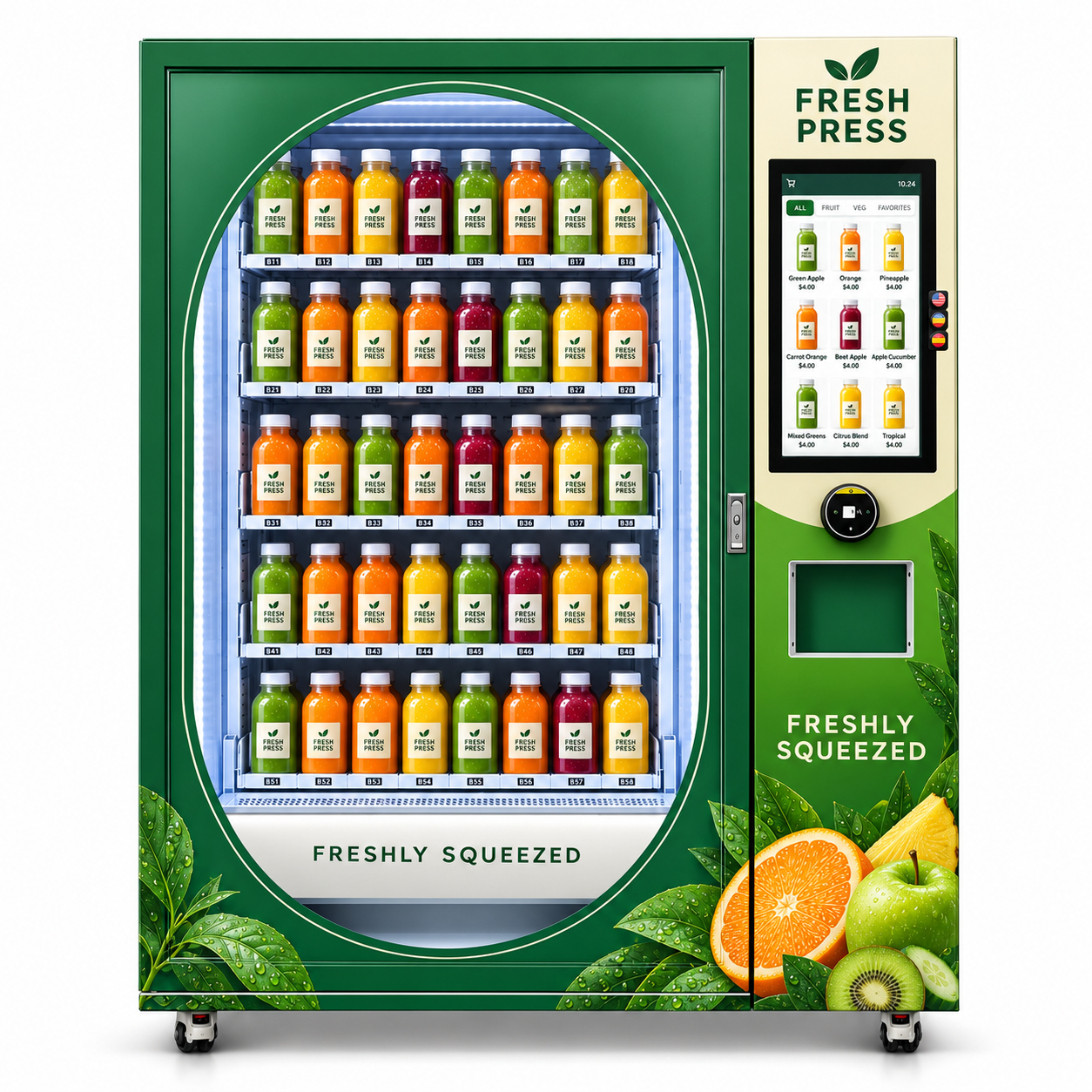
Forest green, cream and fruit artwork connect the cabinet with the bottled juice range. Use actual product names, images and permitted claims to make the screen catalogue easy to follow.


A Fresh Press bottled juice vending machine for a visible drink offer and a more organised refill routine. Build the business around the right bottle, the right site and the numbers that remain after costs.
Explore the machine ↗Plan the operating return ↗Supplied concept images show pre-bottled drinks. Onboard juice extraction is not shown. Final hardware, cooling and software functions are subject to the agreed configuration.
A clear product description helps customers, search engines and AI tools identify the actual offer without confusing the fruit-themed artwork with a juice-making process.
A glass-front vending machine concept for selling sealed, pre-bottled fruit and vegetable drinks. It is not presented here as an automatic fruit-cutting, pressing or blending machine.
The delivered configuration and approved packages determine the supported range. No juice preparation system is demonstrated in the supplied pictures.
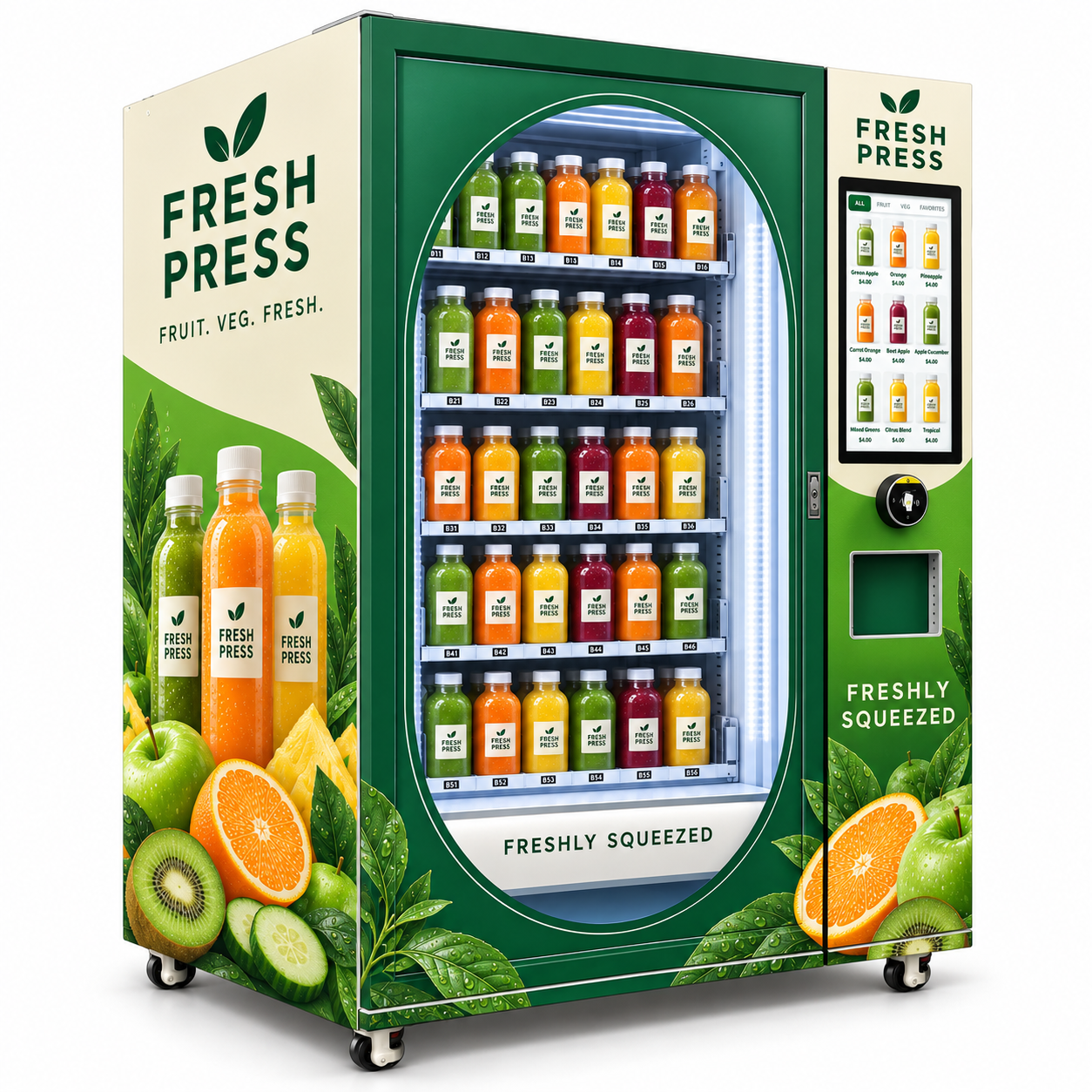
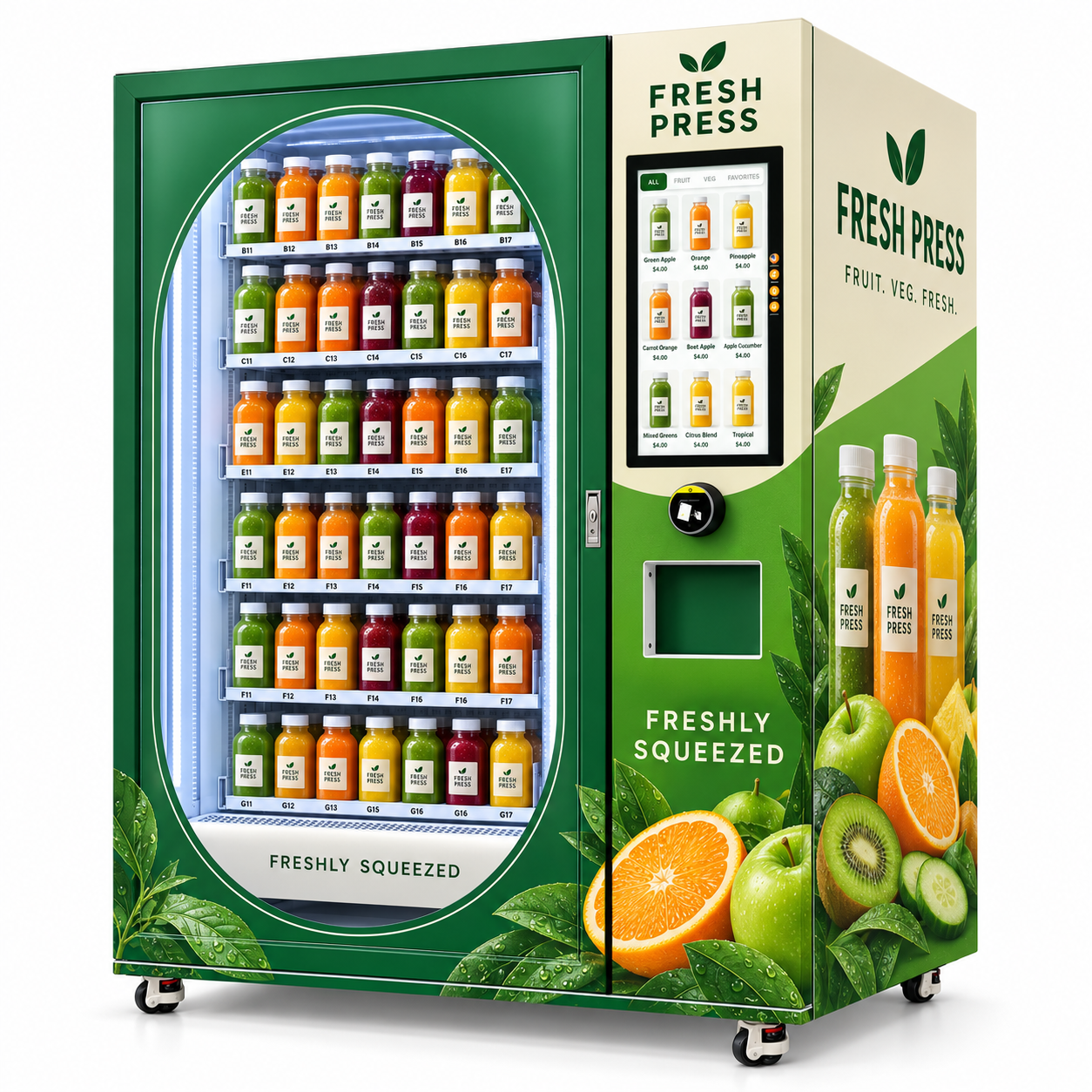
The images show a portrait selection screen, separate payment position, illuminated bottle display, collection opening, castors and Fresh Press botanical artwork.
Illustrations differ in row and bottle arrangement. Screen artwork and payment symbols do not establish supported languages, integrations or certified capacity.
Choose the cabinet around your product storage requirement, package test, site conditions and service plan. Confirm cooling, sensors and cloud features in the written quotation.
No price, dimensions, temperature range, power consumption, certificate or warranty period was supplied. Ask for these before comparing total ownership cost.
This Fresh Press concept puts ready-bottled fruit and vegetable drinks behind a large illuminated window. For an operator, the useful question is straightforward: can this cabinet sell the right bottles, at a workable margin, with a manageable refill routine?
The green cabinet, cream fascia and bright bottle display make the drink category easy to understand. Customers can see a physical offer before using the screen. That can help in places where people have only a short break to choose a drink.
Check the window sightline at the actual approach angle. Avoid a position hidden by a queue, a pillar or direct glare. A good-looking render cannot tell you whether a particular corridor converts passing traffic.
A vending point can serve bottled drinks without staffing a separate juice counter during every selling hour. You still need people for replenishment, cleaning and support; the saving comes from organising those tasks into planned visits.
Compare the complete route cost with your existing staffed arrangement. Include driving, loading, expiry checks and customer issues. Do not treat unattended selling as a business with no labour.
The supplied pictures show a glass-front bottled-drink display, product selection screen, separate payment device, collection opening and castors. The images are concept evidence; they do not establish the final engineering specification.
The front window gives bottled products room to be recognised. Internal lighting makes the visible range part of the selling experience. This is useful when labels and juice colours help customers distinguish the options.
Ask for lighting access, replacement arrangements and real photographs with your bottles loaded. Check visibility with labels facing forward and under the lighting conditions of your intended site.
The illustrated screen shows drink images, names, prices and category tabs. A clear interface can shorten the path from browsing to choosing. The exact screen size, software behaviour and supported languages need confirmation.
Request a live demonstration using your own product names. Check long names, allergens or ingredient links, price formatting, sold-out states and how customers return to the previous screen.
Use the front and side views to discuss branding and site visibility. These are the supplied product images, not a dimensional drawing or a record of tested hardware.
Views contain inconsistent shelf layouts. Confirm the actual build from an approved configuration sheet rather than adding up bottles in the pictures.
Treat temperature, expiry and refill timing as operating decisions from day one. The images do not confirm a temperature range, refrigeration capacity, food-safety certification or storage suitability for any particular juice.
Different juice products can have very different storage needs. Use the producer’s validated temperature range and shelf life. A fresh appearance on the wrapper is not evidence that the cabinet is suitable for an unpasteurised or short-life product.
Give the supplier the product storage specification and likely ambient conditions. Ask for written compatibility and loaded-cabinet performance evidence before committing to chilled stock.
Bottles can warm up during loading, transport and replenishment. A cabinet cannot undo poor upstream handling. Plan how stock reaches the site and how long the door stays open during a refill.
Time a real route with the intended insulated or refrigerated transport. Follow the drink producer’s handling instructions and document the checks required by your local food business procedures.
Remote management is valuable when it turns machine information into a useful action: refill a strong seller, investigate a failed vend or review a weak location. The following are procurement priorities, not a claim that every pictured function is included.
Product-level sales can show which flavours deserve more space. Machine-level totals let you compare locations, provided you also consider opening hours, selling price, downtime and local costs.
Request a sample report and a live demonstration. Check whether quantities, revenue, refunds, tax treatment and timestamps can be exported in a format your accounts process can use.
A stock view can help decide which bottles to load for the next visit. Its usefulness depends on correct initial counts, refill entries, successful vend detection and how manual removals are recorded.
Ask whether inventory is sensor-based, transaction-based or manually entered. Reconcile the dashboard with a physical count during the pilot and record the reasons for any difference.
Make each step easy to understand at the site. The render suggests a visual product menu and collection opening; the final user flow should be demonstrated on the delivered configuration.
Position the front so customers can identify bottled juice before they stand at the screen. Keep the surrounding sign simple: product category, where to start and where to collect.
Walk the approach from both directions. Check that the collection opening stays clear and that the machine does not create a queue across an accessible route.
Names and photos help distinguish flavours. Customers may also need ingredients, allergens, pack size and storage advice. A small screen should direct them to information in a way that fits local rules.
Approve actual screen copy and product photos. Verify that the name, price and delivered bottle agree. Avoid implying health effects that are not supported by the product information.
Footfall alone is not a sales forecast. Look for people who want a bottled drink at a moment when the machine is convenient, visible and priced sensibly. Each setting below is a hypothesis to test.
A gym may provide repeat visits and an audience familiar with bottled drinks. The opportunity depends on member habits, opening hours, competing drinks and whether the venue already has a staffed counter.
Measure sales around class times and quieter periods. Confirm which product claims the venue permits and whether its rent or commission leaves enough contribution after spoilage.
An office can offer predictable weekday traffic and planned delivery access. A chilled drink may fit a break or lunch purchase, but hybrid work can reduce demand on particular days.
Use actual attendance patterns. Adjust stock before weekends, public holidays and office closures. Include security access time in the cost of each refill.
The render contains small sealed bottles, but it supplies no dimensions, weights, material limits or delivery mechanism specification. Treat package testing as part of purchasing, not a problem to solve after the cabinet arrives.
A bottle that fits on a shelf may still fail to travel correctly through the vending system. Caps, labels and shrink sleeves can change how the package sits and moves.
Send filled production samples with final caps and labels. Record maximum dimensions, filled weight and manufacturing tolerances, then ask for the approved lane setup.
PET, glass and other materials can behave differently during handling. Pulp content, carbonation or pressure sensitivity can also affect the suitability of a product and its package.
Do not assume glass bottles or carbonated drinks are compatible. Obtain written approval and review repeated vend tests using the exact package and fill conditions.
Start with a price customers will accept at the site, then work backwards through landed drink cost, payment charges, site commission, route work and expected stock losses. The screen prices in the artwork are illustrative.
Include the filled product, retail packaging, inbound delivery and any non-recoverable costs you allocate to saleable stock. A headline factory cost may omit items that reduce the usable margin.
Use the same unit everywhere: one sold bottle. Keep carton quantities, bundles and multi-buy offers separate until they have been converted to a comparable per-bottle basis.
A fixed monthly rent and a sales commission affect weak months differently. A high-footfall venue can still produce a poor return if the commercial terms absorb most of the contribution.
Confirm the calculation base, tax treatment, minimum fees, payment schedule, electricity responsibility and contract exit conditions. Model both an expected month and a weak month.
A good refill is a repeatable routine, not simply putting more bottles inside. Use sales evidence to prepare stock, then reconcile it with what is actually in the cabinet.
Review recent sales, known site closures and any machine alerts. Load the transport stock by product and batch so the visit can be completed with less searching and fewer open-door minutes.
Use a pick list tied to a named machine and visit time. Carry approved cleaning materials, a count sheet and the tools or parts your training permits you to use.
Check the physical stock, packaging and remaining shelf life before adding bottles. Remove damaged or withdrawn stock and record the reason so losses are visible in the accounts.
Follow the producer’s withdrawal rules. Place earlier eligible expiry dates to sell first where the delivery system allows, without mixing up product-to-selection mapping.
No warranty duration, response time or service package was supplied with these pictures. Build the support arrangement into the quotation so you know what is included, what is chargeable and who performs each task.
A useful warranty states the covered parts, exclusions, start date, claim process and cost responsibilities. These details matter more than a general promise of long-term support.
Ask about labour, travel, freight, consumables, payment terminals and third-party components. Confirm whether installation or operating conditions affect cover and retain the final written terms.
If the system supports useful logs and remote checks, a technician may be able to narrow down a problem before anyone travels. This can help prepare the right part and reduce an avoidable second visit.
Request a fault-handling demonstration. Confirm how you submit logs, photos and transaction references, and how support distinguishes a payment issue from a product-delivery issue.
The visual direction follows the supplied wrap: deep forest green, cream panels, a tall oval display and bright fruit colours. The product page uses rounded botanical cards, ingredient-colour accents and an operator planning notebook.
The cabinet artwork says Fresh Press and Freshly Squeezed. These words describe a branding direction in the picture; they do not prove an onboard squeezing or juice-making function.
This page describes a bottled juice vending machine. Only use fresh-pressed or cold-pressed product claims when they match the drinks you source and the information you are authorised to publish.
Show the real bottled product, a short name, pack size and actual selling price. Attractive photography works best when it reduces doubt rather than replacing essential buying information.
Ask who creates product images, who uploads changes and how many catalogue items are included. Confirm languages and currency display with a working example.
The exact machine dimensions, weight and electrical requirements have not been supplied. Use the final drawing and installation guide to check the route from unloading to the operating position.
Measure doors, corners, thresholds and lift access using shipping and unpacked dimensions. Protect the machine and building during movement and arrange lifting equipment where required.
Confirm unloading responsibility, packaging disposal and whether a site survey is included. Ask who carries the cost if the delivered machine cannot reach the agreed position.
A machine needs the electrical supply specified for the delivered configuration. If refrigeration is included, ventilation and heat rejection may affect both performance and the usable location.
Obtain voltage, frequency, rated load, plug details, protection requirements and clearance distances. Use qualified installation help where required by the site or local rules.
Identify the few events that can stop sales or damage stock, then give each one a practical response. The aim is a usable operating plan that fits your staff and site.
Connection issues, terminal faults or acquiring problems can prevent a sale even when the cabinet has stock. The customer-facing message and staff escalation route should be clear.
Confirm whether other supported payment methods remain usable. Keep terminal support details and transaction references available without recording unnecessary card information.
A disconnected dashboard can make stock and status information stale. It does not by itself tell you whether local sales continue, stop or follow a restricted mode.
Ask for the documented offline behaviour of vending, payment and data logging. Test reconnection and check that records synchronise without duplicate or missing transactions.
Use this table to compare supplier replies. A feature visible in an illustration is different from a tested performance value or an item included in the commercial offer.
| Item | Current evidence | Before ordering |
|---|---|---|
| Product category | Bottled juice vending machine concept | Sealed, ready-bottled drinks shown; no extraction equipment shown. |
| Visual identity | Forest green, cream, fruit and leaf artwork | Confirm final wrap, logo rights and print specification. |
| Display | Glass-front illuminated product presentation shown | Confirm glazing, lighting specification and service access. |
| Selection interface | Portrait product menu shown | Confirm screen size, touch input, software, languages and accessibility. |
| Payment | Separate device position shown | Confirm terminal, local acquiring, methods, fees and settlement. |
| Product collection | Opening below the payment area shown | Internal delivery mechanism and detection not established. |
| Selections and capacity | Not verified | Different image views have different arrangements; request actual layout. |
| Bottle size and material | Not supplied | Approve filled dimensions, weight, cap, label and material by test. |
| Temperature range | Not supplied | Confirm product compatibility and loaded-cabinet thermal performance. |
| Cooling system and refrigerant | Not supplied | Confirm included hardware, operating limits and maintenance needs. |
| Remote platform | To be specified | Confirm stock, sales, alerts, remote updates, subscriptions and data export. |
| Connectivity | Not supplied | Confirm wired, Wi-Fi or cellular options and connection ownership. |
| Dimensions and mass | Not supplied | Request shipping and installed dimensions, weight and clearance drawing. |
| Power requirements | Not supplied | Confirm voltage, frequency, rated load, plug and protective requirements. |
| Energy consumption | Not supplied | Request measured kWh under relevant load and ambient conditions. |
| Castors and positioning | Castors visible | Confirm load rating, levelling, locking and final stability instructions. |
| Environment rating | Not supplied | No outdoor, IP, weather or corrosion rating established. |
| Certifications | Not supplied | Request market-specific documents tied to the exact delivered model. |
| Warranty and service | Not supplied | Confirm coverage, exclusions, labour, freight, response and parts access. |
| Lead time and commercial price | Quotation required | Separate cabinet, options, payment, freight, tax, setup and recurring costs. |
Use the filter to explore example range roles. These are merchandising ideas, not a confirmed list of products or a statement that any bottle is compatible.
Start with a familiar flavour that customers understand quickly. Choose based on your supplier’s product data and actual local demand, not only the orange artwork.
Record product code, bottle size, shelf life, landed cost and selling price. Keep first fills small enough to learn without forcing excess waste.
A green bottle can add visual variety and a distinct choice. Make the name specific enough that buyers understand the ingredients without reading a long sales pitch.
Review taste feedback and sold units before expanding space. Do not use detox, immunity or other health claims without the evidence and permissions required for your market.
A second fruit profile may widen choice, but each extra SKU takes stock space and needs its own refill and expiry check. Add it for a reason you can measure.
Compare contribution per occupied selection and waste by SKU. A broad range that turns slowly can be less useful than a smaller range that sells reliably.
A small trial slot lets you learn about a seasonal flavour without changing the whole offer. Give the test a clear start, end and quantity so the result is interpretable.
Use the same price and cost basis in reports. Track promotional days separately and do not project a launch offer’s sales directly into a full-year forecast.
Change the example inputs to match your project. All money values use one currency of your choice. This is a contribution model for a steady month, not a promised result or a supplier quotation.
Use these example numbers as a worksheet, in one consistent currency and tax basis. They are not a quotation or sales forecast.
| Daily sales × selling days | 25 bottles × 30 days = 750 sold bottles |
|---|---|
| Selling price | 4.00 per bottle |
| Monthly sales | 3,000.00 |
| Landed cost | 1.50 per purchased bottle |
| Waste assumption | 8% of purchased bottles are not sold |
| Purchased stock cost | 750 ÷ 0.92 × 1.50 = 1,222.83 |
| Of which wasted stock cost | 97.83, already included above; do not subtract it again |
| Payment charges | 2.5% of sales + 0.05 per sold bottle = 112.50 |
| Site commission | 10% of sales = 300.00 |
| Fixed monthly operating costs | 350.00 |
| Refill labour and transport | 12 visits × 12.00 = 144.00 |
| Monthly operating contribution | 3,000 − 1,222.83 − 112.50 − 300 − 350 − 144 = 870.67 |
| Installed investment example | 6,500.00 |
| Simple payback example | 6,500 ÷ 870.67 = approximately 7.47 months |
Monthly contribution = sales − cost of all purchased bottles − payment charges − site commission − fixed costs − refill costs. Purchased bottles = sold bottles ÷ (1 − waste share). Use the same sold unit for price, cost and volume. Put fixed site rent in operating costs and avoid counting it twice. Include software, data, energy, insurance and maintenance where applicable.
Break-even sold bottles per day = monthly fixed costs including visits ÷ per-sold-bottle contribution ÷ selling days. The example is about 9.05 bottles per day. Per-bottle contribution must be positive. Simple payback only applies to positive contribution and assumes that result repeats. Financing, depreciation, income tax and working-capital changes are excluded. This is not guaranteed net profit.
This companion tool takes your current return-planner assumptions and compares a lower and higher daily sales volume. It holds costs, refill visits, waste rate and selling days constant so you can see the direct effect of volume.
| Example daily sold volume | Monthly contribution |
|---|---|
| Quiet period: 12 bottles / day | 161.04 |
| Base period: 25 bottles / day | 870.67 |
| Busy period: 40 bottles / day | 1,689.48 |
These examples use 30 selling days and the same price, costs, 8% waste and 12 refill visits as the monthly worksheet. A busier period may need more visits; a quieter period may have higher waste. Adjust these costs too before making a decision. This is a volume comparison, not an annual forecast.
Review fixed rent, commission, product mix and route cost. Check site closures and remaining product life before increasing the fill. Use observed demand from a stable pilot, rather than raising the sales estimate until the result looks attractive.
Calculate a stock target for one SKU or one group with the same shelf life. Run different expiry profiles separately. The tool does not know your cabinet capacity; compare its answer with the approved usable layout.
| Demand | 25 bottles per day |
|---|---|
| Refill interval | 3 days |
| Demand buffer | 15% |
| Target stock after refill | 25 × 3 × 1.15 = 86.25; round up to 87 bottles |
| Usable selling life on arrival | 5 days, after the required withdrawal margin |
| Expected sales within usable life | 25 × 5 = 125 bottles |
| Target stock coverage | 87 ÷ 25 = 3.48 days |
The target is stock on hand after refill, not bottles to add. Subtract eligible existing stock and compare the result with approved usable cabinet capacity. Run different shelf-life products separately.
If usable selling life were only 2 days, expected sales within that period would be 50 bottles. The 87-bottle target would exceed this amount and would need revision. Extra buffer cannot extend shelf life. Actual demand can fall below the estimate, so a target below the expected life limit can still create waste. Follow validated storage, withdrawal and handling procedures for every batch.
A profitable-looking bottle margin can disappear into frequent small trips. Group visits where product shelf life and site access allow, and count travel as part of the service cost.
A short-life range may need visits even when the cabinet is not empty. A longer-life product may allow a different cadence if storage conditions and demand support it.
Do not reduce visits simply to improve a spreadsheet. Maintain the checks needed for product safety and the service standard agreed with the venue.
The refill cost should cover preparation, travel, parking, access, counting, cleaning and record keeping. A ten-minute load can still require an hour of paid time.
Time a complete visit from preparation to completion. Allocate shared route costs consistently and include missed-access or repeat visits in the pilot review.
If a remote stock view is available, it may help avoid trips that add little stock or fail to address an actual fault. Its value depends on reliable data and disciplined use.
Compare the planned visit with the physical findings. If counts are regularly wrong, resolve the data process before relying on the platform for route decisions.
Before the final handover, agree what the machine must demonstrate with your drinks and your operating configuration. This checklist helps organise the discussion; specialist requirements may need additional tests.
A pilot is useful when it produces enough reliable operating evidence to decide the next step. Keep the review focused on contribution and service effort, not only the sales total.
Record site opening hours, actual traffic, competing offers and the initial assumptions used in the return planner.
A written baseline makes it easier to tell whether a change in sales came from the machine, the range or the site.
Observe real customer purchases and confirm the complete selection, payment and collection flow. Reconcile machine sales with payment settlement and physical counts.
Resolve mapping and transaction issues before using the data to make expansion decisions.
Review SKU-level sales, waste, refill time and stockouts. Change one commercial variable at a time where practical.
If you change price, range and stock depth together, record it clearly so you do not overstate what caused the result.
Compare actual operating contribution and service load with the buying case. Consider venue terms, seasonality and customer support experience.
Scale only if the result supports it. A revised range, a smaller fill or a different site may be a better next step than another cabinet.
Record opening days, paid and delivered bottles, refunds, sales by SKU, withdrawn stock, refill quantities, physical-count differences, service minutes and any downtime. Add the venue charge, payment fees and loaded route cost. Compare the result against the return planner on the same tax and currency basis. Keep customer observations short and specific, such as repeated difficulty finding the collection opening or demand for a missing pack size.
A clear brief helps suppliers answer the same questions and makes competing offers easier to compare. Use the checks below, then contact WEIMI through its website with your chosen bottle and site information.
The website link opens WEIMI’s homepage. Confirm current contact details and quote scope there. No enquiry is sent by this page.
Short answers keep the product category and operating limits clear. Use the linked sections to turn each answer into a check for your own project.
The supplied images show sealed bottles offered through a vending cabinet. No fruit loading, pressing or blending equipment is shown. This page describes bottled juice retail. The words Fresh Press and Freshly Squeezed are part of the illustrated artwork, and any claim about the drink itself must match the product you source.
See the practical detail ↗Capacity is not verified. The three images show different row and selection arrangements, so counting visible bottles would give an unreliable specification. Ask for the final selection layout, bottles per lane and total usable capacity with your actual filled package.
See the practical detail ↗That depends on the validated storage requirement of the product and the performance of the supplied configuration. Confirm cooling range, loaded performance, ambient limits and your complete cold-chain procedure. Do not rely on the appearance of the cabinet to establish food storage suitability.
See the practical detail ↗No bottle material approval was supplied. Send filled samples with final caps and labels. Ask for written compatibility and repeated vending tests for the exact package. Glass, large bottles and pressure-sensitive products should not be assumed to work.
See the practical detail ↗Request those functions in the written software scope and a live demonstration. This page explains the operational value of sales, stock, alerts and remote updates, but the pictures do not prove that any particular cloud platform or subscription is included.
See the practical detail ↗The image shows a separate payment device, but it does not verify payment brands, wallets or country coverage. Confirm local acquiring, supported methods, fees, settlement, refunds and connection requirements with the supplier and payment provider.
See the practical detail ↗No outdoor or IP rating was supplied. Confirm environmental suitability and installation requirements in writing for the actual site. A roof, canopy or protected-looking location does not by itself establish that the cabinet is suitable.
See the practical detail ↗There is no fixed payback period. Daily sales, price, product cost, waste, venue charges, payment fees, route work and installed investment all change the answer. Use the return planner with your own assumptions, then compare the result with real pilot data.
See the practical detail ↗No warranty term or service commitment was supplied. Request the written scope, exclusions, labour and shipping responsibilities, training, spare-parts access and support process with the quotation. Treat a general support statement as a starting point for clarification.
See the practical detail ↗Ask for the available artwork and software options, the approval process and any extra cost. Use actual product photographs, ingredient information and permitted claims. Confirm that menu names, prices and physical selection mapping remain consistent after an update.
See the practical detail ↗It does not calculate sales tax, VAT, financing, depreciation or income tax. Use a consistent money and tax basis for all inputs. Monthly operating contribution is a planning measure before these items and should not be described as guaranteed net profit.
See the practical detail ↗Treat the payment system, machine controller and customer support process as one working flow. The right configuration is the one that is supported in your market and behaves predictably when a transaction does not complete.
The customer should see the intended amount and currency before confirming payment. Discounts, taxes and multiple-bottle transactions need explicit behaviour if they are offered.
Use a small real transaction in acceptance testing. Match the selected product, terminal amount, vending record and settlement report. Confirm how receipts are supplied if required.
A paid order with no bottle delivered needs a traceable outcome. An automatic reversal, a refund or a support case depends on the purchased integration.
Ask for the exact sequence and timing. Confirm what the customer sees, what the operator receives and how a fault is reconciled if the machine goes offline during the event.
Terminal rental, acquiring fees, fixed transaction charges, SIM data and cloud services may come from different providers. Small charges become material across many sales.
Get the full recurring-cost schedule and contract ownership. Use the return planner with an appropriate per-bottle fee if customers can buy several bottles in one transaction.