


Protein Drink Vending Machine | Bottled Beverage Retail
PROTEIN DRINK / SELF-SERVICE RETAIL LAB
Protein Drink Vending Machine
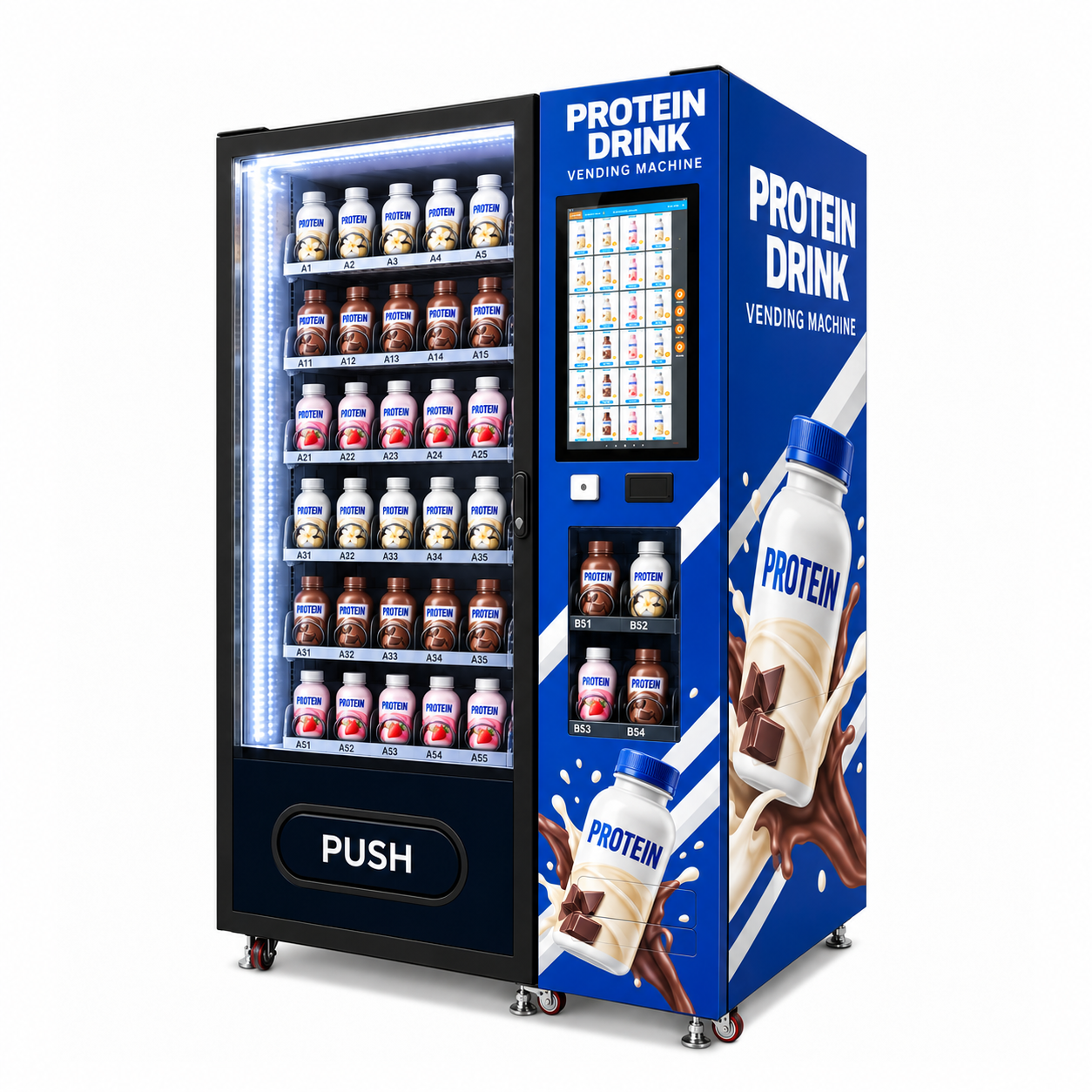
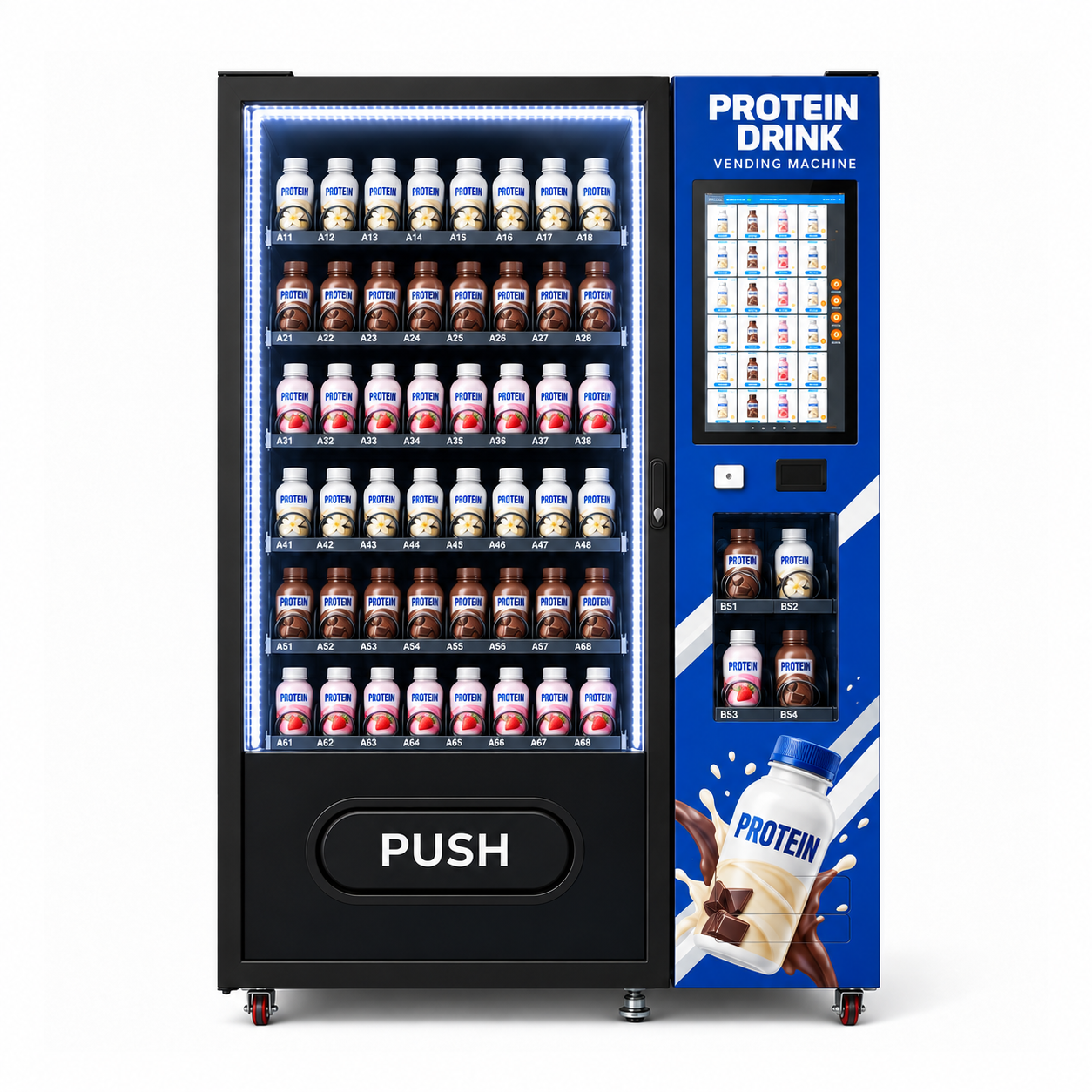
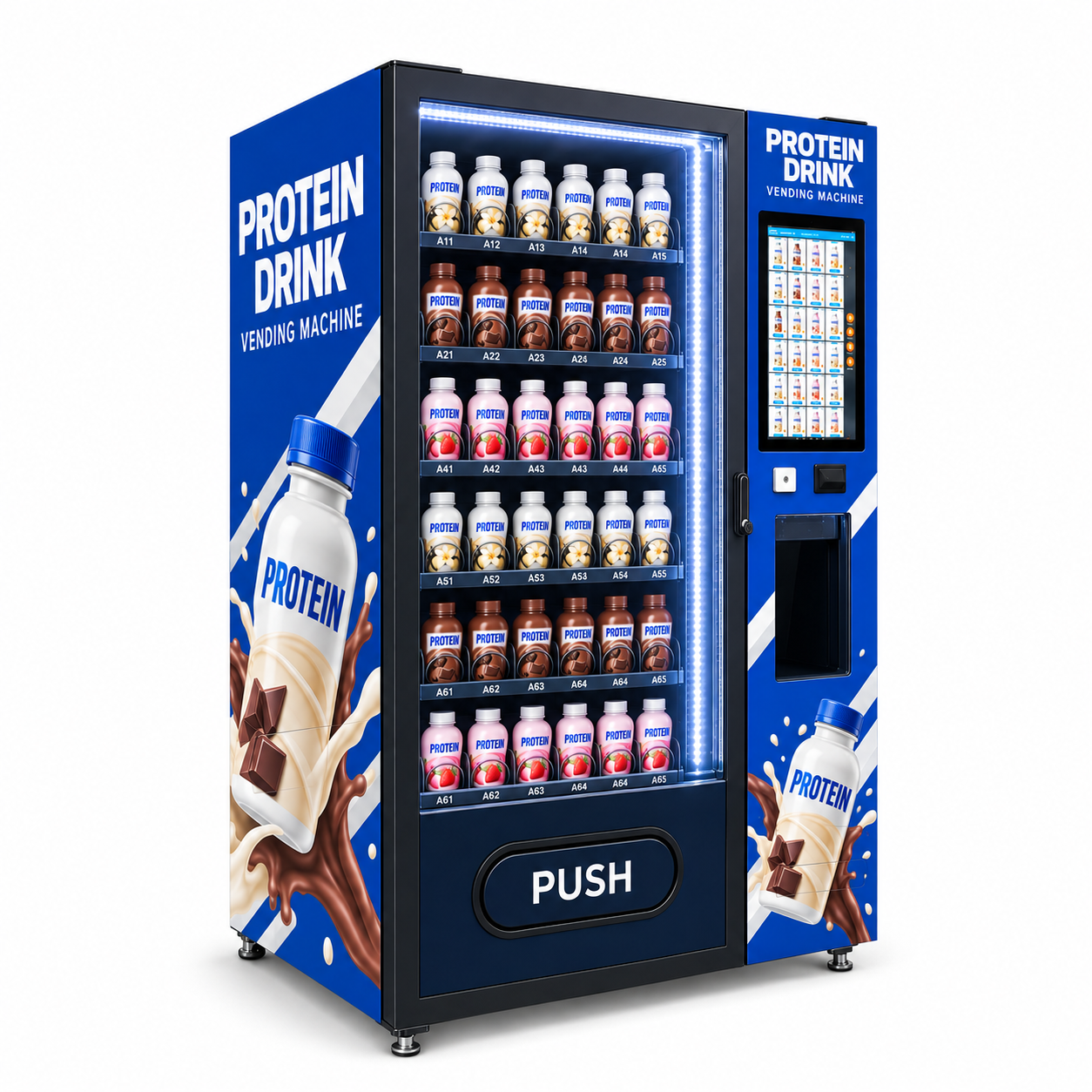
Develop a focused retail point for approved bottled protein drinks. Royal-blue panels, milk-white diagonal graphics and cocoa-toned bottle artwork give this concept a distinctive category identity, supported by an illuminated merchandise window and portrait selection screen.
Product storage
Shelf-stable or chilled requirements must match the final configuration.
Package acceptance
Approve geometry, weight, release and retrieval for each SKU.
Operating rhythm
Balance availability, dates and the cost of servicing the site.
Return case
Use realistic demand, payment fees and a complete ownership budget.
Agree bottle compatibility, actual collection route, payment services and written support scope. Match each product storage instruction to the final configuration; refrigeration, temperature range and elevator delivery are not established by the images.
Request a beverage project proposal →WEIMI / PROTEIN DRINK RETAIL LAB
BOTTLED
CONVENIENCE.
MEASURED
OPPORTUNITY.
Protein Drink Vending Machine — a focused bottled-beverage retail concept built around product fit, practical operation and a clear investment case.
Inspect the machine →Build the range →Calculate the case →GATE 1 / PRODUCT STORAGE
Start with the actual bottle label.
Shelf-stable or chilled requirements must match the final configuration.
Open this gate →GATE 2 / PACKAGE ACCEPTANCE
Test the full filled bottle.
Approve geometry, weight, release and retrieval for each SKU.
Open this gate →GATE 3 / OPERATING RHYTHM
Build a workable refill route.
Balance availability, dates and the cost of servicing the site.
Open this gate →GATE 4 / RETURN CASE
Model contribution before rollout.
Use realistic demand, payment fees and a complete ownership budget.
Open this gate →DESIGN FILE / THREE REFERENCE VIEWS
Royal blue. Milk white. Cocoa accents.
The wrap uses bold protein-drink typography, white diagonal stripes and bottle-and-splash imagery. The images show different shelf facings and right-hand opening treatments; confirm the final layout rather than treating a rendering as an engineering specification.
THE OPERATOR ADVANTAGE
Build a useful retail point around bottled protein drinks.
DEMAND
Capture a relevant purchase
An approved fitness, workplace or retail location can provide a practical refreshment occasion.
BUYER CHECKPOINT
Measure actual retained purchases and incremental sales before expanding.
Discuss requirements →LABOUR
Reduce counter dependency
Self-service selection can offer a different staffing pattern from a dedicated drinks counter.
BUYER CHECKPOINT
Stocking, cleaning, support and maintenance still need assigned people.
Discuss requirements →CLARITY
Present the actual range
The illuminated product window makes bottle identity and flavour variety visible.
BUYER CHECKPOINT
Match images, volume and product descriptions to the loaded SKU.
Discuss requirements →IDENTITY
Make the category visible
Royal-blue panels, white diagonal stripes and bottle artwork give the concept a strong category identity.
BUYER CHECKPOINT
Approve final artwork and lighting hardware with the supplier.
Discuss requirements →GROWTH
Start with a controlled pilot
A single site can test demand, service effort and the right assortment depth.
BUYER CHECKPOINT
Use contribution after costs to judge expansion, not machine count.
Discuss requirements →EFFICIENCY
Use an existing route
Combine replenishment with suitable site visits where practical.
BUYER CHECKPOINT
Include travel, parking, venue access and loading time in the operating budget.
Discuss requirements →THE BOTTLE PORTFOLIO
Choose the range by customer need and contribution.
FLAVOUR
Flavour architecture
The references suggest vanilla-style, chocolate-style and strawberry-style bottle artwork.
BUYER CHECKPOINT
Treat illustrations as a merchandising concept, not a verified supplied catalogue.
Discuss requirements →PORTION
Bottle volume
Identify exact serving volume and pack count before payment.
BUYER CHECKPOINT
Small and large bottles need individual dispensing approval.
Discuss requirements →ACCURACY
Nutrition information
Use verified manufacturer data for protein content, ingredients and allergens.
BUYER CHECKPOINT
Do not infer protein grams or nutritional benefits from concept labels.
Discuss requirements →CHOICE
Dairy and alternatives
Stock only suitable products with clear ingredient and storage information.
BUYER CHECKPOINT
Separate dairy, lactose-related and plant-based descriptions accurately where applicable.
Discuss requirements →MARGIN
Price tiers
Compare contribution across each stocked SKU instead of treating all sales equally.
ALLOCATION
Assortment depth
Begin with a manageable range and allocate positions from real demand.
THE EQUIPMENT FIT GRID
Test the bottle, the transaction and the installation.
DIMENSIONS
Geometry
Measure bottle height, diameter, shoulder profile and base shape.
MASS
Filled weight
Test filled samples in the proposed stocking orientation.
MECHANISM
Release behaviour
Verify the internal mechanism using representative bottles and positions.
BUYER CHECKPOINT
Exterior artwork does not establish a spiral, conveyor or elevator.
Discuss requirements →HANDOVER
Collection clearance
Test comfortable retrieval and inspect the bottle after the full delivery route.
BUYER CHECKPOINT
Confirm the function of the lower PUSH panel and right-hand opening.
Discuss requirements →CONTROL
Transaction continuity
Review successful payments, declines, interrupted connectivity and restart behaviour.
BUYER CHECKPOINT
Specify available transaction records and the refund process.
Discuss requirements →INSTALLATION
Site readiness
Confirm electrical supply, floor support, access route and service clearances.
BUYER CHECKPOINT
Dimensions, outdoor suitability and equipment weight need final documentation.
Discuss requirements →THE STORAGE DECISION
Agree product requirements before specifying cooling.
PRODUCT BRIEF
Shelf-stable products
Some unopened products may permit ambient storage under manufacturer instructions.
BUYER CHECKPOINT
Verify the actual SKU; category names alone do not establish storage conditions.
Discuss requirements →COOLING BRIEF
Chilled products
Products that require refrigeration need a verified refrigerated configuration.
ACCEPTANCE
Product temperature
For chilled service, define and test product temperature in representative conditions.
BUYER CHECKPOINT
Air readings alone may not establish the temperature of newly loaded bottles.
Discuss requirements →RECOVERY
Refill recovery
Evaluate the agreed cooling setup after representative replenishment.
BUYER CHECKPOINT
Specify loading conditions and acceptance criteria rather than inventing recovery times.
Discuss requirements →OPERATING COST
Energy and ventilation
Obtain representative energy data and required ventilation clearances.
BUYER CHECKPOINT
Use the selected model and real site conditions in cost estimates.
Discuss requirements →RESPONSE
Exceptions
Define how unsuitable stock is isolated following a storage or quality concern.
BUYER CHECKPOINT
Confirm monitoring, alarms and sale-blocking functions separately; none are assumed.
Discuss requirements →THE REPLENISHMENT PLAYBOOK
Protect availability and margin between visits.
ACCURACY
Map each SKU
Keep flavour, volume and product image aligned with the physical stock position.
INTEGRITY
Check seals
Inspect caps, labels and bottles for damage or leakage before loading.
BUYER CHECKPOINT
Remove unsuitable units and follow manufacturer handling guidance.
Discuss requirements →ROTATION
Rotate dates
Use an appropriate first-expiring-first-out process and retain batch information.
BUYER CHECKPOINT
Monitor remaining saleable life rather than unit count alone.
Discuss requirements →SCHEDULING
Plan visit timing
Use actual demand by day and venue activity to schedule refills.
BUYER CHECKPOINT
More frequent visits may reduce stockouts but increase labour and travel.
Discuss requirements →WASTE
Review losses
Track returns, discarded stock and markdowns by product.
BUYER CHECKPOINT
Avoid counting the same refund or loss twice in the financial model.
Discuss requirements →CUSTOMER CARE
Keep the service clear
Provide a practical help route for incomplete delivery or product enquiries.
THE VENUE SELECTOR
Place the offer where the purchase makes sense.
FITNESS
Fitness facilities
A permitted gym may offer a relevant audience for a verified bottled range.
BUYER CHECKPOINT
Do not translate the venue context into unverified recovery or performance claims.
Discuss requirements →RECREATION
Sports centres
An approved shared facility may support convenient purchases around activities.
WORK
Workplaces
A known audience may support repeat refreshment purchases.
BUYER CHECKPOINT
Compare contribution with existing food service and route costs.
Discuss requirements →COMMUNITY
Residential properties
A suitable common area can provide convenient local access.
BUYER CHECKPOINT
Test demand and permissions before funding stock for a small audience.
Discuss requirements →HOSPITALITY
Hospitality spaces
An approved visitor area may suit a focused beverage offer.
BUYER CHECKPOINT
Define help responsibility and whether chilled service is required.
Discuss requirements →RETAIL
Retail satellites
An existing retailer can test a complementary self-service location.
BUYER CHECKPOINT
Measure new sales and any displacement from the staffed counter.
Discuss requirements →THE SERVICE AGREEMENT BOARD
Define ownership protection before placing the order.
BEFORE ORDER
Configuration review
Submit bottles, site conditions and payment requirements for written approval.
BEFORE HANDOVER
Acceptance evidence
Record appearance, functions, correct fulfilment and product condition.
AT LAUNCH
Operator training
Cover loading, catalogue mapping, checks, cleaning and exceptions.
BUYER CHECKPOINT
Confirm training language, format and included installation assistance.
Discuss requirements →PROTECTION
Equipment warranty
Request duration, coverage, exclusions and the claim process.
BUYER CHECKPOINT
Merchandise complaints and refunds require separate operating responsibility.
Discuss requirements →RESOLUTION
Technical escalation
Agree support channels, hours and the route to on-site work.
BUYER CHECKPOINT
No response-time or uptime promise is established without written terms.
Discuss requirements →CONTINUITY
Parts and upkeep
Request model-specific parts, lead times and recurring service fees.
BUYER CHECKPOINT
Include technician access and maintenance in lifecycle costs.
Discuss requirements →THE RETURN MODEL
A financial scenario, not a sales promise.
SALES
Revenue basis
Use net realised revenue from retained sales.
STOCK
Landed cost
Include merchandise purchase, inbound logistics and relevant per-unit costs.
FEES
Payment friction
Account for percentage charges and any minimum transaction fee.
OVERHEADS
Site costs
Include rent or commission, power, software and connectivity.
FUNDING
Working capital
Fund the installed machine, opening stock and a practical operating reserve.
BUYER CHECKPOINT
Additional stock can increase cash needs even when gross sales grow.
Open the model →DECISION
Pilot review
Compare actual contribution, losses, downtime and service hours.
THE CONTRIBUTION SCOREBOARD
Hypothetical USD assumptions: average retained sale $5; landed bottle cost $2.70; payment fee 4% or $0.20; loss and support allowance $0.10. Contribution per retained sale is $2 before fixed monthly costs of $700. Installed equipment capital is assumed at $6,500 plus opening stock of $500, giving $7,000 initial funding.
These are modelling inputs, not equipment quotations, verified protein-drink margins or sales forecasts.
| Monthly result | 300 sales | 600 sales | 900 sales |
| Net sales | $1,500 | $3,000 | $4,500 |
| Variable contribution | $600 | $1,200 | $1,800 |
| After fixed costs | -$100 | $500 | $1,100 |
| Simple recovery | No payback | 14.0 months | 6.4 months |
Operating break-even is 350 retained sales per month. Recovering the illustrative $7,000 within 24 months requires at least 496 monthly retained sales under the same constant assumptions. Translate targets using actual trading days.
Simple recovery excludes financing, income tax, depreciation, ramp-up, changing stock funding, residual value and discounting. Include refill labour, travel, site charges, energy, software, connectivity, maintenance and insurance. Avoid counting the same refund or loss twice.
BUYER KNOWLEDGE BASE
Open the question that matters.
Is refrigeration included?
Refrigeration has not been confirmed from the supplied information. Match the actual drink storage instructions to a documented equipment configuration, and test chilled performance where required.
Ask about this configuration →Does every bottle fit?
No universal compatibility is established. Bottle geometry, cap design and filled weight vary. Approve each sealed SKU and stocking orientation with complete vending tests.
Ask about this configuration →How many bottles does it hold?
The concepts show different visible facings. Total capacity depends on internal depth, layout and approved bottles; request a final loading plan instead of counting rendered products.
Ask about this configuration →What is the right-side opening?
The front and right views show bottles in a small window, while the left view shows a dark opening. Confirm its function and the actual collection route in the final drawings.
Ask about this configuration →Does it use an elevator?
The exterior does not identify the internal release and transfer system. Ask the supplier to demonstrate the actual design with representative bottles.
Ask about this configuration →Can I offer dairy and plant-based drinks?
Only suitable, correctly labelled products should be considered. Verify storage needs, ingredients, allergens and dispensing compatibility for each item before stocking.
Ask about this configuration →Can protein amounts be shown on the menu?
Use verified manufacturer information for the exact bottle and serving size. Do not infer protein content, suitability or health benefits from the reference artwork.
Ask about this configuration →What payment methods are available?
Specify the destination, provider, currency and required methods in the proposal. Screen graphics alone do not establish wallet, card or settlement support.
Ask about this configuration →Can I manage stock remotely?
Request the exact reporting, catalogue, inventory and alert functions needed. Availability depends on the supplied platform, connectivity and service fees.
Ask about this configuration →What warranty should I expect?
Obtain written coverage, duration, exclusions, repair responsibilities and parts arrangements. No specific warranty period or response time has been confirmed.
Ask about this configuration →What is the payback period?
Calculate from actual initial funding and positive operating contribution. The workbook below uses hypothetical inputs and is not a demand forecast or guaranteed return.
Ask about this configuration →Can the machine operate outdoors or all night?
Only where the specified equipment, location permissions and operating plan support it. Images do not establish weather protection, continuous stock availability or guaranteed uptime.
Ask about this configuration →