


WEIMI / THE BOTTLE GALLERY
Wine locker vending machine.
Give every bottle its own stage.
Illuminated bottle lockers, self-service selection and remote operations. Plan fit, collection and margin around your venue.
Is this the right wine vending machine for your site?
What does it sell? Whole bottles collected from individual compartments; no by-the-glass dispenser is specified.
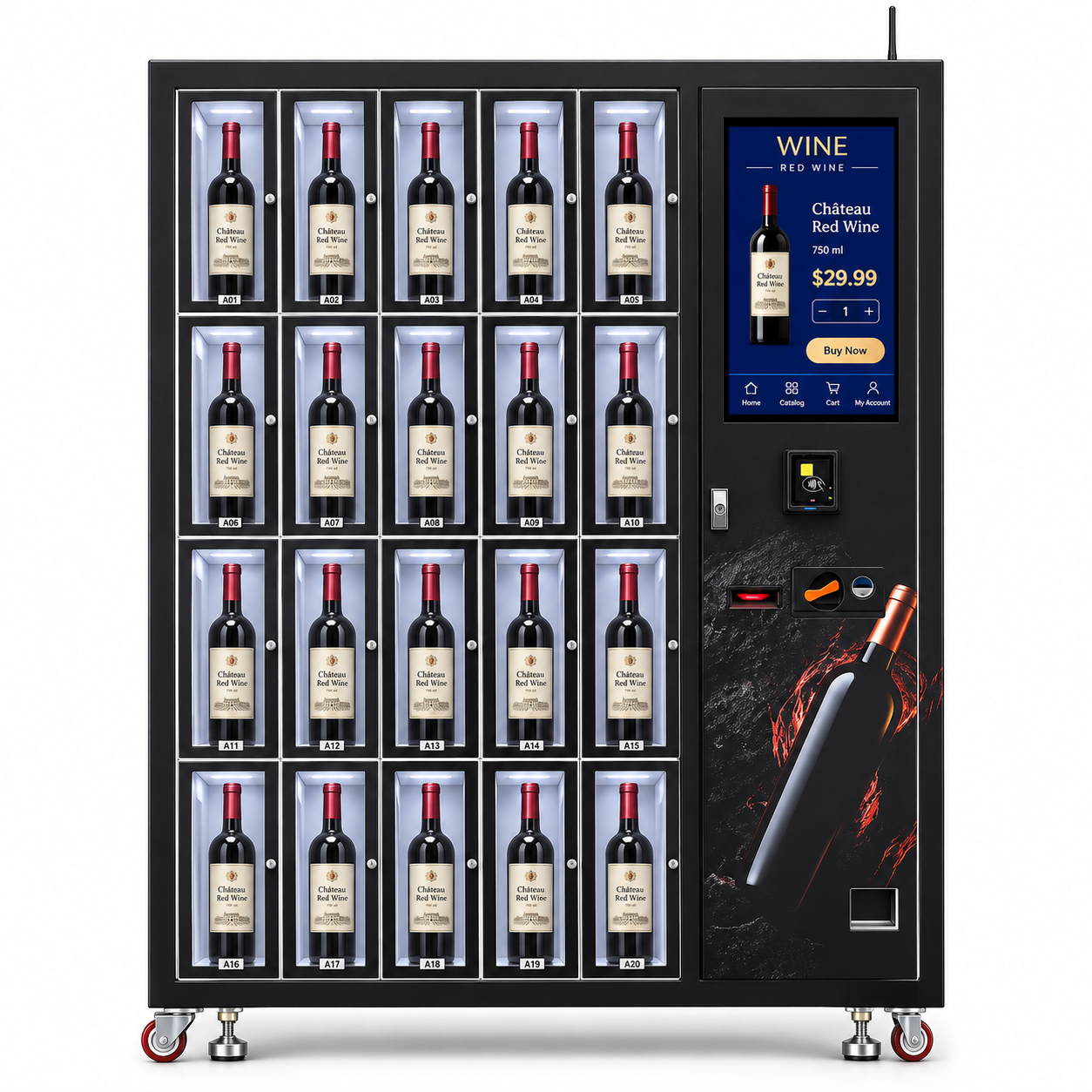
How many positions? A01–A20 are pictured. Final bottle capacity and fit require the production drawing and sample test.
Is it refrigerated? Remote temperature control is in the supplied brief. Confirm the installed cooling package and numeric range; no cellar-performance data is supplied.
What does it cost? No equipment price was supplied. Request a configuration quote and use the margin calculator for your site costs. The screen price is example artwork.
Bottle compatibility ↗Cost and payback ↗Warranty ↗The whole-bottle retail format.
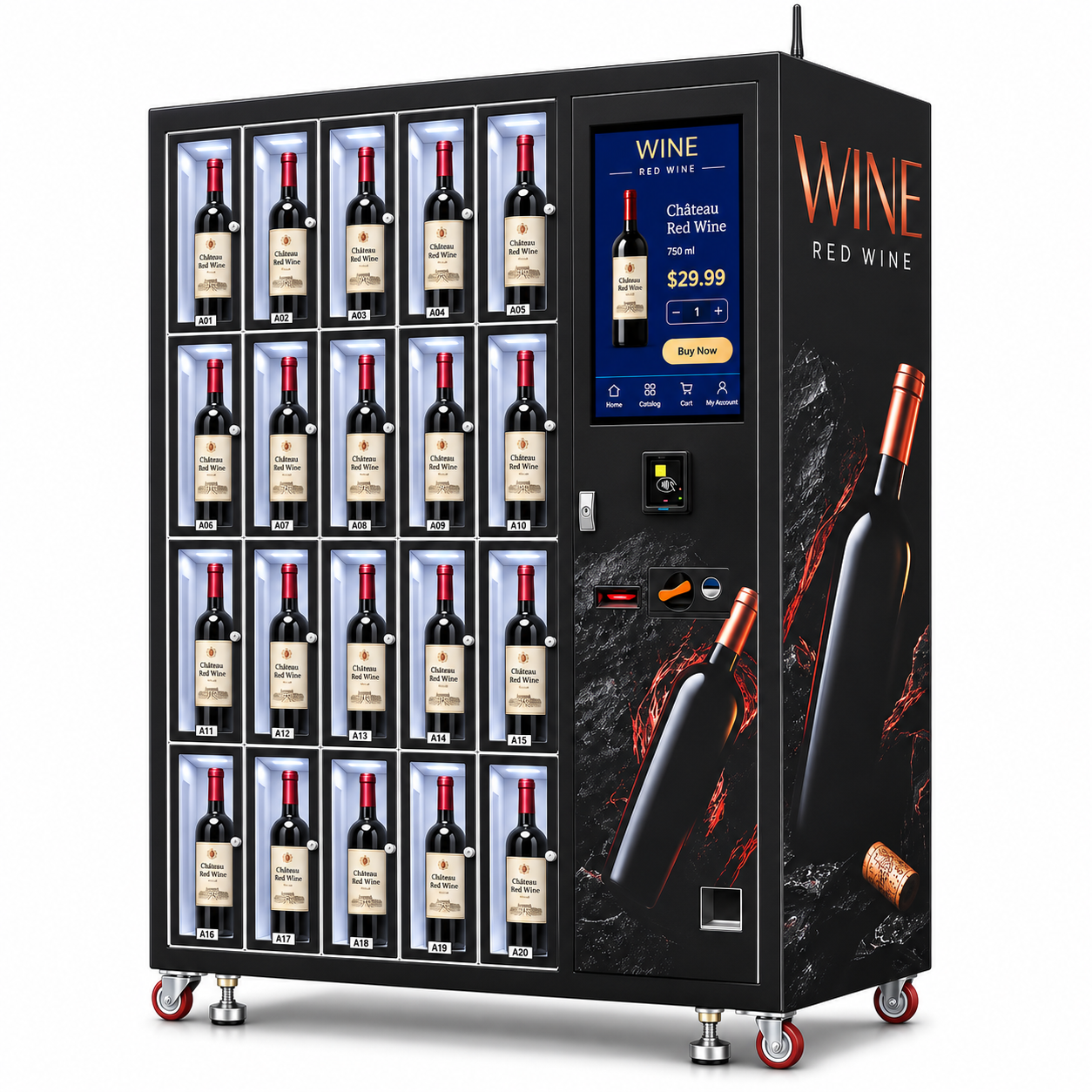
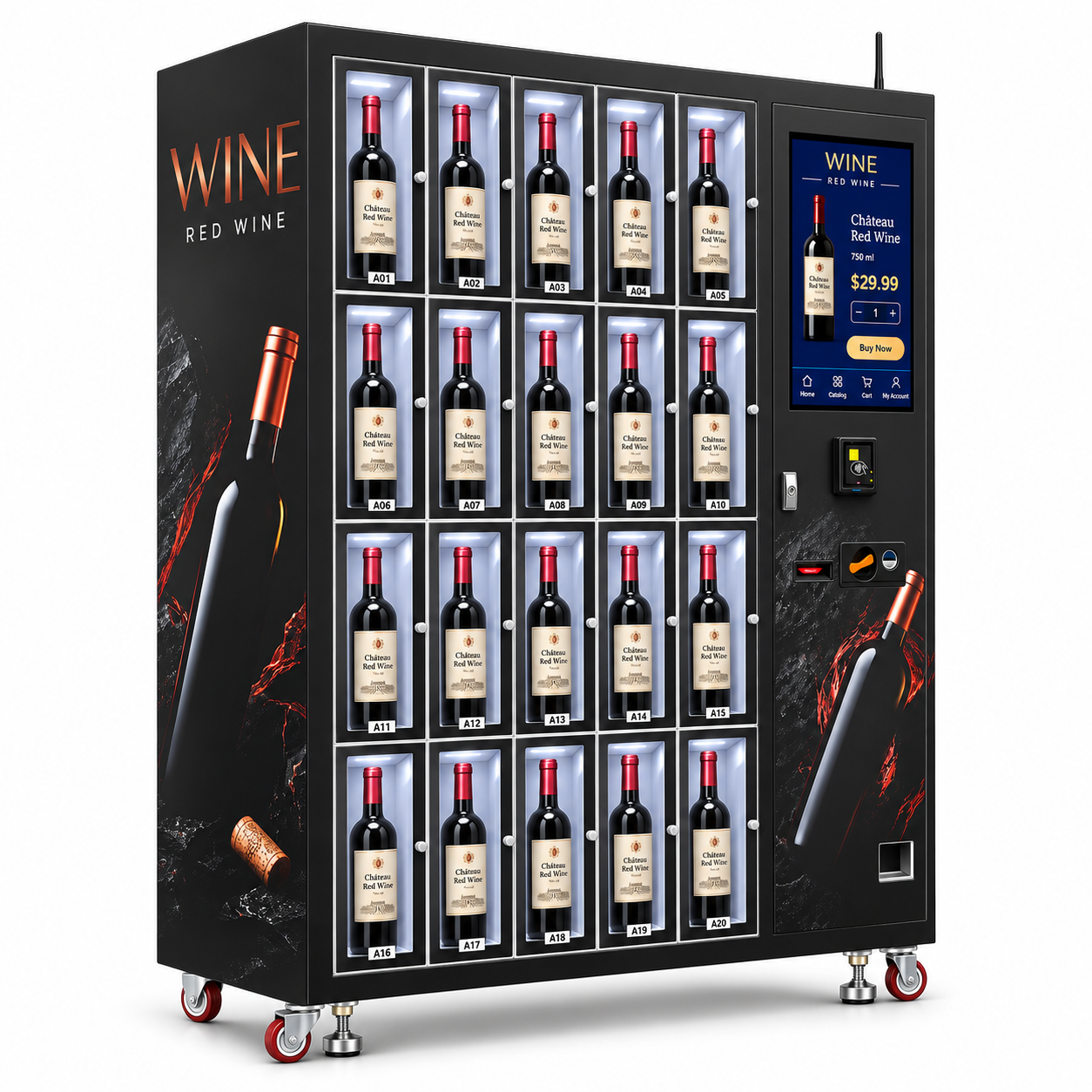
Five columns and four rows are pictured, labelled A01–A20, with a shared right-hand touchscreen and payment area. The intended locker workflow provides access to an authorised compartment. Confirm the release sequence and failed-release recovery on the ordered machine.
Start with the actual bottle, not just “750 ml”.
Measure the complete retail unit.
Send height, maximum diameter, filled weight and any sleeve, gift box or security tag.
One position, one clear stock identity.
Agree the approved loading arrangement for each product.
Try the top and bottom rows.
Test placement, release and removal with filled samples in several positions.
Choose. Pay. Find the assigned compartment.
Make the choice useful.
Show brand, product identity, bottle quantity and the supported product information fields, including ingredients where relevant.
Match the local payment habits.
Bank cards, electronic wallets and QR payments are configurable under the supplied brief.
Make the next door obvious.
The interface should direct the buyer to the assigned position after authorisation.
Payment options: bank cards, electronic wallets and QR payment, configured for the local provider and currency. Confirm ingredient/brand fields, screen languages, multi-compartment orders and failed-release/refund handling. Include the full bottle and packaging in fit tests.
Know what to bring before the refill visit.
Turn records into a refill list.
Map each wine and compartment clearly.
Look beyond gross revenue.
Compare bottles sold, product mix and trading periods, then connect sales to the margin retained after fees and replenishment costs.
Give each email an owner.
Automatic stock, sales and payment notifications can reduce the need to keep the dashboard open.
Read the WEIMI remote-management overview ↗
Plan campaign rules ↗Assign each compartment to its SKU, record refills/removals and reconcile failed releases. Confirm report time zone, refunds and export format. Test inventory, sales and payment email triggers. Stock records do not imply independent bottle detection.
Included: real-time inventory monitoring and sales analysis.
Use promotions with a margin in mind.
A bigger basket should retain value.
Set supported multi-buy discounts for eligible products.
Suggest a relevant next choice.
The system can recommend related products based on customer preferences under the supplied brief.
Keep the screen in step with the stock.
Play supported brand slogans and promotional information.
Near-expiry alerts and automatic markdowns
The supplied system can warn about approaching dates and automatically reduce prices. Use accurate product/batch data and a documented saleability plan. For wine, decide whether these rules apply to a specific date-sensitive product or another supported stock policy; do not invent a universal expiry period for bottled wine. Test the trigger, price floor and reset after refill.
Night, holiday and non-business-period pricing
Scheduled price changes are supported in the supplied brief. Confirm time zone, campaign priority and offline behaviour. Test both the displayed and charged prices at a schedule boundary. The schedule should follow the venue’s permitted access and sales hours.
Confirm recommendations based on customer preferences, supported brand slogans and promotion playback, multi-buy eligibility and partial-order settlement. No particular AI method or sales increase is promised.
Order a storage setup you can verify.
A setpoint needs a performance specification.
Confirm the temperature range, sensor position, ambient limits, ventilation clearance and loaded performance.
Define what “off” actually switches.
Demonstrate the scope of remote on/off commands and acknowledgement.
Specify cooling range, ambient limits, sensor/readings, ventilation, alarms if required, and remote on/off scope. Test recovery and active-order handling. Numeric performance is not supplied.
Order online. Collect with a code.
Customers can order on a merchant website or platform and collect with a pickup code. Confirm platform compatibility, integration fees, stock reservations and code validity. Test a valid, expired and used code, connection loss and a multi-bottle order. Agree who handles cancellation, refunds and uncollected stock; physical collection sensing is not specified.
What remains after the bottle leaves?
The arithmetic is deliberately visible
Unit contribution = selling price × (1 − combined percentage charges ÷ 100) − product cost − other variable cost. Monthly operating contribution = unit contribution × bottles per day × trading days − monthly fixed costs. Break-even bottles per day = fixed costs ÷ trading days ÷ positive unit contribution, rounded up. Simple payback = initial outlay ÷ positive monthly contribution. This is an operating scenario, excluding financing, depreciation and income tax.
For a purchase quote, include equipment, freight, installation, payment setup and opening stock. For running costs, include rent, refill travel/labour, power, software, connection and maintenance. Compare the retained contribution, not just gross revenue.
Buy against a drawing and a test, not a rendering.
| Item | Current information | Confirm in the order |
|---|---|---|
| Layout | Five columns × four rows, labelled A01–A20 in the reference. | Approve the final production drawing and identifiers. |
| Compartment fit | Numeric internal dimensions have not been supplied. | Confirm clear opening, usable height/width/depth and load limit. |
| Overall size & weight | No numeric values supplied. | Request cabinet/packed dimensions and net/gross weight. |
| Cooling package | Remote temperature setting is in the supplied function brief. | Confirm installed equipment, range, ambient limits and performance. |
Put the after-sales process in writing.
Know how a claim moves.
Free repair and replacement parts are included during the supplied warranty period. Confirm the start date, coverage conditions and claim route.
Start with a useful diagnosis.
Remote fault diagnosis can help identify the next action. Keep machine identity, transaction details, fault messages and suitable photos available.
Find a small fault before a stop.
Periodic preventive checks can identify door, payment and cooling issues early. Request the operator/service task list and record completed work.
Brand options include custom interface appearance and display languages, branded machine wrap and an optional advertising lightbox. Confirm artwork proofs, network access, power, service clearance and permitted venue use. The images do not establish outdoor suitability.
18-month warranty: free repairs and replacement parts. Optional extended warranty; 24/7 service and remote fault diagnosis.
Agree what “ready to trade” means.
0 of 6 acceptance items selected.
Can I use a wider bottle or gift pack?
Only after testing the complete retail unit. Confirm internal dimensions, door opening, filled weight and collection clearance.
Can it work without someone standing beside it?
The supplied system supports self-service buying and remote operating tools. The venue still needs an approved retail access model, a refill routine and a customer-help process.