


WEIMI / THE PASTURE COLLECTION
Egg locker vending machine.
A farm shop with its own rhythm.
Present packed eggs clearly, offer self-service collection and use remote records to plan the next refill. Built around a confirmed carton, site and service plan.
Visible cartons. A clear collection plan.
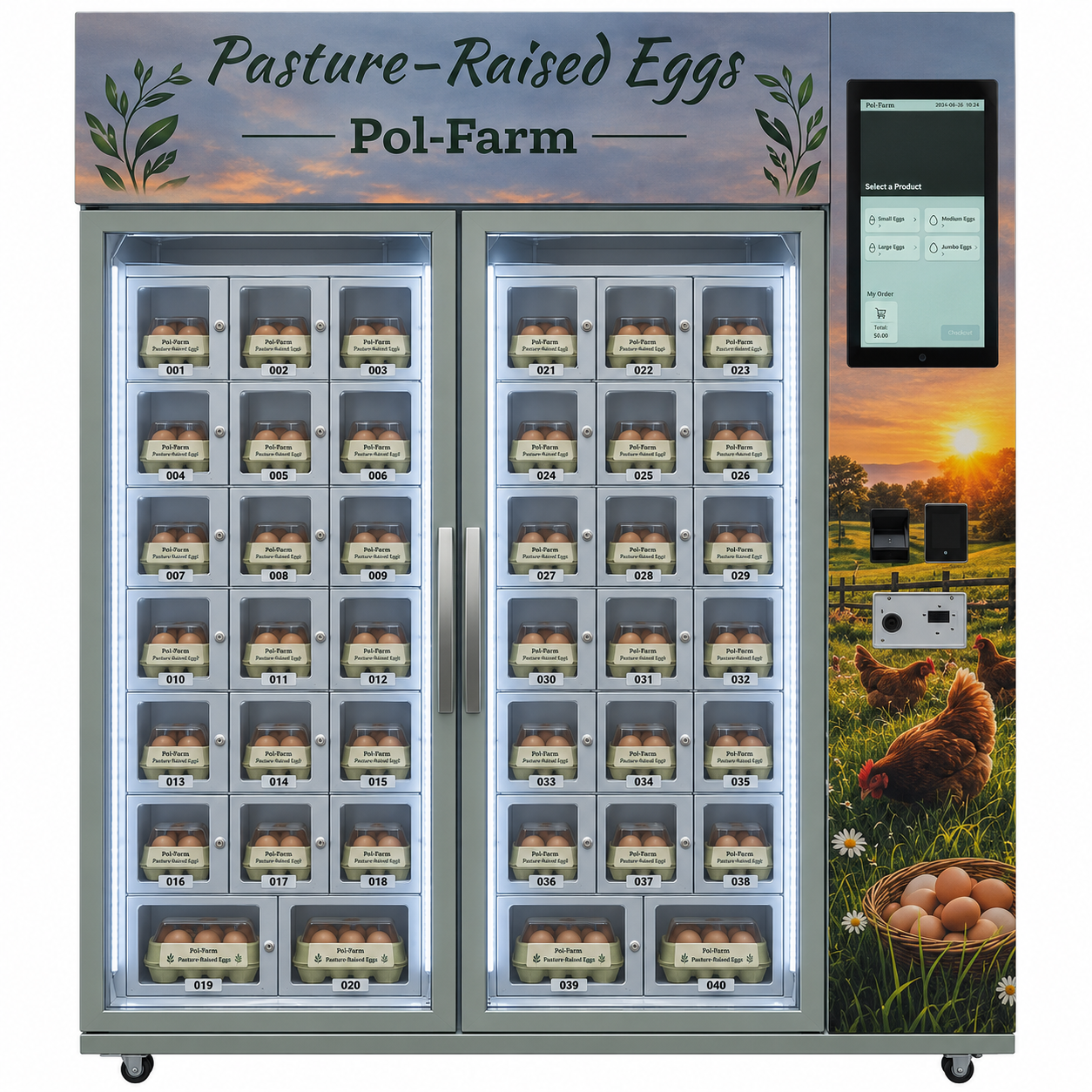
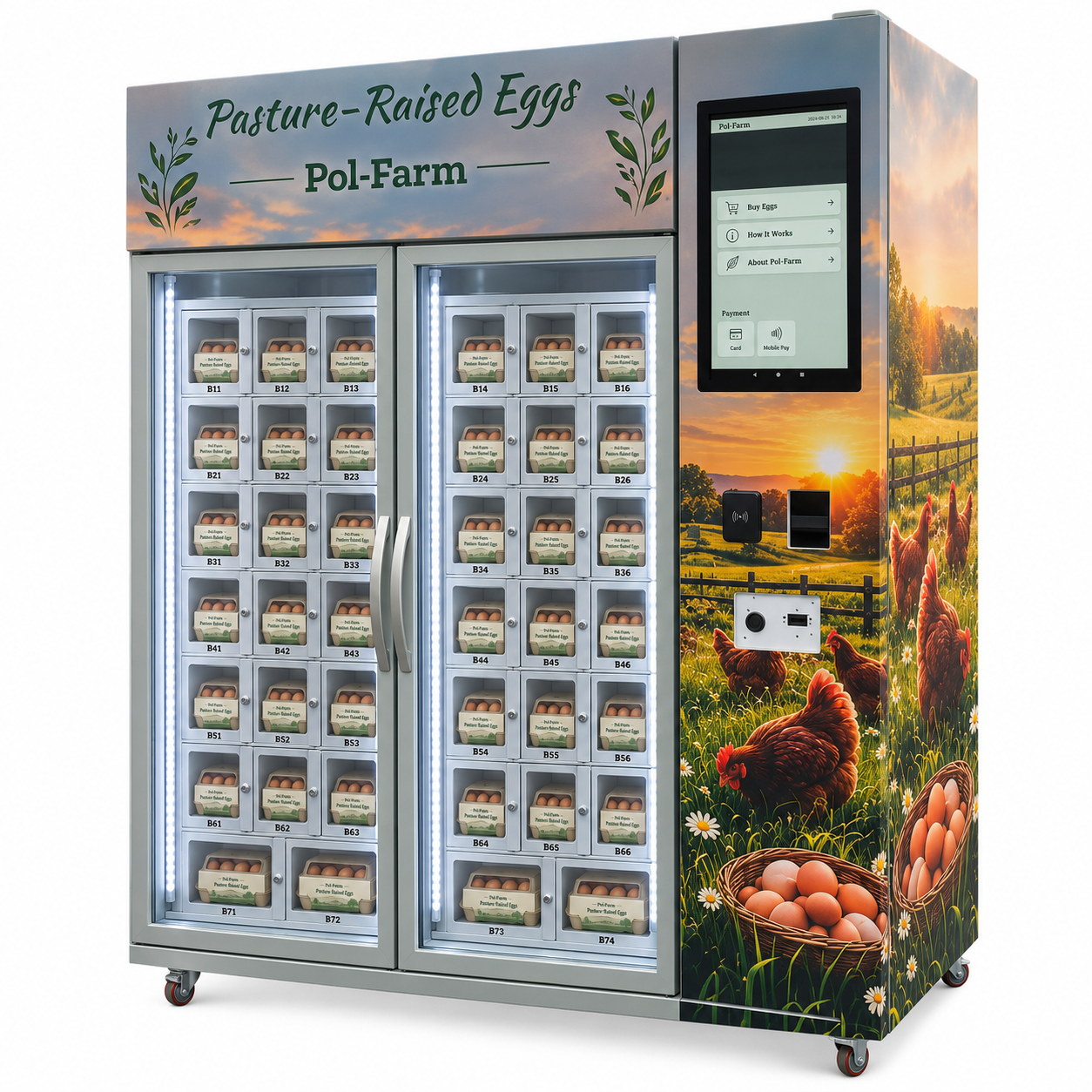
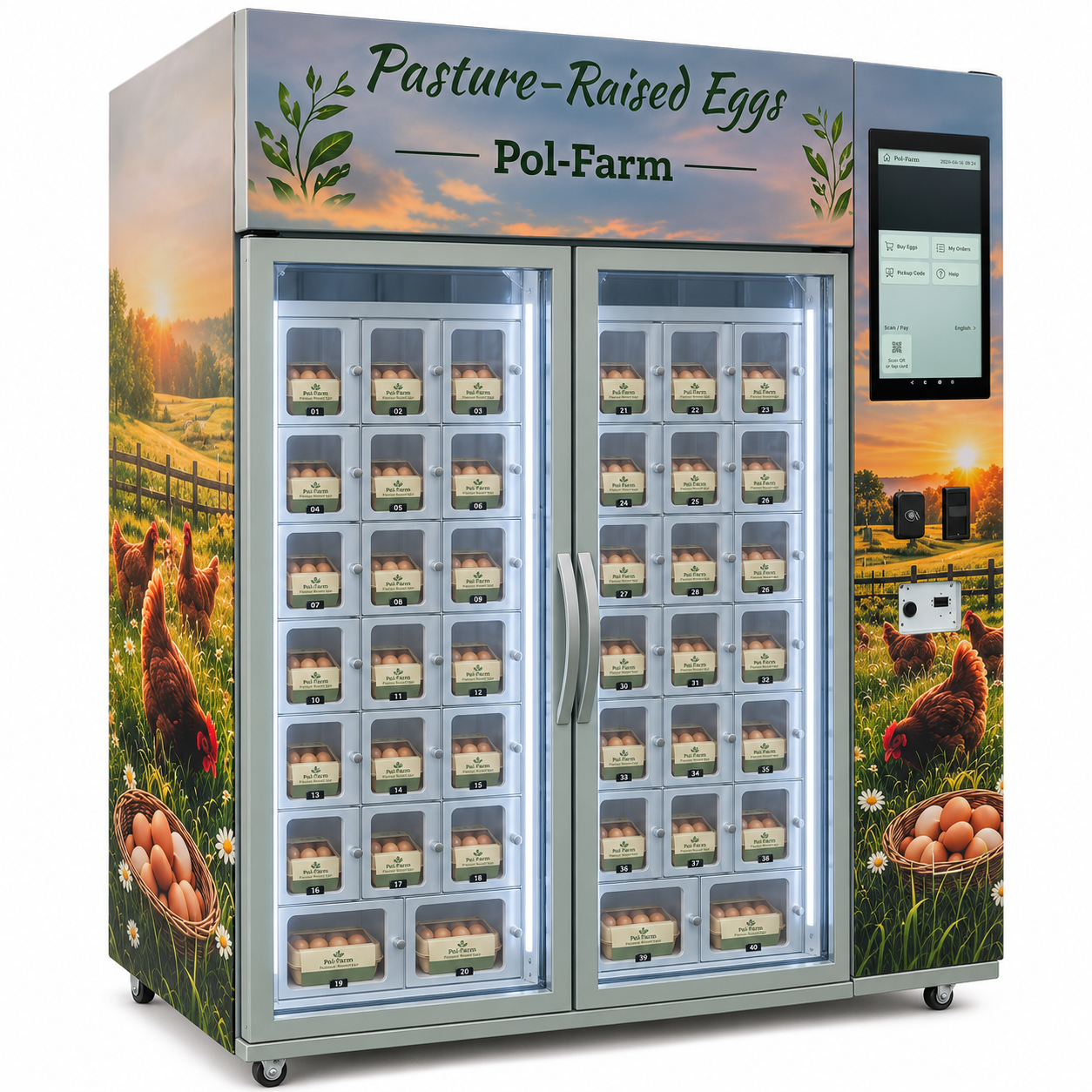
Two illuminated compartment banks share the right-hand touchscreen and payment area.
Explore a layout before you order one.
Tap a numbered position to explore the pictured arrangement.
Bank A / 001–020
Bank B / 021–040
Front reference: 40 numbered positions. The four wider lower positions are 019, 020, 039 and 040. Confirm all measurements in the order.
Make a first purchase feel straightforward.
The supplied system brief includes product information, interface language choice and self-service selection and payment.
Show the useful facts.
Display the brand, pack quantity, egg size or grade where applicable, price and supported product information fields such as ingredients.
Offer the local payment habits.
Bank cards, electronic wallets and QR payments can be configured under the supplied brief.
Point to the assigned door.
After authorisation, the configured locker flow should identify the correct position and explain how to collect the carton.
Small routines that keep the shop useful.
Start with filled carton samples, a realistic site and a clear product record.
Measure the full carton.
Confirm width, depth, height, filled weight and door-opening clearance.
Give each batch a next action.
The supplied system supports near-expiry warnings and automatic markdowns, plus night, holiday and non-business-period price schedules.
Keep the larger basket profitable.
Multi-item discounts, recommendations based on customer preferences and brand/promotion playback are included in the supplied brief.
Choose a practical collection stop.
Check customer access, power, network, ventilation and the refill route.
See what sold before you drive out to refill.
The supplied remote-management functions include real-time inventory monitoring, sales analysis and automatic stock, sales and payment emails.
Load from a useful stock list.
Track product and position records so you can prepare a refill by bank and SKU.
Judge the range by retained value.
Use sales data to compare carton sizes, trading periods and locations.
Give every notice an owner.
Automatic inventory, sales and payment notices help the operator follow up without keeping the dashboard open.
Explore WEIMI remote-management functions ↗
Set date and price rules ↗Connect stock to margin ↗Choose the cooling package around the actual egg supply.
The supplied brief includes remote refrigeration temperature adjustment and around-the-clock remote equipment on/off control.
Set a condition the machine can maintain.
Where the ordered refrigeration configuration supports it, adjust the setpoint remotely to suit the documented storage requirements.
Know exactly what the command switches.
Remote on/off control can support a planned operating routine or remote troubleshooting.
Turn an online order into a planned collection.
Customers can order through a merchant website or platform and collect using a pickup code under the supplied feature brief.
Keep reserved cartons out of walk-up stock.
Agree which products can be ordered online, when a compartment is reserved and how the machine updates availability.
Test the code at the machine.
Use a valid pickup code to demonstrate the complete release and collection process.
Return unused reservations correctly.
Define what happens when a customer does not collect.
Calculate what remains after the refill trip.
A machine creates another way to sell eggs.
A transparent contribution model.
Monthly contribution = cartons per day × trading days × [price × (1 − combined percentage charges ÷ 100) − goods cost − other variable cost] − monthly fixed costs. Simple payback = initial outlay ÷ positive monthly contribution.
Count the time spent selling.
Monthly fixed costs can include site rent, refill labour, travel, electricity, connectivity, software and maintenance provision.
How long will the loaded stock last?
Use the approved saleable carton quantity rather than a guessed egg capacity.
Separate coverage from a route promise.
Planning stock = loaded saleable cartons − reserve. Coverage in days = planning stock ÷ daily demand. Route requirement = daily demand × interval + reserve. The planner reports a surplus or shortage against that requirement.
Bring a plan for each compartment.
Prepare cartons by SKU and position, check product dates, record loading and leave each label and price in agreement.
Buy against a clear configuration.
Use this register to turn the pictured concept and supplied system functions into a concrete quotation.
| Item | Current brief | Confirm before ordering |
|---|---|---|
| Machine format | Egg compartment / locker vending machine with a shared right-hand operating area. | Confirm the model code, production configuration and cabinet control arrangement. |
| Pictured positions | Front image shows labels 001–040 and four wider lower positions. | Approve the final count, layout and compartment identifiers in a signed drawing. |
| Carton capacity | Determined by approved cartons, compartment geometry and loading rules. | Request tested carton quantities by SKU; |
| Dimensions & weight | Numeric values have not been supplied. | Request overall size, packed size, net/gross weight, door clearance and access requirements. |
| Electrical supply | Rated voltage, frequency and input power have not been supplied. | Confirm local supply compatibility, circuit, plug and site installation requirements. |
| Refrigeration | Remote temperature setting is included in the supplied system brief. | Confirm installed cooling equipment, temperature range, ambient limits and measured performance. |
| Door control | Numbered individual compartments are visible in the reference. | Confirm locks, release sequence, access path, feedback and recovery; |
A support plan that reaches beyond the first sale.
The supplied service terms include an 18-month warranty with free repairs and replacement parts during the warranty period, optional extended coverage, preventive maintenance and 24/7 customer service with remote fault diagnosis.
Free repair and replacement parts.
The supplied warranty commitment covers free repair and replacement parts during the 18-month warranty period.
Start with useful remote diagnosis.
Around-the-clock customer service and remote fault diagnosis help the operator describe a problem and identify the next action.
Keep small faults visible.
Preventive checks help identify door, payment, cooling and cleanliness issues before they cause a longer interruption.
Agree what a ready machine looks like.
Use this checklist as a discussion aid for factory acceptance and site handover.
0 of 6 discussion checks selected.
The details buyers usually want to settle.
Key configuration questions, answered plainly.
How many eggs does this machine hold?
The front reference shows forty numbered compartments, not a verified egg capacity. Total eggs depend on carton size, approved cartons per compartment and the production layout. Ask for a tested loading schedule in cartons and eggs for your chosen range.
Does the carton fall into a pickup tray?
This page describes an egg locker / compartment format, where the intended workflow is collection from an authorised position. Confirm the supplied door-release and access sequence with a live demonstration. The reference does not establish an elevator or drop delivery mechanism.
Is it a refrigerated egg vending machine?
The supplied functions include remote refrigeration temperature adjustment. The installed cooling package and model-specific range still need confirmation. Order against documented egg storage requirements, site ambient conditions and the agreed temperature performance.
Will it work outdoors at my farm entrance?
The illustrations do not establish a weather-resistance rating. Ask for the equipment’s actual installation rating, shelter needs, electrical requirements, ambient limits and security provisions for the proposed site.