


Premium Mobile Retail. A Smarter Investment. | Samsung Galaxy S26 Ultra Vending Machine
SMART ELEVATOR / PREMIUM ELECTRONICS RETAIL
Samsung Galaxy S26 Ultra Vending Machine
Build a focused self-service sales point for approved Samsung Galaxy S26 Ultra devices and compatible accessories. Smart elevator delivery combines with an illuminated merchandise display, portrait selection screen and front pickup opening to create a premium retail experience with a practical ownership plan.
Curate phones, compatible cases, earbuds and charging accessories around a real customer need. Evaluate each category by contribution, demand and the capital tied up in stock.
The included smart elevator supports the retail unit during the elevator stage. Validate the complete transfer and collection route with your actual sealed packages.
Combine clear SKU mapping, verified storage, regional-version and accessory information and a realistic replenishment route. Self-service transactions still require stock care, customer support and maintenance.
Agree package tests, payment configuration, operator training, equipment warranty and spare-parts arrangements in writing. Merchandise warranty and genuine sourcing are separate procurement details.
Final capacity, dimensions, payment services, software functions and commercial terms depend on the agreed configuration. Concept imagery does not imply Samsung endorsement or authorisation.
Discuss your retail projectTHE ELECTRONICS RETAIL SYSTEM / BUILT AROUND THE BUYER
01 / Premium connected retail02 / The ownership advantage03 / The assortment and margin mix04 / Smart elevator delivery05 / Performance that matters06 / The machine gallery07 / Buyer protection and service08 / Location strategy09 / Inventory, trust and operating control10 / Investment and return11 / Buyer questions12 / The procurement brief01 / PREMIUM CONNECTED RETAIL
Premium mobile retail. Built for a smarter investment.
Create a distinctive self-service retail point for Samsung Galaxy S26 Ultra devices and approved mobile accessories. Smart elevator delivery supports the collection experience, while the illuminated product window and portrait screen give a focused assortment a premium presence. Build the investment around verified packages, a serviceable location and measurable operating contribution.
Explore the value driversFollow the elevator journeyView the machine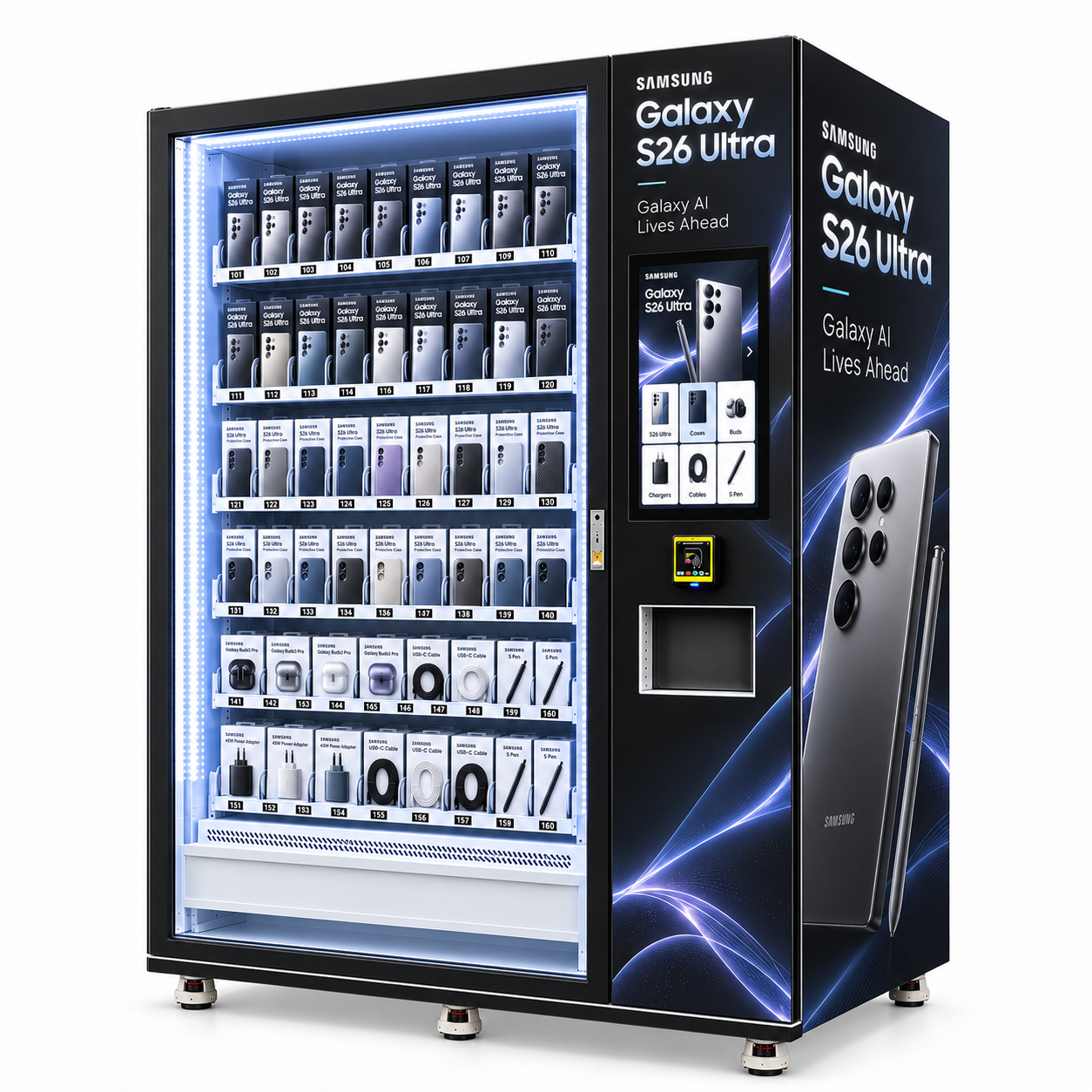
Right perspective / Electronics retail concept
SMART ELEVATOR DELIVERY / RETAIL EFFICIENCY / OWNERSHIP PLANNING
02 / THE OWNERSHIP ADVANTAGE
More retail opportunity, with a focused operating model.
Create an additional sales touchpoint with a manageable assortment and a clear operating plan. The opportunity is a more focused retail model, built around the economics of your actual site.
A new sales channel
An approved vending location can reach customers away from a conventional phone and accessory counter. Use the machine to test a focused offer in an existing retail property, leisure destination or other suitable venue before considering a larger staffed format.
Evaluate incremental sales rather than assuming every machine purchase is a new customer.
Focused staffing requirements
Self-service selection and collection can reduce the need for a dedicated cashier at the machine. Staff still replenish stock, answer questions and manage exchanges, so the benefit comes from how the installation fits an existing service route.
Compare total paid operating hours with a realistic alternative retail arrangement.
A visible premium display
Illuminated shelves and a large glazed window present the merchandise directly. A coherent collection can support confidence in a higher-value purchase, especially when the actual model, colour, size and unit packaging match the digital catalogue.
Evaluate readability, reflections and merchandise presentation at the chosen site.
An approachable expansion model
A single installation can serve as a controlled pilot for a new customer group or location. Begin with a defined assortment and a measurement period, then use actual demand and servicing effort to decide whether another unit is justified.
Approve expansion against contribution and operating evidence, not machine count alone.
Supported delivery for retail units
The confirmed smart elevator system supports the merchandise during the elevator stage of collection. For phone and accessory buyers, this creates a useful basis for protecting the presentation of an approved sealed retail unit through a considered handover.
Validate release, platform transfer and retrieval with actual retail packages.
A cabinet that communicates premium mobile retail
Obsidian framing, cool illumination and electric-blue artwork create a coherent electronics display. The portrait screen groups phone and accessory choices beside the merchandise window, while the separate terminal and front pickup opening organise the purchase area.
Approve the final artwork and catalogue against your actual merchandise and commercial permissions.
03 / THE ASSORTMENT AND MARGIN MIX
Devices attract attention. Accessories broaden the offer.
Explore the commercial levers that matter to an equipment buyer. Each connects an operational choice to a measurable business outcome.
Location-led demand
Select a site with a credible device or accessory purchase occasion and relevant visitors. Premium electronics sales depend on product trust, compatibility and availability; total footfall alone does not establish demand.
Record qualified visitors and actual conversion during the pilot.
More relevant selling hours
The machine can support self-service purchases during the hours permitted by the site and operating plan. Additional availability may help capture demand outside a staffed counter's schedule when power, stock and customer support are maintained.
Extended access is a site decision; uninterrupted 24-hour availability is not assumed.
A portfolio of purchase occasions
The references suggest phones, protective cases, earbuds, charging adapters, cables and stylus products. Select a practical subset based on demand and package testing. Accessories can broaden the range of transaction values while devices establish the premium category.
Model the actual unit margin of every category; the artwork is not a supplied-stock list.
The right version, before checkout
Show the exact model, storage, colour, regional version and any carrier restrictions for phones. For accessories, state the supported devices and included components. Better product information can reduce unsuitable purchases and the time spent resolving compatibility enquiries.
Check cases, earbuds, chargers, cables and S Pen compatibility individually against current documentation.
Operating routes that make sense
Combine inspection and replenishment with existing site visits where practical. The potential labour advantage depends on travel time, refill frequency and the amount of customer support required, not simply the absence of a cashier.
Include driving, parking, administration and support time in the cost model.
A repeatable rollout decision
Use one site's results to create an evidence-based deployment brief: demand, contribution, variant availability, service hours and technical issues. That record helps compare future locations on a consistent basis.
A successful pilot supports a decision; it does not guarantee the same return elsewhere.
04 / SMART ELEVATOR DELIVERY
A premium purchase deserves a considered handover.
Follow the complete transaction, from an exact variant selection to collection of the approved retail unit. Smart elevator delivery is included in the requested machine configuration.
01 / Select a verified SKU
The shopper chooses an accurately described phone or accessory. The menu should distinguish storage and regional variants, make the package contents clear and match the physical product assigned to that stock position.
A retail transaction does not automatically include activation, setup, data transfer or a carrier plan.
02 / Confirm the purchase
Show the complete selling price and the relevant exchange or refund information before checkout. The reference includes a payment terminal, but the enabled provider and services depend on the destination configuration.
Confirm supported currencies, payment fees and settlement arrangements.
03 / Transfer the sealed package
The selected package transfers from its stocked position onto the elevator platform. Small accessory cartons and longer device boxes can behave differently, so support geometry and release settings need approval for the complete retail package.
Test sealed samples across the smallest and largest approved formats.
04 / Carry toward collection
The elevator supports the retail unit during its travel toward pickup. The final equipment determines movement, sensing and control details; exterior images do not establish travel speed or a particular detection system.
Specify delivery performance and verification in the acceptance plan.
05 / Present the unit
The customer retrieves the purchase through the configured collection opening. Confirm that the approved package fits comfortably and that instructions explain when access is ready and how to remove the item.
Verify the largest approved package and delayed-collection behaviour.
06 / Support exceptions
Define what happens when payment succeeds but the expected handover does not finish. A documented customer-help and transaction-review procedure protects the buyer's reputation and gives the operator a repeatable response.
Agree delivery records, refund responsibility and fault escalation before launch.
05 / PERFORMANCE THAT MATTERS
Specify performance around your actual phone and accessory stock.
Protect the investment by translating the retail idea into measurable acceptance requirements. The right test is a complete customer purchase with the products you intend to sell.
Sealed-package compatibility
Approve each full retail unit with its original enclosure, labels and included components. Phone packaging and accessory cartons differ in depth, stiffness and weight; the display rendering does not prove fit for every current or future model.
Provide actual packaged dimensions and weight for storage, elevator and pickup checks.
Repeatable delivery
Run repeated purchase cycles across the relevant stock positions and package variants. Inspect successful completion and the condition of the merchandise, then agree how failures are recorded and corrected before acceptance.
Use agreed test conditions and a documented success criterion, not an invented reliability percentage.
Accurate fulfilment protects margin
Correct selection means delivering the purchased storage, colour and regional variant, or the exact compatible accessory. Align the physical package, position label and catalogue record after every refill and assortment change.
Test a representative purchase from each approved package group before commercial use.
Transaction continuity
Check successful and declined payments, interrupted connectivity and the agreed restart process. These scenarios help define the customer experience and the operator's response when normal trading is interrupted.
Confirm which controls and transaction records the supplied system actually provides.
Display and interface clarity
Assess product visibility, screen readability and collection instructions under the site's real lighting. A polished rendering cannot establish how reflections, customer reach or surrounding signage will affect a live installation.
Make the final acceptance review include a customer-facing walkthrough.
Installation and serviceability
Confirm floor space, access route, electrical supply, environment and service clearances from the final model documentation. An installation that is easy to replenish and service can reduce recurring disruption and unnecessary site visits.
Record dimensions, power and ambient limits in the signed technical specification.
06 / THE MACHINE GALLERY
A technical silhouette. A clear retail presence.
Inspect the front, left and right reference views. The illuminated window, portrait screen, front collection opening and category graphics establish the visual concept. Visible shelf counts and printed package labels do not establish final capacity or device specifications.
Right perspectiveFront elevationLeft perspective
Right perspective / Electronics retail concept
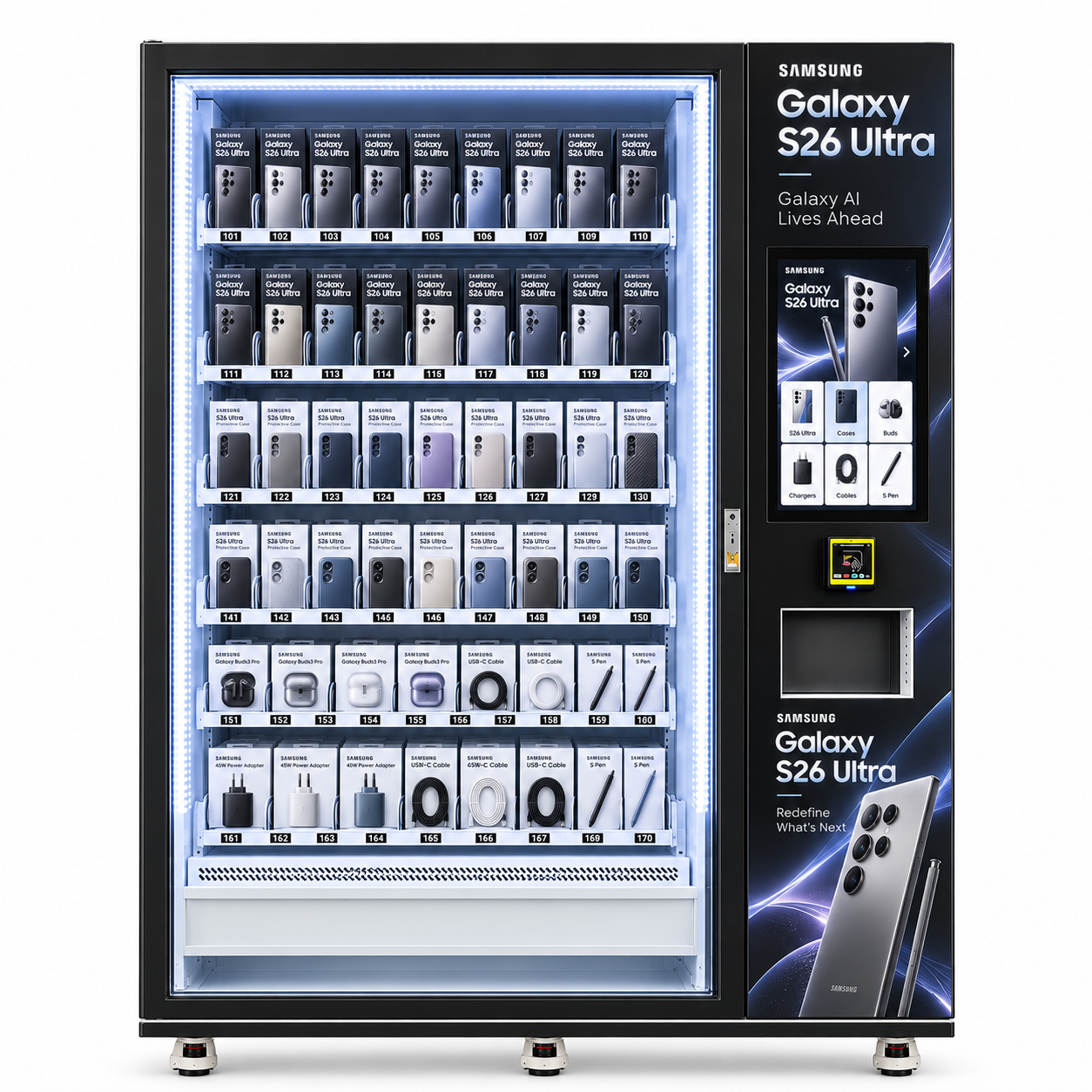
Front elevation / Electronics retail concept
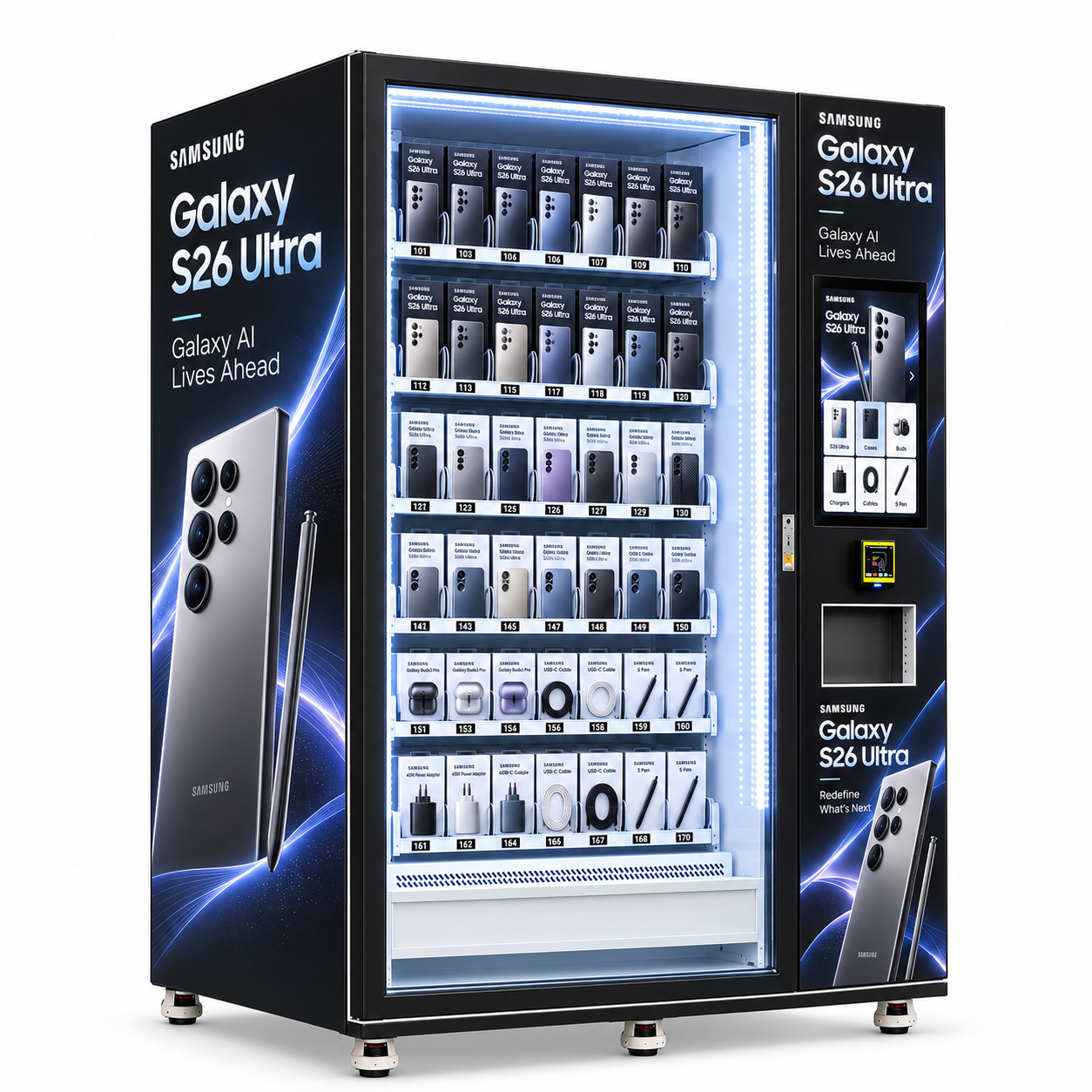
Left perspective / Electronics retail concept
07 / BUYER PROTECTION AND SERVICE
Make support part of the purchase specification.
A dependable ownership plan includes more than the cabinet. Use these service workstreams to define the deliverables and commercial protections you need in the final supply agreement.
Pre-order configuration review
Ask for a written review of the proposed packages, site and payment requirements before approving the machine configuration. Identifying a mismatch early can avoid an unsuitable stock layout or a costly installation change later.
Agree who approves samples and which drawings form the order specification.
Documented acceptance
Create a clear checklist covering appearance, functions, approved packages and complete purchase cycles. A shared acceptance record gives buyer and supplier a concrete reference for resolving outstanding items before handover.
Define test scope, evidence and the treatment of unresolved defects in the agreement.
Operator training plan
Request training on stocking, catalogue mapping, cleaning, routine checks and transaction exceptions. Good handover materials help the buyer's team maintain correct variant availability and respond consistently to customer questions.
Confirm format, language, attendees and whether installation support is included or separately priced.
Clear responsibility after the sale
Agree equipment warranty coverage, exclusions, repair routes and spare-parts arrangements in writing. Separately establish who handles phone faults, accessory questions, product returns and regional merchandise warranty eligibility. A clear handoff reduces time lost between suppliers.
Machine support does not itself provide manufacturer device coverage, activation or data-transfer services.
Technical support and escalation
Agree support channels, operating hours, response expectations and the route from remote diagnosis to on-site action. A structured process can help the operator resolve faults efficiently without promising a response time that has not been contracted.
Identify responsibilities for the equipment, payment terminal and network service separately.
Parts and lifecycle planning
Request a recommended spares list, maintenance guidance and an explanation of software or service fees. Understanding replacement parts and recurring costs helps the buyer evaluate ownership over the planned operating life.
Confirm availability, lead times and costs for the exact supplied model.
08 / LOCATION STRATEGY
Match the purchase occasion to the installation.
Explore six placement briefs. Select sites where product trust, variant availability and customer assistance can support a higher-value phone and accessory purchase.
Electronics retail locations
An approved installation can complement a staffed electronics store with a focused accessory range or additional collection point. Nearby expertise can answer compatibility questions while self-service checkout handles suitable purchases.
Measure incremental contribution and possible displacement of existing counter sales.
Shopping centres and mixed retail
A permitted location near complementary retail can expose a curated phone-and-accessory offer to relevant shoppers. Compare purchase intent, security arrangements and support access before committing premium device inventory.
Use a limited pilot to measure conversion, category mix and operating effort.
Shopping and lifestyle centres
A strong display can introduce the offer in an approved retail circulation area. Assess visibility, dwell time, conversion, rental terms and competing phone and accessory options before committing capital to the location.
Use contribution after site costs to compare candidate properties.
Hotels and travel environments
A replacement charging accessory or cable can serve a practical travel need where suitable stock is available. Higher-value phone purchases require clear product identity, warranty information and a dependable support route.
Confirm electrical and device compatibility for the customer market.
Events and temporary activations
An approved event installation can test audience response within a defined period. Include transport, setup, staffing support, insurance and unsold-stock handling in the project budget rather than measuring gross event sales alone.
Confirm artwork permissions, permitted trading and safe installation arrangements.
Workplace and mixed-use properties
A suitable shared environment may support a convenience-led accessory offer for a known audience. Start with a controlled model and compatibility mix, then compare purchases with servicing effort and the ongoing site terms.
Scale only when the measured economics and support arrangements justify another unit.
09 / INVENTORY, TRUST AND OPERATING CONTROL
Protect margin between the sale and the refill.
For phone and accessory, operational discipline means the right unit, in the compatible version, at the right stock position. Manage the range as a working-capital decision.
Variant-level control
Keep separate records for model, storage, colour, region and carrier status where relevant. Record accessory compatibility alongside the SKU. Distinct labels reduce confusion when similar cartons occupy neighbouring positions.
Confirm which inventory and reporting functions are included before specifying your operating process.
Protect working capital
Balance device inventory with faster-moving accessories using actual demand and landed costs. New product generations can change the attractiveness of older stock, so review ageing and markdown exposure as well as the number of units on hand.
Set reorder and review rules that reflect the value tied up in each SKU.
Replenishment accuracy
Check the exact SKU, generation and accessory compatibility against the assigned stock location before loading. Clear labels and a position guide reduce the risk of delivering a visually similar but different item and creating an avoidable support case.
Test a sample purchase after material catalogue or position changes.
Returns and product support
Publish a clear policy covering unopened goods, compatibility mistakes and faulty merchandise under applicable terms. Assign responsibility for device support, receipts, refunds and product warranty enquiries separately from machine fault handling.
Budget processing, shipping, payment disputes and any reduced resale value.
Price and contribution control
Review realised selling price after promotions and the true landed cost of each unit. Add transaction costs and a reasonable returns allowance to understand contribution rather than relying on a headline retail margin.
Separate sales tax collected for authorities from operating revenue as applicable.
Traceability for higher-value inventory
Retain sourcing records and appropriate serial or IMEI records for stocked phones. Reconcile merchandise received, loaded, sold and returned, with access limited to authorised operators. Good records help investigate discrepancies and support product-service enquiries.
Automatic IMEI capture is not assumed; agree the available software and manual record process.
10 / INVESTMENT AND RETURN
Understand the route from revenue to payback.
Compare illustrative mixed-basket trading scenarios, then replace every input with actual device and accessory economics. Sales revenue is not profit, and a larger device share may increase cash tied up in stock without increasing percentage margin.
An illustrative business case, not a revenue promise.
All figures below are hypothetical USD assumptions for one machine: weighted-average net realised revenue per completed, retained transaction across a hypothetical device and accessory mix $140; landed merchandise cost $85; payment fees $4.20; returns and service allowance $7 per sale. Contribution per transaction is $43.80 before monthly fixed costs.
Assume monthly fixed operating costs of $1,500 and 30 trading days. Assume installed equipment capital of $12,000 plus $5,100 of opening inventory, for an initial cash commitment of $17,100. These are modelling inputs, not WEIMI prices or claims about Samsung product margins.
| Monthly result | 30 transactions | 60 transactions | 90 transactions |
|---|---|---|---|
| Net sales | $4,200 | $8,400 | $12,600 |
| Variable contribution | $1,314 | $2,628 | $3,942 |
| After fixed costs | -$186 | $1,128 | $2,442 |
| Simple cash recovery | No payback | 15.2 months | 7.0 months |
The decision thresholds
Operating break-even is $1,500 / $43.80 = 34.25 transactions per month, rounded up to 35 whole transactions. At 30 trading days this is about 1.17 transactions per day. To recover the illustrative $17,100 within 24 months requires at least 51 transactions per month under the same constant assumptions.
Simple recovery equals initial cash commitment divided by positive monthly operating contribution. It excludes financing, income tax, depreciation, ramp-up, changes in inventory funding and residual value. It is not a discounted cash-flow return or a guaranteed calendar payback period.
Include rent or revenue share, software, connectivity, electricity, insurance, refill travel, labour and maintenance in your own fixed or variable cost structure. Do not double-count returned sales or charge both a full refund deduction and the same expected refund in the allowance. Use net retained sales consistently.
Compare actual downside demand with cash reserves before committing. A larger initial stock purchase, a higher return rate or a lower realised selling price can delay capital recovery even where gross sales look attractive. Set a pilot review date and a clear decision to improve, relocate or stop an underperforming installation.
Technical and service procurement checklist
| Smart elevator delivery | Confirmed for this requested configuration; transfer, sensing and collection controls to be specified for the supplied model. |
|---|---|
| Visible customer interface | Illuminated window, portrait screen, separate payment terminal and front pickup opening shown in the references. |
| Approved retail packages | Sealed device and accessory cartons require individual approval. Compatibility with all Samsung Galaxy S26 Ultra generations, storage and regional versions or package revisions is not established. |
| Stock capacity | To be calculated from approved packages and final layout; visible labels and facings do not establish usable capacity. |
| Delivery performance | Agree test cycles, representative positions, package-condition criteria and handling of incomplete deliveries. |
| Payment configuration | Provider, currencies, services, transaction fees, connectivity and settlement to be confirmed for the destination. |
| Software and connectivity | Catalogue fields, inventory records, remote functions and recurring fees to be specified, not inferred from screen imagery. |
| Dimensions and electrical supply | Final footprint, weight, service clearances, voltage, plug and rated power require model documentation. |
| Environment and protection | Permitted ambient conditions, indoor or outdoor suitability and security features to be confirmed for the actual installation. |
| Service and warranty | Training, documentation, coverage duration, exclusions, response arrangements and spare parts to be agreed in writing. |
| Product provenance and warranty | Confirm genuine sourcing, market-specific product eligibility, receipts and merchandise warranty terms separately from the machine service contract. |
11 / BUYER QUESTIONS
Clear answers for a better equipment decision.
Use the question index to explore performance, ownership costs, support arrangements and the conditions behind a realistic return.
What is the main commercial advantage?
The machine can create an additional self-service retail point with a focused assortment and a different staffing pattern from a conventional counter. The benefit depends on relevant demand, site costs, variant availability and the servicing plan; it should be measured through a pilot.
Is smart elevator collection included?
Yes. Smart elevator delivery is the confirmed requirement. Ask the final proposal to describe product release, transfer to the platform, movement and collection access, and verify the complete sequence with the actual sealed retail units you will stock.
Does every selection include an Samsung Galaxy S26 Ultra?
No. The references show phone devices alongside cases, charging products and other accessories. The menu must identify exactly what one transaction contains and distinguish an accessory-only purchase from a device.
Will all Samsung Galaxy S26 Ultra boxes and accessories fit?
No universal fit is established. Provide the actual sealed cartons for each SKU so storage, release, elevator support and the collection opening can be evaluated. New package generations or accessory formats need a compatibility review.
How do buyers avoid regional or accessory mismatches?
Maintain a verified catalogue with the phone model, storage, region and carrier conditions where applicable. Match each accessory to manufacturer documentation for the intended device. Show package contents clearly; do not imply that every charger, case, cable or stylus supports every phone feature.
Is this an Samsung-authorised vending machine?
The supplied concept artwork does not establish Samsung authorisation, endorsement or affiliation. Confirm genuine product sourcing, the use of Samsung names and imagery, and the commercial permissions applicable to the planned installation.
How reliable is dispensing?
No tested reliability percentage has been provided. Specify repeatable purchase tests with approved packages and representative positions, agree acceptance criteria and document exceptions. Correct item fulfilment and merchandise condition matter as well as mechanical completion.
Can it operate without staff?
It can support self-service transactions in the agreed configuration, but stocking, cleaning, customer help, returns and maintenance still need assigned responsibilities. Model the actual hours and travel required rather than assuming a labour-free operation.
What service protection should an equipment buyer request?
Ask for a written equipment support scope covering installation guidance, training, fault triage, parts availability, warranty exclusions and response arrangements. Establish merchandise warranty and customer-return handling separately. Exact coverage and timing must be agreed in the proposal.
Can remote inventory tools be provided?
Include the functions you need in the software brief. Remote stock information, alerts, reports and catalogue editing require confirmation of the supplied platform, connectivity and fees; they cannot be assumed from the screen design.
What is the expected payback period?
Use installed equipment cost, opening inventory and actual operating contribution to calculate a scenario. The examples on this page are illustrations, not forecasts. A location with negative contribution has no operating payback under those assumptions.
What costs are easy to overlook?
Include freight, duties where applicable, installation, stock funding, rent, payment fees, software, connectivity, power, insurance, servicing labour and returns. Model financing and tax separately where relevant and avoid counting the same cost twice.
How should electronics returns be handled?
Provide clear pre-purchase terms and a practical service route consistent with applicable requirements. Separate compatibility questions, defective merchandise, changed-mind returns and failed vending transactions. Agree who assesses returned goods and bears the associated costs.
Can it trade 24 hours a day?
Only where site access, permissions and the operating arrangements support it. Power, stock availability and technical condition also matter. The machine concept does not establish continuous availability or a guaranteed uptime level.
Is refrigeration required?
Refrigeration is not part of the confirmed phone and accessory-machine request. Specify an appropriate storage environment for the actual products and packaging, following their supplier guidance and the equipment's permitted installation conditions.
What should a buyer send for a proposal?
Provide destination, quantity, complete retail-package samples, model and size mix, site conditions, desired payments and service expectations. Add an investment budget and pilot objectives so equipment configuration and ownership costs can be discussed together.
12 / THE PROCUREMENT BRIEF
Build a phone and accessory channel with a clear business case.
Bring the real retail packages, the site economics and the service requirements. A detailed brief supports a more accurate configuration proposal and a more useful investment comparison.
Define genuine merchandise
List devices and accessories separately, with model, generation, colour, compatibility, source and packaged dimensions. Provide sealed samples for each format, plus customer-facing product information and any traceability requirements.
The concept display is not a verified supplied-stock catalogue or an authorisation statement.
Define the site economics
Record rent or revenue share, trading hours, relevant visitors and the cost of accessing the site. Include delivery, installation and any property-specific obligations in the initial investment estimate.
Use written site terms and a conservative demand scenario.
Define the technical acceptance
Agree the approved packages, purchase sequence, item mapping and exception tests. Specify the required documentation and evidence so both parties understand what successful handover means.
List measurable requirements without substituting unverified headline performance claims.
Define the support package
Request explicit warranty scope, training, technical support and spares arrangements. Separate included deliverables from optional services and recurring charges so the ownership budget reflects the actual offer.
Support terms should be written into the final proposal and agreement.
Define the pilot review
Set a review period and measure sales by size, contribution, returns, downtime and service hours. Decide in advance what evidence would justify assortment changes, a new location or a second machine.
Avoid expanding on gross revenue alone.
Request a project proposal
Share destination, quantity, approved product samples, site information and payment requirements with WEIMI. Ask for an itemised equipment and support quotation that can be compared against the same operating assumptions.
Final price, lead time, supply scope and commercial terms are confirmed in the quotation.
Continue your WEIMI visit
Explore the wider WEIMI equipment collection to compare retail formats for a different merchandise brief.
Browse vending equipmentRead the company introduction as you prepare supplier and project discussions.
Learn about WEIMIContinue to the general FAQ for additional company and equipment enquiry information.
Explore general questionsShare the assortment and destination through the contact page to begin a configuration discussion.
Discuss your electronics projectSamsung and Samsung Galaxy S26 Ultra names appear in the supplied concept references. No official equipment endorsement or brand affiliation is claimed.