Elevator-assisted collection
The intended benefit is a more controlled route from shelf release toward pickup. Test the exact pack, weight, transfer and delivered condition; the exterior views do not establish zero impact or a maximum payload.


THE GREEN RETAIL CLUB / LACOSTE-THEMED RETAIL
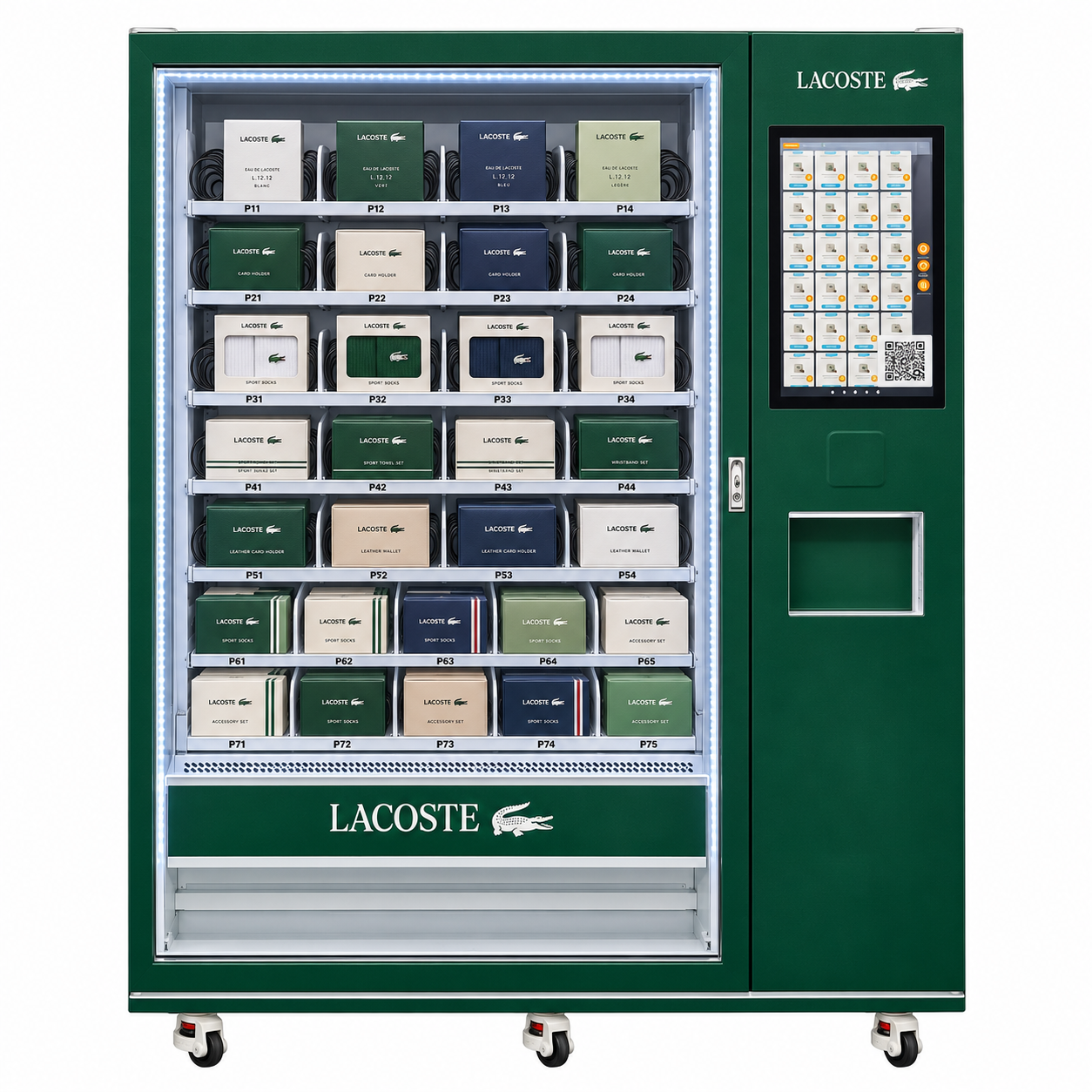
A Lacoste-themed elevator vending machine for an approved selection of boxed accessories and gifts. Forest green panels, silver framing and an illuminated display follow the visual language of the supplied machine.
The intended benefit is a more controlled route from shelf release toward pickup. Test the exact pack, weight, transfer and delivered condition; the exterior views do not establish zero impact or a maximum payload.
Supported stock, sales, price and content management can help organise refill visits and keep the menu aligned with the goods. Confirm enabled modules, connectivity, roles and recurring costs.
Compare product contribution, venue costs, payment fees, route work and working capital. The detailed page includes two buyer-input planners for operating contribution and capacity-aware refills.
A CURATED ASSORTMENT. A CONSIDERED DELIVERY.
A Lacoste-themed premium merchandise elevator vending machine for approved boxed gifts and accessories. Put the pack on display, plan the collection path and keep the operating numbers visible.
See the handover path ↗Build your business case ↗Lacoste-themed reference artwork. Final branding, stock supply and machine configuration are separate items to confirm.
01 / THE HANDOVER PATH
The purpose of an elevator-assisted configuration is to bring a released product toward the collection position rather than rely on a long uncontrolled drop. The benefit depends on the complete pack-to-platform-to-opening path, not simply the presence of a moving carriage.
The reference views show products held in shelf lanes with spiral-like dispensing hardware visible around many packs. A product must release cleanly before the elevator can help.
Have the supplier identify the final dispensing mechanism and lane setup. Test the real filled box, not an empty carton. Check snagging, doubles, leaning packs and the last unit in a lane.
A suitable elevator arrangement receives the released pack and carries it toward handover. Ask how the product is supported through the transition and how the mechanism handles its weight and centre of gravity.
Request maximum and minimum pack size/weight, platform dimensions, positioning method and complete delivery footage. Do not assume a particular number of axes, belt transfer, zero free fall or a sensor arrangement from these exterior renderings.
The right-hand opening gives the customer a visible collection point. Clear screen instructions should explain when retrieval is ready and what to do if an item is not delivered.
Test the opening with the largest approved pack and a real customer reach. Confirm any door or shutter, obstruction response, product detection, retry and refund process on the quoted machine.
02 / THE ASSORTMENT STUDIO
The pictures suggest boxed fragrance, socks, small leather goods, towels and accessory sets. These are visual examples. Final compatibility depends on the complete retail pack, its orientation, the dispensing hardware and the elevator path.
A rigid carton can offer a repeatable shape for loading and release. Measure the filled box, including sleeves, hang tabs, security labels and any protective outer wrap.
Check corners, seals, surface scuffing and product movement inside the box. A soft empty sample does not represent a heavier retail unit. Do not remove necessary product protection just to fit a lane.
Socks, towels and other textiles can deform, lean or catch if their packaging is inconsistent. A neat presentation box may help, but it changes dimensions and goods cost.
Test the exact packaging you will sell. Confirm whether a lane needs different guides, a different spiral pitch or another mechanism. Adjustability and conversion parts must appear in the supplied scope.
A fragrance box may contain glass or liquid, while a leather accessory may be light but easily marked. Neither category is automatically compatible with every elevator machine.
Include item mass, leakage protection, orientation and product-specific storage guidance in the sample pack. Check the actual transfer and collection condition. No refrigeration, climate control or anti-theft certification is established by these images.
03 / THE OPERATOR CONSOLE
WEIMI describes general remote stock, sales, price and content management functions. Their availability on this elevator cabinet depends on compatible controls, enabled modules, connectivity and account permissions. Have the supplier demonstrate the exact package you are buying.
Supported stock records can help you pack the next route before leaving the storeroom. Separate saleable availability from goods removed for damage, samples, service tests or manual corrections.
Demonstrate one sale, refill, manual removal and failed delivery. Confirm when inventory is deducted and whether detection means a product reached the platform, reached the pickup opening or was actually collected.
Supported menu tools can help update product photographs, prices and descriptions. This matters when two packs look similar but contain a different size, colour or set.
Push a change, verify acknowledgement and complete a purchase at the new price. Confirm supported languages and the roles allowed to edit content. Ask what happens to pending transactions during a change.
Useful reports distinguish successful sales, payment failures, delivery failures and refunds. Product-level movement helps decide which goods deserve more space.
Trace an order through the screen, machine record, payment provider and export. Confirm currency, time zone, fee treatment, report definitions, retention and recurring costs. Do not assume automatic refunds or remote elevator release are included.
Explore WEIMI general remote-management functions ↗
Read the manufacturer backend overview ↗
Turn functions into acceptance tests ↗04 / THE MARGIN DESK
A high ticket price is not the same as a high retained margin. Use a consistent currency and tax basis. For a mixed range, use a defensible weighted average, then check the key SKUs separately.
Price minus goods, percentage fees and other variable cost gives unit contribution. Multiply by units sold, then deduct monthly fixed operating costs.
Include site rent, route work, connectivity, software, power and a reasonable provision for unsold or damaged goods without double-counting. Use actual quoted costs; do not treat all unpaid owner time as free.
Simple payback divides initial outlay by positive monthly operating contribution. Include machine purchase, freight, setup and opening stock where you pay for them.
The result does not predict demand and is not a finance, depreciation or tax schedule. Include financing and replacement obligations in a separate cash-flow review where relevant. A non-positive contribution cannot support a finite simple payback.
05 / THE STOCK DESK
Use tested saleable capacity for the selected SKU allocation, not the full machine capacity when only part of the cabinet is available. This planner uses your expected sales rate; it does not predict purchases.
06 / THE CONFIGURATION REGISTER
No dimensions, load rating, screen measurement, vend time, energy reading, price or warranty period was provided. The references show the retail concept; the quotation should define the delivered machine.
Final model, packed/unpacked dimensions, weight, delivery access, power/plug, rated ambient conditions, clearances and securing instructions.
One approved production layout, lane mechanisms, adjustment parts, pack allocation and tested unit capacity for each SKU.
Receiving area, transfer route, permitted pack size/weight, positioning, detection, collection opening and demonstrated cycle behaviour.
Delivered-pack condition standard, detection scope, failed-vend response, safe obstruction handling and qualified-service access.
Panel specification, touch support, languages, product fields, price update process and customer exception messages.
Local provider, methods, merchant ownership, fees, settlement, online needs, refunds and reconciliation procedure.
Enabled stock, sales, content, status and alert modules; user roles, exports, administrator ownership and renewal costs.
Whether climate control is included, product-specific storage suitability, rated electrical load and measured consumption if available.
Freight, commissioning, training, warranty scope, spares, labour/shipping responsibilities and after-warranty support.
07 / THE OWNERSHIP PLAN
An elevator machine combines dispensing, moving transfer hardware, payment and software. A useful support plan separates safe operator checks from qualified service work, and gives each exception a named route.
Train the operator on the exact packs, lanes, lift route, account and payment integration. Commission the cabinet at its final site after handling and installation.
Receive loading, cleaning, safe shutdown and fault-reporting instructions. Record the final configuration and demonstrate the first refill, test sale and report export. Confirm delivery access and any site-specific installation requirements before shipment.
Ask what warranty covers parts, labour, freight and attendance. Separate machine, payment-provider, network and software responsibilities. No response time or coverage period was supplied.
Agree support channels, hours, fault evidence and escalation. Request recommended spares and availability after warranty. Moving mechanisms and electrical equipment should be serviced under the manufacturer’s qualified-service instructions.
A clear procedure can reduce downtime caused by an unclear handover between operator, supplier and payment provider. Record time, product, lane, order and the observed delivery state.
Ask which safe checks the operator may make, how affected sales are paused if supported, and how goods/stock are reconciled after service. Do not promise remote repair, automatic failover or backup power without a supplied feature.
08 / THE WITNESSED RECORD
Use this checklist to organise demonstrations. Marks stay only in the current open page; they do not certify the machine or save a service record. Keep the actual test results, configuration and videos with your order.
0 of 6 checks marked.
09 / THE GALLERY
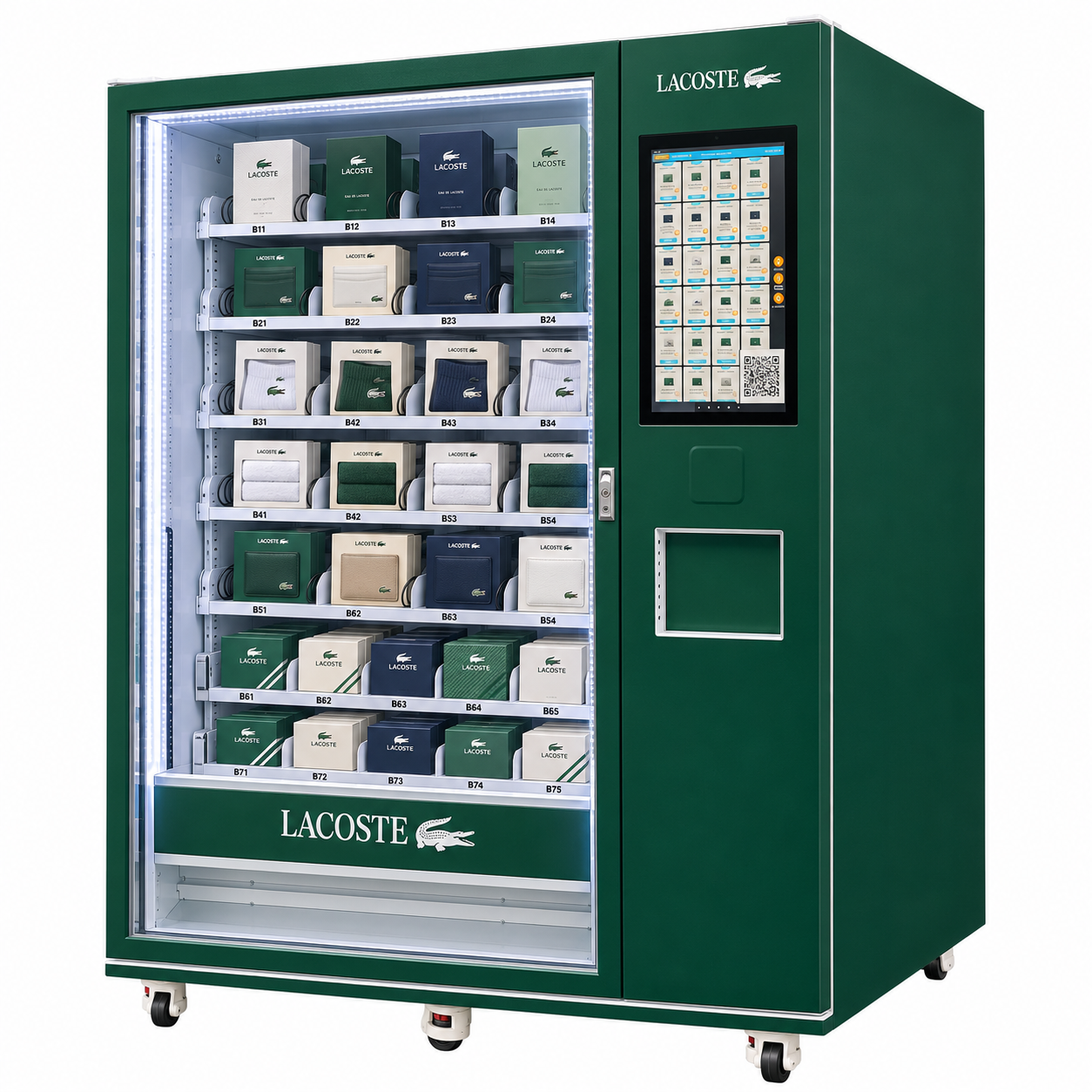
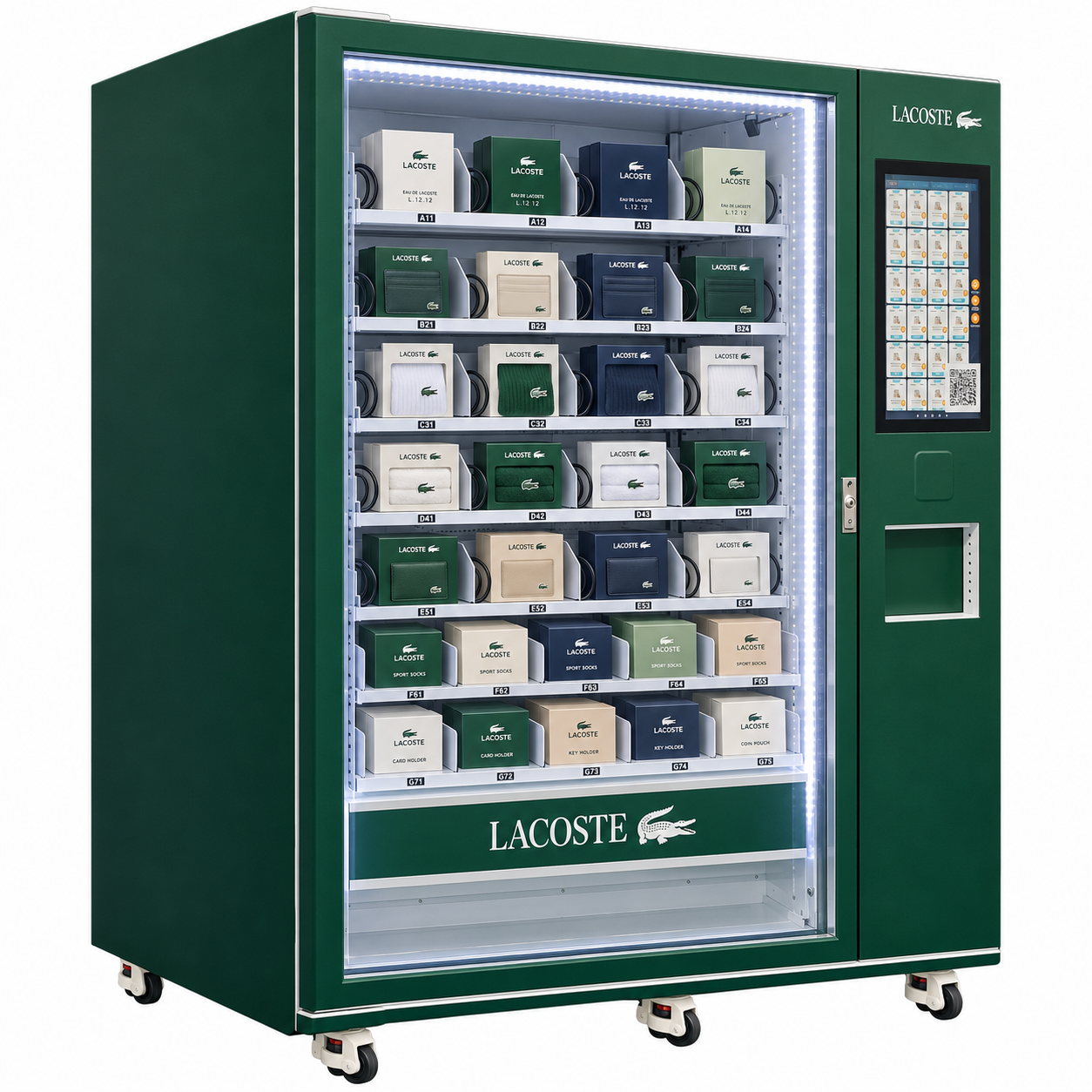
The supplied renderings use forest green panels, silver framing, cream and navy packs, and Lacoste names and crocodile graphics. Pack assortments and shelf labels vary between views. Treat them as styling references, then approve one final build.
10 / YOUR NEXT MOVE
A useful quote starts with the goods you will actually sell and the place you will operate. Keep the discussion specific enough to compare suppliers on the same basis.
Share country, currency, site type, access hours, product photographs, packed dimensions and weight. Include local payment needs, planned refill route and the remote tasks you need.
Add the intended artwork, stock supply arrangement and your customer-support expectations. If a storage condition matters to the product, send that documented requirement too.
Request the model sheet, final layout, pack-to-pickup demonstration, enabled modules, complete price, recurring costs, training and written service coverage.
Compare freight, setup, payment integration, opening stock, subscriptions and support responsibilities as separate lines. Confirm the acceptance evidence and any approved changes before production.
Discuss your premium retail project ↗
Revisit the cost model ↗Back to the retail edit ↗