


A Little Tote. A Beautiful Stop. | Trader Joe's Tote Bag Vending Machine
A Little Tote. A Beautiful Stop. | Trader Joe's Tote Bag Vending Machine
Turn an everyday carry into a considered self-service purchase. This Trader Joe's tote bag vending-machine concept combines smart elevator delivery with an illuminated merchandise display and a portrait selection screen. Cream framing, forest-green panels and botanical artwork create a distinctive retail presence for compatible packaged totes and folded reusable bags. Build the assortment around the actual products you supply, then confirm package fit, payment configuration and the complete collection sequence.
- Smart elevator delivery for approved packaged tote formats.
- Illuminated merchandise window and portrait selection screen.
- Forest-green and cream botanical design direction.
- Final assortment, payments and technical specification agreed for your project.
THE BOTANICAL CARRY COLLECTION / SMART ELEVATOR VENDING
01 / The carry collection02 / The retail idea03 / The assortment edit04 / Smart elevator handover05 / Packaging and fit06 / The three-view gallery07 / The design language08 / The location collection09 / Operator experience10 / Configuration record11 / Questions and answers12 / Your next retail stop01 / THE CARRY COLLECTION
A little tote. A beautiful stop.
An everyday carry becomes a considered self-service purchase. Explore a botanical tote-bag vending concept with smart elevator delivery, an illuminated collection and a portrait selection screen.
Explore the collectionFollow the elevator journeyView the machine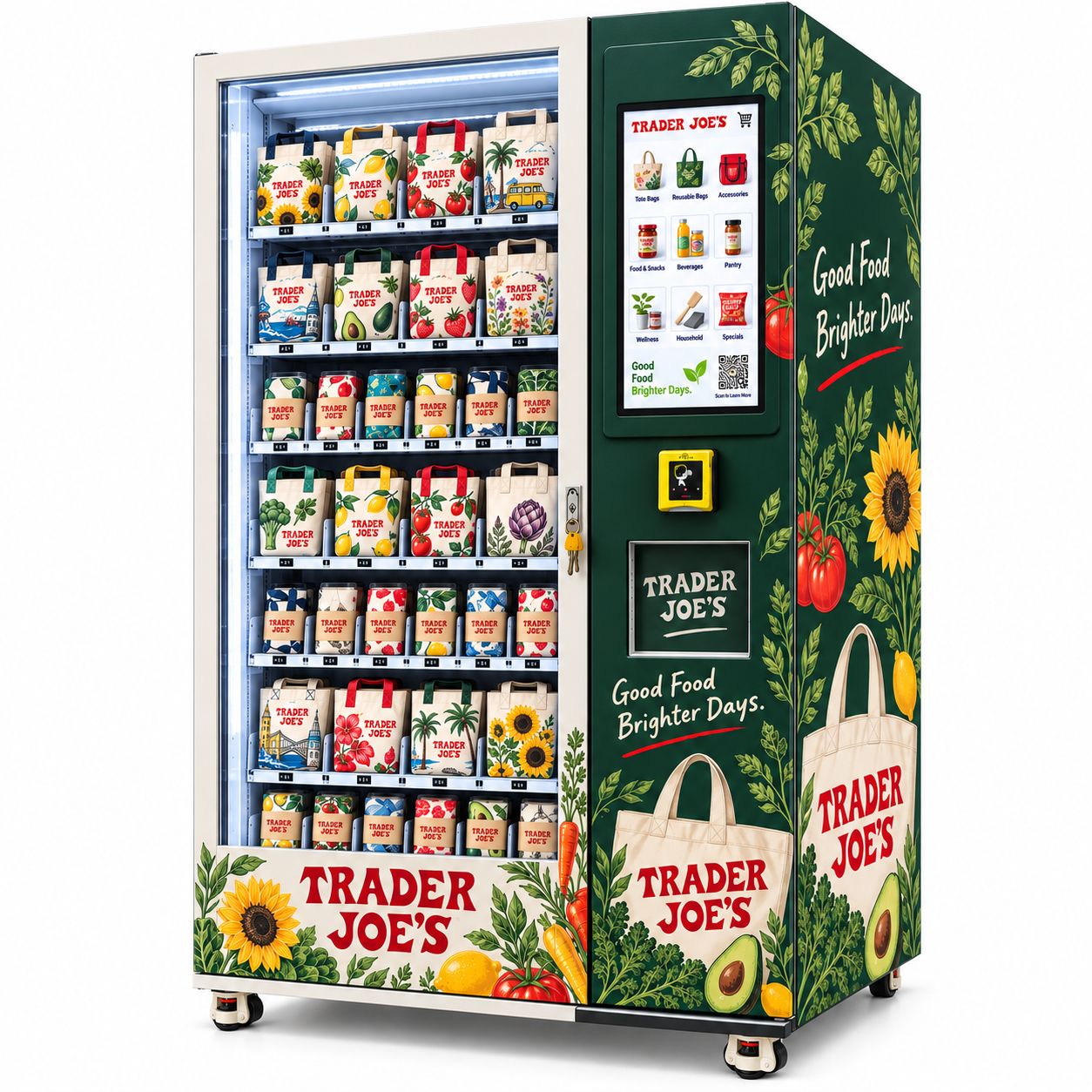
Right perspective / Botanical retail concept
SMART ELEVATOR DELIVERY / ILLUMINATED DISPLAY / BOTANICAL RETAIL IDENTITY
02 / THE RETAIL IDEA
Everyday utility. A memorable encounter.
Make the merchandise the centre of the experience: visible designs, clear choices and a supported journey to collection.
A collection worth pausing for
The glazed display gives customers a direct view of stocked merchandise. Cream-coloured bags, coloured handles and illustrated fronts form a recognisable collection before a customer touches the screen. Arrange actual retail units with their identifying design facing the customer.
Build the display around genuine products available for your market.
Smart elevator delivery
The specified configuration includes a smart elevator collection system. A selected retail unit is supported during the elevator stage on its way to pickup, creating a considered handover for packaged textile products.
Agree the transfer mechanism, platform geometry and final collection sequence for the supplied model.
A focused retail touchpoint
Bring a tote assortment to an approved location without designing a conventional staffed display counter around every purchase. The cabinet brings merchandise presentation and a self-service selection point into one coordinated installation.
Review installation dimensions, customer approach and servicing access for the actual site.
A visible digital menu
The portrait screen shown in the references provides a prominent point of choice. A well-organised catalogue can connect a photographed design to its name, packaged format and price, helping customers understand what one purchase contains.
Confirm touch functions, supported fields and language options in the final software configuration.
Distinctive from three angles
Forest-green side panels and cream front framing create a coherent identity around the product window. Botanical illustrations continue across the cabinet, giving an angled approach as much character as a straight-on view.
Review the complete panel artwork against the approved cabinet drawing.
An assortment you can operate
The most effective opening range is one the operator can source, package and replenish consistently. Use finished retail units and clear product information to connect the visual concept with a workable day-to-day offer.
Equipment supply, merchandise supply and brand-asset permissions are separate project details.
03 / THE ASSORTMENT EDIT
Choose the format. Shape the collection.
Explore six merchandising directions drawn from the supplied visuals. Exact products and current availability are confirmed separately with the merchandise supplier.
Illustrated tote edit
Large illustrated fronts give customers an immediate reason to compare designs. Sunflower, lemon, tomato and botanical motifs appear in the references; name only the exact stocked products in the live menu. Let the genuine merchandise carry the story.
Photograph the real sellable unit and show the design the customer will receive.
Folded reusable-bag edit
The references show compact folded units held by paper-like bands or enclosed in packaging. This format can make a small display position visually tidy while keeping a broader printed design available after unfolding.
Use a stable finished package; loose folded fabric needs separate compatibility testing.
Colour-led discovery
Handle colour and print can help shoppers orient themselves across a collection. Pair those visual cues with a clear product name so that similar-looking units do not become confusing at checkout or during replenishment.
A colour family is a browsing aid, not a guarantee of material or size.
City and travel motifs
Several reference bags use landmark or travel imagery. A destination-themed edit can suit a souvenir retail brief where the products are legitimately available and the site supports that audience. Keep the origin and naming accurate.
Do not label a design as an official city exclusive without current product evidence.
Seasonal botanical stories
Flowers, leaves and produce illustrations offer a way to organise a changing visual story. Keep seasonal stock separate in the catalogue when its design or packaging differs from the everyday collection, and make availability clear.
The visual reference alone does not establish a limited edition or a future stock commitment.
A focused mixed collection
Upright-looking totes and compact folded units may be considered in the same retail concept. Their different silhouettes create variety, but the approved layout must accommodate each packaged unit independently through the complete delivery route.
Use package dimensions and testing to assign positions and determine usable capacity.
04 / SMART ELEVATOR HANDOVER
Support the package. Simplify the pickup.
Smart elevator delivery is the confirmed handling feature. Follow the six-stage concept, then validate the complete journey with the actual packaged tote assortment.
01 / Select the design
The customer reviews the catalogue and chooses an available item. A clear photo, design name and price connect the digital choice to the physical stock position assigned by the supplied system. Keep the information easy to compare.
Confirm how availability and product-to-position mapping are maintained.
02 / Complete checkout
A separate yellow payment terminal is visible in the references. The enabled provider, card services, wallets and currencies depend on the destination and final payment configuration. Instructions should explain the actual supported purchase process.
Test successful payment and the agreed response to declined or interrupted transactions.
03 / Transfer the retail unit
The packaged unit moves from its stock position onto the elevator platform. For textile merchandise, support at this transfer matters as much as vertical movement: a flexible corner or a loose handle can change how the unit behaves.
Validate the actual release method using representative finished retail units.
04 / Move toward collection
The elevator supports the retail unit during travel toward the collection level. The precise route, motion profile, sensing and control logic depend on the supplied equipment rather than what can be seen in an exterior rendering.
Agree performance requirements without assuming a particular travel time or sensor set.
05 / Present the purchase
The machine makes the product available at its configured pickup point. Instructions should tell the customer when collection is ready and how to retrieve the package without pulling on an exposed handle, sleeve or decorative wrapping.
Confirm opening dimensions, the access sequence and delayed-collection behaviour.
06 / Resolve exceptions
Customers should be able to recognise an incomplete handover and find help. Agree how the system records a transaction and how the operator responds when a product is paid for but not collected as expected.
Define support and refund procedures together with the configured payment provider.
05 / PACKAGING AND FIT
A soft product needs a defined retail unit.
Choose the packaging before approving the layout. A folded textile, an upright tote and a wrapped bundle can behave differently in motion.
Control loose handles
Handles and straps should stay within the approved package envelope during loading and delivery. A tidy front view is useful, but the critical check is whether anything can protrude, unfold or catch along the real transfer route.
Inspect each proposed packing method with the machine supplier.
Measure the stocked form
Record width, height, depth and weight of the packaged sellable unit. An unfolded tote dimension describes customer use; it does not tell the operator whether the unit fits a stock position, elevator platform or pickup opening.
Keep unfolded product dimensions and packaged dimensions as separate records.
Keep the fold consistent
A stable folding method makes handling more predictable. Decide where the handles sit, how the bag is held closed and how much variation is acceptable between replenishment batches. Include the actual material and packaging in approval samples.
Test several real units rather than approving a format from a single ideal sample.
Protect print and finish
Suitable packaging helps preserve the presentation of light fabric, printed surfaces and handles during stocking and transfer. Avoid a sleeve that slips away or a stiff corner that unexpectedly changes the package movement.
Inspect the package after repeated deliveries for creasing, abrasion and displaced wrapping.
Label the genuine product
The customer record should identify the actual bag, verified dimensions, material and care information where available. Align the dispensed label with the photo and description displayed in the catalogue so the purchase is easy to understand.
Cotton content, load rating and washability cannot be inferred from the images.
Approve each revision
A change of fabric, fold, sleeve, handle arrangement or package size may alter dispensing behaviour. Treat a revised retail unit as a compatibility check even when its product name and decorative print have not changed.
Document the approved package version and its positions for the refill team.
06 / THE THREE-VIEW GALLERY
Forest green. Cream canvas. A complete story.
Compare the front, right-angle and left-angle references. The images communicate the retail concept; final dimensions, hardware and internal construction are defined in the supply specification.
Right perspectiveFront elevationLeft perspective
Right perspective / Botanical retail concept
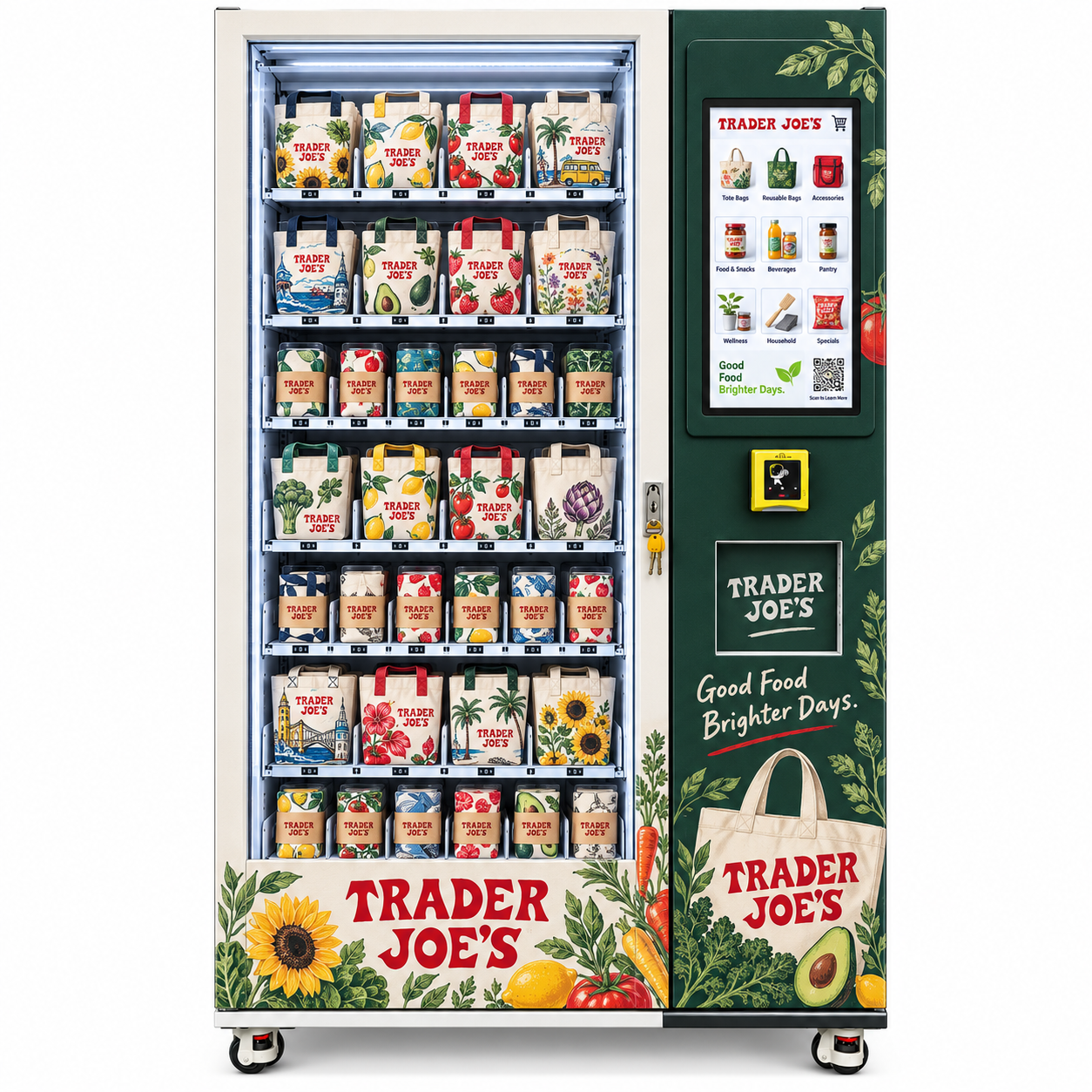
Front elevation / Botanical retail concept
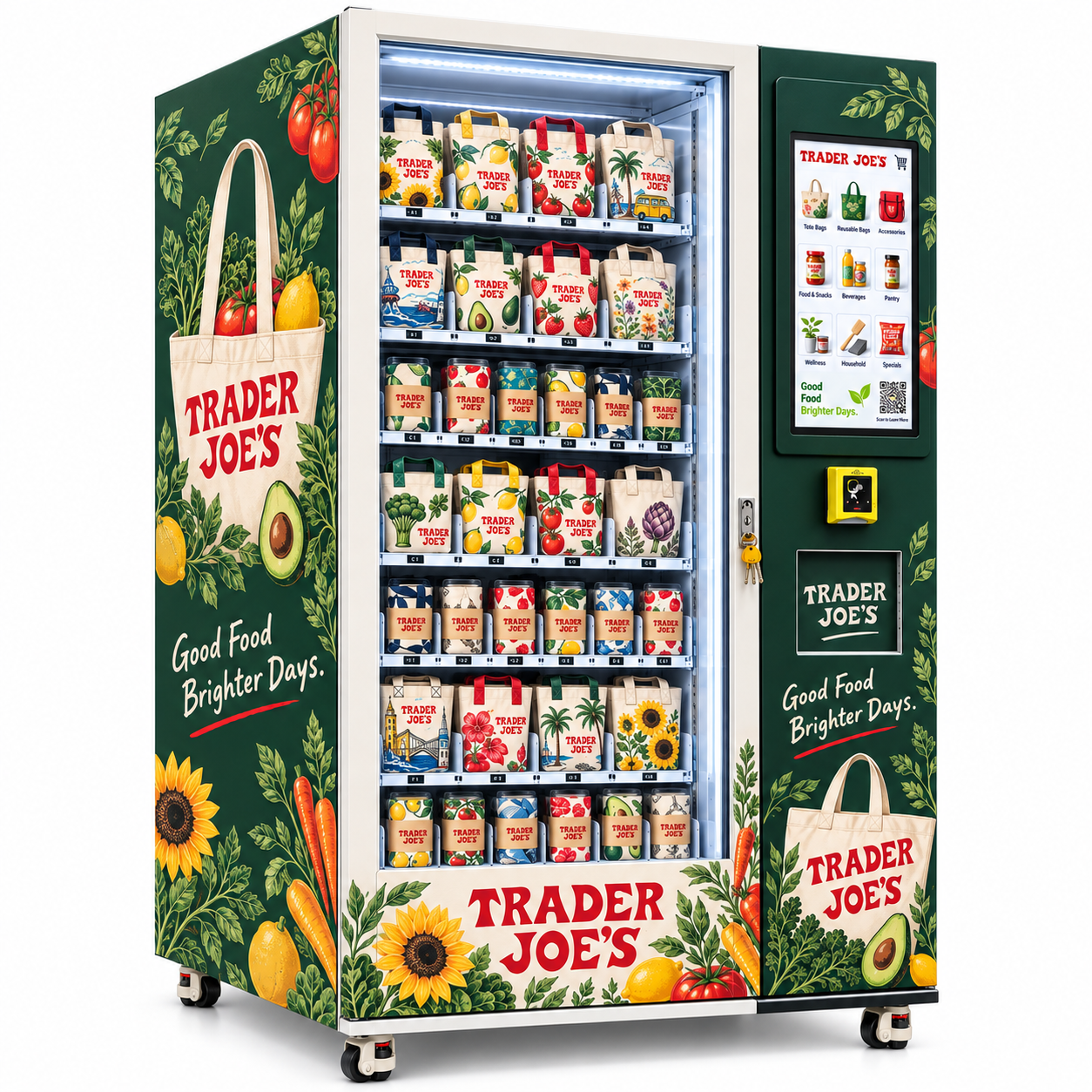
Left perspective / Botanical retail concept
07 / THE DESIGN LANGUAGE
Botanical warmth. A disciplined retail layout.
Use natural tones, purposeful contrast and quiet space to keep the collection visible. The cabinet, menu and packaging should feel like one considered presentation.
Forest-green architecture
Deep green panels frame the screen and carry the side artwork. The colour creates a calm backdrop for cream totes and bright produce motifs, making the machine read as a coherent retail display rather than unrelated surfaces.
Approve printed colour and material finish using the production proof.
A cream display frame
The pale frame separates the merchandise window from the darker control column. This contrast helps the assortment read from the approach, particularly when light-coloured bags sit against the interior shelving and illumination.
Assess reflections and label visibility under actual site lighting.
Illustration around the edge
Leaves, sunflowers, tomatoes and citrus imagery flow around the cabinet. Keeping detail at the perimeter allows the displayed bags and purchase controls to remain the central information, while the side panels tell a broader visual story.
Keep graphics clear of vents, hinges, locks, instructions and service access.
A clear screen hierarchy
Use recognisable categories and consistent product imagery. Put the stocked tote collection first; unrelated food, drink and household icons in a concept screen should not become live menu items simply because they appear in a rendering.
Publish only merchandise approved for this configuration and available to purchase.
A composed front elevation
The window, portrait screen, terminal and lower panel form the visible composition. Align final graphics to these fixed elements so that product names, instructions and collection cues remain readable throughout the purchase.
Confirm the actual pickup interface rather than identifying it solely from a decorative panel.
Brand identity with precision
Trader Joe's names and artwork appear in the references. Use product descriptions and assets appropriate to the commercial arrangement. A branded equipment concept does not establish an official machine affiliation or endorsement.
Confirm sourcing and artwork rights before approving branded production files.
08 / THE LOCATION COLLECTION
A useful purchase, in a well-chosen place.
Explore placement ideas through audience, access and replenishment. Each site requires permission and an installation review.
Shopping destinations
An approved retail setting can place the assortment near a practical carrying need or a browsing occasion. Choose a position where customers can stop, compare designs and collect their purchase without obstructing circulation.
Coordinate the location with the property operator and relevant retail brand requirements.
Visitor and souvenir spaces
A themed bag can work as a useful carry and a reminder of a visit. Use accurate descriptions and a relevant assortment rather than assuming every reference design has destination-specific provenance or exclusive availability.
Check merchandise permissions, visitor flow and the route to customer assistance.
Hotels and guest areas
A permitted guest-area installation can offer a bag for an outing or an additional carry item. Keep the catalogue concise and the collection instructions understandable for the expected customer language mix.
Agree responsibility for replenishment, faults and guest enquiries with the property.
Campus and workplace spaces
Consider a focused selection in approved common areas where a reusable bag suits the audience. Match prices and formats to the site and use real demand to refine the opening stock mix after deployment.
Review site policy, access hours, power connection and refill routes.
Events and pop-up retail
A machine can form part of a planned event installation when delivery, setup and servicing are organised. Keep the range manageable and assign responsibility for replenishment and customer questions during the activity.
Visible castors do not replace approved transport, securing and installation procedures.
Travel-related environments
A packaged tote can suit visitors who need an additional carry item, subject to site approval. Check passenger movement, luggage clearance and how a customer obtains help before selecting the exact machine position.
Outdoor use, continuous availability and accessibility compliance need specific confirmation.
09 / OPERATOR EXPERIENCE
Keep the collection considered, every day.
The customer sees a beautiful display. The operator needs consistent stock, clear records and a practical care routine behind it.
Receive and inspect
Check incoming merchandise against the approved product and packaging record. Look for inconsistent folds, open sleeves, loose handles and visible damage before assigning units to the active stock positions.
Set aside uncertain units until their compatibility and condition are resolved.
Load approved positions
Place each format in its tested position and orientation. A familiar product name is insufficient when batches use different packaging or a different fold; the complete retail unit determines how the machine handles it.
Provide a stock-position guide with photographs of approved packaged units.
Align menu and merchandise
Customers should receive the design they selected. Update physical stock and digital product mapping together, then confirm the menu photo, name and price before making the changed selection available for purchase.
Verify which catalogue and stock controls are included in the supplied software.
Care for customer surfaces
Clean the display window, screen area and collection zone using the equipment instructions. Light textile merchandise benefits from a tidy cabinet and clean handling at every stage of stocking and replenishment.
Use approved methods and protect stocked textiles from cleaning residues.
Review operating evidence
Track actual sales, refill needs and recurring collection issues using records the supplied system provides. Refine the assortment from real demand instead of filling every position with an untested product variant.
Remote inventory, alerts and analytics are functions to confirm in the software scope.
Plan support and service
Assign responsibility for customer help, payment exceptions, mechanical service and spare parts. Keep the equipment documentation and current approved assortment record accessible to the people who operate and maintain the machine.
Agree training, warranty scope, response arrangements and spares in the supply proposal.
10 / CONFIGURATION RECORD
Beautiful outside. Clearly specified inside.
Smart elevator delivery is confirmed for the requested configuration. Use this record to separate visible design features from technical details to agree.
| Machine concept | Self-service vending for compatible packaged Trader Joe's tote bags and reusable-bag formats; actual merchandise selected separately. |
|---|---|
| Smart elevator delivery | Included in the requested configuration. Confirm transfer, supported movement and the final pickup sequence for the supplied model. |
| Merchandise window | Illuminated glazed display visible in the references. Final shelf arrangement and lighting specification to be confirmed. |
| Digital selection | Portrait screen shown. Touch operation, screen dimensions, catalogue functions and supported languages to be agreed. |
| Payment hardware | Separate yellow terminal visible. Provider, enabled services, currency, fees and settlement depend on the final configuration. |
| Package formats | Upright-looking totes and compact folded units appear in the visuals. Each finished retail unit requires approval. |
| Usable capacity | Determined by approved package dimensions and final layout. Visible front-facing units do not establish total stock capacity. |
| Product release | Release mechanism, lane or shelf design and platform transfer to be confirmed; not identifiable from the exterior. |
| Collection access | Opening dimensions, door operation, reach and delayed-pickup behaviour to be demonstrated with approved samples. |
| Detection and controls | Product sensing, interlocks, delivery confirmation and fault handling are functions to specify in the final equipment scope. |
| Storage environment | Use conditions suitable for the textile products and packaging. Refrigeration is not specified for this configuration. |
| Connectivity | Network services and any remote management, reporting or alerts to be agreed; not established by the screen rendering. |
| Cabinet and footprint | Dimensions, loaded weight, clearances and access route to be checked using the final installation drawings. |
| Power requirements | Voltage, frequency, plug, rated power and connection requirements to be confirmed for the destination. |
| Artwork and finish | Cream framing, green panels and botanical graphics form the reference direction. Final materials, colours and asset use require approval. |
| Supply and support | Stock inclusion, installation, documentation, training, warranty, maintenance and spares are defined in the final supply agreement. |
11 / QUESTIONS AND ANSWERS
Explore the details. Shape a clearer brief.
Choose a question to explore package formats, smart elevator delivery, payment configuration and the practical details of your project.
Does it include smart elevator delivery?
Yes. Smart elevator collection is the confirmed feature of this requested configuration. The final proposal should describe how the selected unit transfers onto the platform, moves toward pickup and becomes available to the customer.
Is this an official Trader Joe's machine?
The images show a branded concept; they do not establish official endorsement, affiliation or a trademark licence. Confirm product sourcing and use of the name, logos and artwork for the particular commercial arrangement.
Can an unpackaged tote be dispensed?
Compatibility must be tested. Loose fabric and handles can change shape or catch during transfer. A consistent packaged or secured retail unit may simplify handling, but its actual form needs approval using real samples.
Can folded reusable bags be stocked?
They can be considered where the storage positions, release mechanism, elevator and opening support them. Test the folded unit with its actual sleeve, band or enclosure rather than judging it from unfolded product dimensions.
What bag dimensions are supported?
No dimensions are established by the renderings. Send the width, height, depth and weight of the packaged unit, including any protruding handles or seams, and obtain approval for the exact assortment and layout.
How many bags can the cabinet hold?
Usable capacity depends on package size, storage depth and the approved layout. Visible row and facing counts describe the pictured display, not the total quantity that can be stocked behind each front-facing unit.
Does the elevator guarantee zero damage?
No handling method alone establishes that guarantee. Validate release, transfer, travel and retrieval, then inspect the package, print, folds and handles after representative repeated deliveries. Record agreed acceptance criteria.
Which payment services are available?
The references show a terminal but do not verify an enabled provider or service. Specify the destination, currency and desired payment methods, then confirm availability, fees and settlement with the relevant provider.
Are the tote bags included?
Merchandise and equipment supply are separate commercial details. If stock is included, identify exact product names, designs, quantities, packaging and sourcing in the agreement rather than relying on display renderings.
Can the menu show our actual range?
Provide accurate photographs and verified names for each retail unit. Confirm catalogue fields and editing functions in the supplied software, and keep physical stock-position mapping aligned with the live menu and price.
Is refrigeration included?
Refrigeration is not part of the confirmed request for this tote-bag configuration. Define the storage environment around the actual merchandise, packaging and permitted site conditions in the equipment specification.
Can it sell the screen's food and drinks?
The screen reference includes other category icons, which do not establish food or beverage compatibility. This project covers approved tote and reusable-bag units unless a different assortment is separately specified and tested.
Can the cabinet use a different identity?
Discuss artwork and finish options using approved assets. Confirm which customisation services are included, review the complete panel layout and keep customer instructions and operating hardware visible and accessible.
Is remote monitoring standard?
Remote inventory, catalogue updates, sales reports and alerts need explicit confirmation in the software and connectivity scope. Their availability cannot be established from the portrait screen or exterior reference alone.
Is outdoor installation possible?
Outdoor suitability is not established by these images. Obtain the actual environmental rating and installation requirements before choosing a site, and agree access, shelter and servicing requirements where applicable.
What is needed for a quotation?
Send the destination, quantity, site brief, packaged product samples, dimensions, weights, payment requirements and approved artwork. Include delivery acceptance criteria and support requirements to make the proposal specific.
12 / YOUR NEXT RETAIL STOP
Bring the collection. Build the right handover.
Share your actual tote samples, packaged dimensions and site brief to discuss a smart-elevator vending configuration around the merchandise you intend to sell.
The merchandise brief
List exact products, design names, packaged dimensions and weights. Include verified material and care information, sourcing arrangements and clear photographs of each unit as it will be stocked and dispensed.
An assortment of real approval samples makes the configuration discussion concrete.
The site brief
Provide the destination, location, access route and intended operating hours. Add restrictions on floor loading, placement, power connection, noise, ventilation and servicing access before the cabinet configuration is finalised.
Check the space with final model drawings before committing to installation.
The payment brief
Specify the currency and payment services required for the market. Confirm the terminal provider, connectivity, settlement requirements and fees with the relevant parties so that checkout matches the destination.
Include payment failures and incomplete delivery in the acceptance plan.
The creative brief
Supply approved artwork, product photographs and a language plan. Choose the panel finish and catalogue style around the actual cabinet layout rather than treating every element in a rendering as a fixed technical specification.
Review a complete production proof with all customer instructions in place.
The acceptance brief
Agree a repeatable purchase test with finished units from the proposed assortment. Include the smallest and largest formats, relevant stock positions, pickup access and the expected response to incomplete delivery.
Record the acceptance criteria alongside the approved package version.
The service brief
Clarify who stocks the machine, supports customers and maintains the hardware. Include documentation, training, spare parts and the scope of post-installation support in the commercial discussion and operator handover.
Clear responsibilities help maintain a consistent experience after launch.
Continue your WEIMI visit
Explore the wider WEIMI equipment collection to compare retail formats for a different merchandise brief.
Browse vending equipmentRead the company introduction as you prepare supplier and project discussions.
Learn about WEIMIContinue to the general FAQ for additional company and equipment enquiry information.
Explore general questionsShare the assortment and destination through the contact page to begin a configuration discussion.
Discuss your tote projectReference concept for compatible packaged tote merchandise. Trader Joe's is a third-party brand; no official equipment endorsement or affiliation is claimed.