


Kirkland Signature Vending Machine | Smart Elevator Retail
EVERYDAY RETAIL / SMART ELEVATOR DELIVERY
Kirkland Signature Vending Machine
Create a focused self-service sales point for approved Kirkland Signature packaged products with smart elevator delivery. Give customers a convenient purchase occasion while building an ownership plan around relevant demand, sensible inventory depth and measurable operating contribution. The supplied references show a black-and-white cabinet with red accents, an illuminated product window, a portrait selection screen and a front pickup opening.
Develop an additional purchase occasion
Reach customers at an approved workplace, residential property or retail location with a focused selection of useful packaged goods. Test whether convenient availability creates incremental sales before committing to a wider deployment.
Supported delivery for approved packages
The confirmed smart elevator supports the retail unit during the elevator stage of collection. Matching package dimensions and weight to the transfer route can help preserve presentation and provide a considered handover for suitable goods.
Control dates and tied-up cash
Order to actual demand and use a suitable date-rotation process, including first-expiring-first-out where relevant. Review slow products before dates become a loss and compare a bulk buying discount with the cost of holding excess stock.
Separate machine service from merchandise care
Agree machine warranty scope, exclusions, repair routes and spare-parts support in writing. Separately assign responsibility for damaged stock, date rotation, product complaints and refunds so each issue has a clear owner.
Final appearance, capacity, payment services and storage conditions depend on the approved configuration. Refrigeration is not confirmed. No Costco or Kirkland Signature endorsement is claimed; sourcing and brand use must be confirmed for the project.
Discuss your everyday retail projectTHE EVERYDAY RETAIL COLLECTION / BUILT AROUND THE BUYER
01 / Everyday retail, thoughtfully delivered02 / The ownership advantage03 / The assortment and margin mix04 / Smart elevator delivery05 / Performance that matters06 / The machine gallery07 / Buyer protection and service08 / Location strategy09 / Inventory, trust and operating control10 / Investment and return11 / Buyer questions12 / The procurement brief01 / EVERYDAY RETAIL, THOUGHTFULLY DELIVERED
Everyday essentials. A stronger retail opportunity.
Create a focused self-service sales point for approved Kirkland Signature packaged products with smart elevator delivery. Give customers a convenient purchase occasion while building an ownership plan around relevant demand, sensible inventory depth and measurable operating contribution. The supplied references show a black-and-white cabinet with red accents, an illuminated product window, a portrait selection screen and a front pickup opening.
Clear sale units. Useful availability. A focused everyday offer.
02 / RETAIL OPERATIONSApproved packages. Disciplined rotation. Practical refill planning.
03 / OWNER ECONOMICSCategory contribution. Stock funding. Transparent scenario comparison.
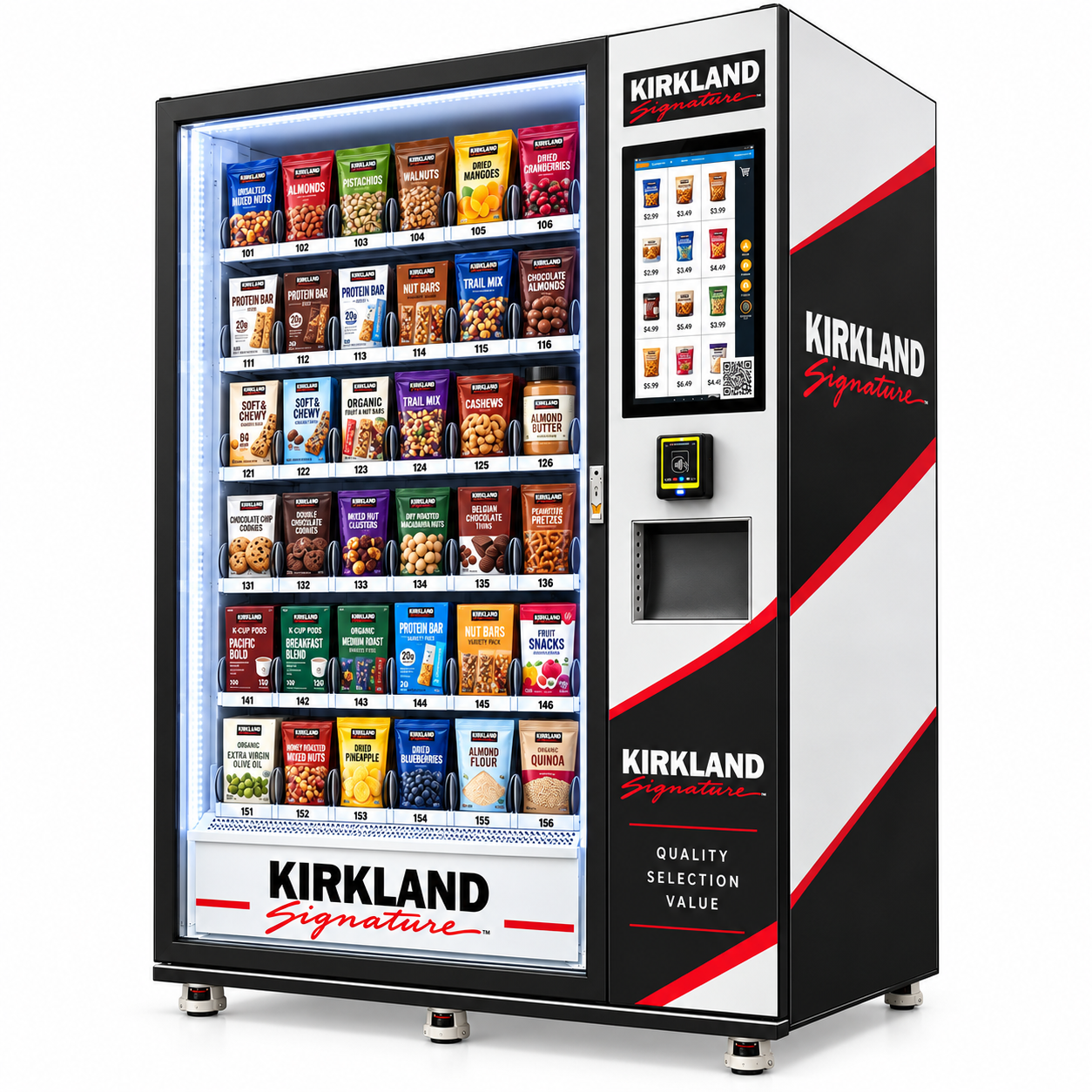
Right perspective / Packaged-goods retail concept
SMART ELEVATOR DELIVERY / RETAIL EFFICIENCY / OWNERSHIP PLANNING
02 / THE OWNERSHIP ADVANTAGE
More retail opportunity, with a focused operating model.
A curated convenience offer can extend an existing retail or service location without reproducing a full store. For equipment buyers, the strongest case connects relevant products, a practical replenishment route and a clear customer-support process.
Develop an additional purchase occasion
Reach customers at an approved workplace, residential property or retail location with a focused selection of useful packaged goods. Test whether convenient availability creates incremental sales before committing to a wider deployment.
Compare new sales with any displacement of your existing counter or shop.
Focused staffing requirements
Self-service selection and collection can reduce the need for a dedicated cashier at the machine. Staff still replenish stock, answer questions and manage exchanges, so the benefit comes from how the installation fits an existing service route.
Compare total paid operating hours with a realistic alternative retail arrangement.
A clear and confident presentation
Specify a product window and customer interface that make package identity, quantity and price easy to understand. A disciplined assortment can reduce decision effort and help customers recognise the value of an individual purchase.
Display lighting, screen format and final cabinet appearance are configuration items to approve.
An approachable expansion model
A single installation can serve as a controlled pilot for a new customer group or location. Begin with a defined assortment and a measurement period, then use actual demand and servicing effort to decide whether another unit is justified.
Approve expansion against contribution and operating evidence, not machine count alone.
Supported delivery for approved packages
The confirmed smart elevator supports the retail unit during the elevator stage of collection. Matching package dimensions and weight to the transfer route can help preserve presentation and provide a considered handover for suitable goods.
Approve the complete release, transfer and pickup sequence with actual sealed samples.
A recognisable black, white and red presentation
The supplied views show contrasting cabinet panels, red diagonal graphics and an illuminated merchandise window. The portrait selection screen and separate terminal organise the purchase area beside the front collection opening.
Approve final artwork and machine configuration; the reference does not establish brand endorsement.
03 / THE ASSORTMENT AND MARGIN MIX
Useful products. Clear portions. A measured margin mix.
Explore the commercial levers that matter to an equipment buyer. Each connects an operational choice to a measurable business outcome.
Match the location to a real need
Choose an assortment around the people using the site and the reasons they would buy there. A familiar product name can support recognition, but repeat sales depend on useful availability, appropriate pricing and dependable fulfilment.
Measure qualified demand and retained purchases during the pilot.
More relevant selling hours
The machine can support self-service purchases during the hours permitted by the site and operating plan. Additional availability may help capture demand outside a staffed counter's schedule when power, stock and customer support are maintained.
Extended access is a site decision; uninterrupted 24-hour availability is not assumed.
A focused snack and pantry assortment
The images suggest nuts, dried fruit, bars, cookies, coffee products and selected pantry goods. Choose approved sale units around local demand, storage requirements and package testing. The artwork is an assortment concept rather than a verified supplied-stock list.
Confirm labels and pack counts; illustrated warehouse packs and jars need individual handling approval.
Make quantity and ingredients clear
Show the exact product, net quantity and pack count for each selection. For food, provide applicable ingredient, allergen and date information through an appropriate customer-facing process so the offer is understood before payment.
Avoid implying that a single unit contains the whole original multipack.
Operating routes that make sense
Combine inspection and replenishment with existing site visits where practical. The potential labour advantage depends on travel time, refill frequency and the amount of customer support required, not simply the absence of a cashier.
Include driving, parking, administration and support time in the cost model.
A repeatable rollout decision
Use one site's results to create an evidence-based deployment brief: demand, contribution, product availability, service hours and technical issues. That record helps compare future locations on a consistent basis.
A successful pilot supports a decision; it does not guarantee the same return elsewhere.
04 / SMART ELEVATOR DELIVERY
A premium purchase deserves a considered handover.
Follow the purchase from an accurately described sale unit to collection. Smart elevator delivery is confirmed; interface details, payment functions and exception controls should be specified for the supplied machine.
01 / Select an exact sale unit
The customer selects an accurately described packaged item. The menu should identify the flavour or variant, net quantity and number of units included, with a photograph or description matching the stock position.
Keep customer information aligned when suppliers change packaging or recipes.
02 / Review price and pay
Present the complete selling price and relevant customer-help information before checkout. Specify the required payment services for the destination, including supported currencies and the process for a declined or interrupted transaction.
Payment terminal type, provider fees and settlement terms require confirmation.
03 / Transfer the sealed item
The selected item moves from its stock position to the elevator platform. Flexible pouches, rigid cartons and bottles can behave differently; approve the actual package and its orientation rather than relying on a category name.
Test the smallest and largest sale units, including weight distribution and transfer clearance.
04 / Carry toward collection
The elevator supports the retail unit during its travel toward pickup. The final equipment determines movement, sensing and control details; exterior images do not establish travel speed or a particular detection system.
Specify delivery performance and verification in the acceptance plan.
05 / Present the unit
The customer retrieves the purchase through the configured collection opening. Confirm that the approved package fits comfortably and that instructions explain when access is ready and how to remove the item.
Verify the largest approved package and delayed-collection behaviour.
06 / Support exceptions
Define what happens when payment succeeds but the expected handover does not finish. A documented customer-help and transaction-review procedure protects the buyer's reputation and gives the operator a repeatable response.
Agree delivery records, refund responsibility and fault escalation before launch.
05 / PERFORMANCE THAT MATTERS
Specify performance around the goods you will sell.
Protect the investment by translating the retail idea into measurable acceptance requirements. The right test is a complete customer purchase with the products you intend to sell.
Package compatibility by sale unit
Check dimensions, weight, rigidity and balance for every proposed retail package. Confirm that storage, release, elevator support and pickup clearance suit the complete unit, including any protective outer packaging.
Request documented package limits and rated loads for the final machine.
Repeatable delivery
Run repeated purchase cycles across the relevant stock positions and package variants. Inspect successful completion and the condition of the merchandise, then agree how failures are recorded and corrected before acceptance.
Use agreed test conditions and a documented success criterion, not an invented reliability percentage.
Accurate fulfilment protects trust
The selected flavour, pack count and product variant must match the delivered item. Align the menu, stock-position label and loaded package after every refill to reduce avoidable refunds and customer dissatisfaction.
Include catalogue changes and mixed-product replenishment in operator training.
Transaction continuity
Check successful and declined payments, interrupted connectivity and the agreed restart process. These scenarios help define the customer experience and the operator's response when normal trading is interrupted.
Confirm which controls and transaction records the supplied system actually provides.
Readable product information
Specify screen readability, price clarity and collection instructions appropriate to the site. Test under real lighting and review customer reach, package retrieval and any food information that must be available before purchase.
The final interface and display arrangement need a customer-facing acceptance review.
Installation and serviceability
Confirm floor space, access route, electrical supply, environment and service clearances from the final model documentation. An installation that is easy to replenish and service can reduce recurring disruption and unnecessary site visits.
Record dimensions, power and ambient limits in the signed technical specification.
06 / THE MACHINE GALLERY
Three views. One distinctive retail presence.
Explore the front and both angled references. Compare product visibility, the customer selection area and the black, white and red cabinet identity. Printed prices and visible facings are illustrative; capacity and supported sale units depend on the final approved layout.
Right perspectiveFront elevationLeft perspective
Right perspective / Packaged-goods retail concept
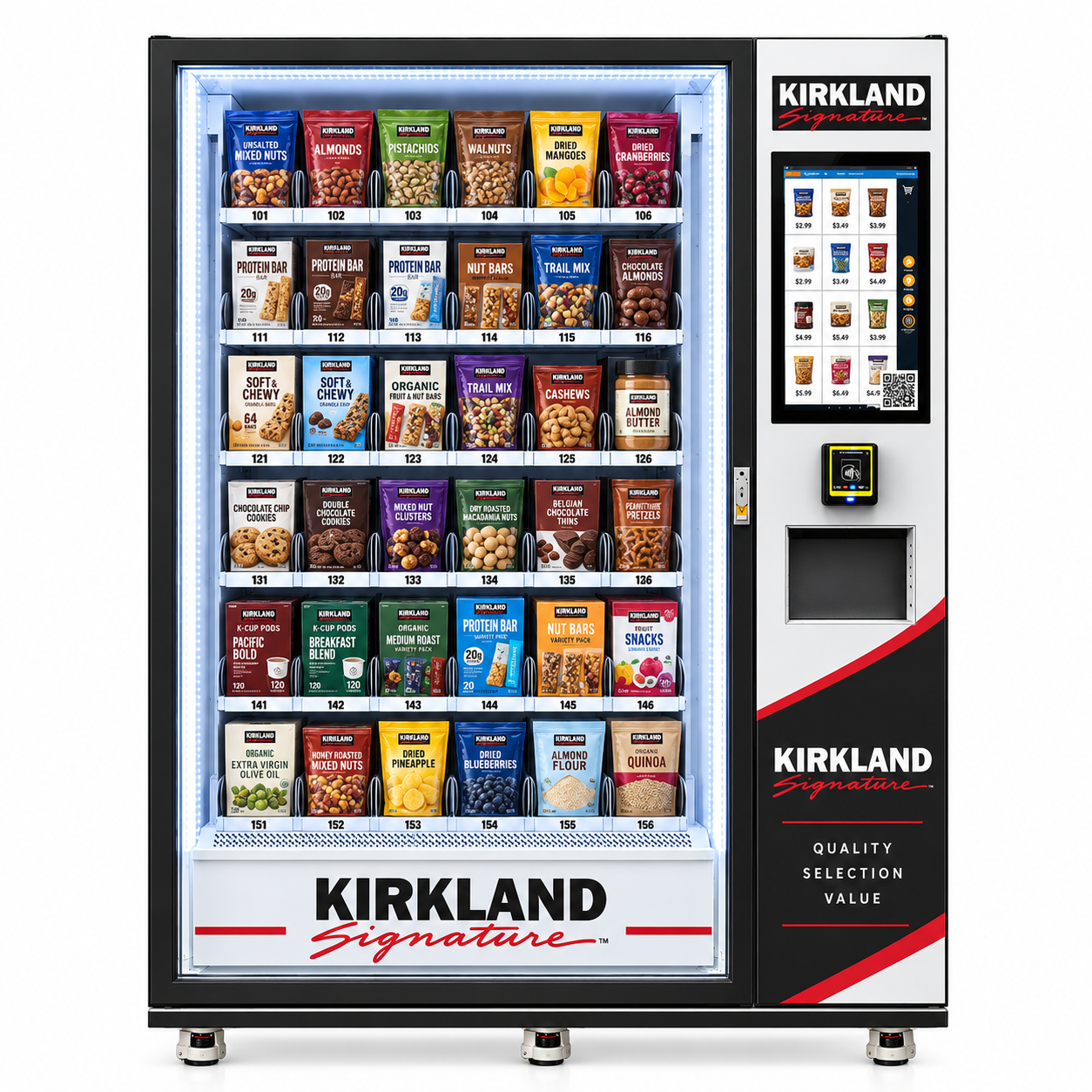
Front elevation / Packaged-goods retail concept
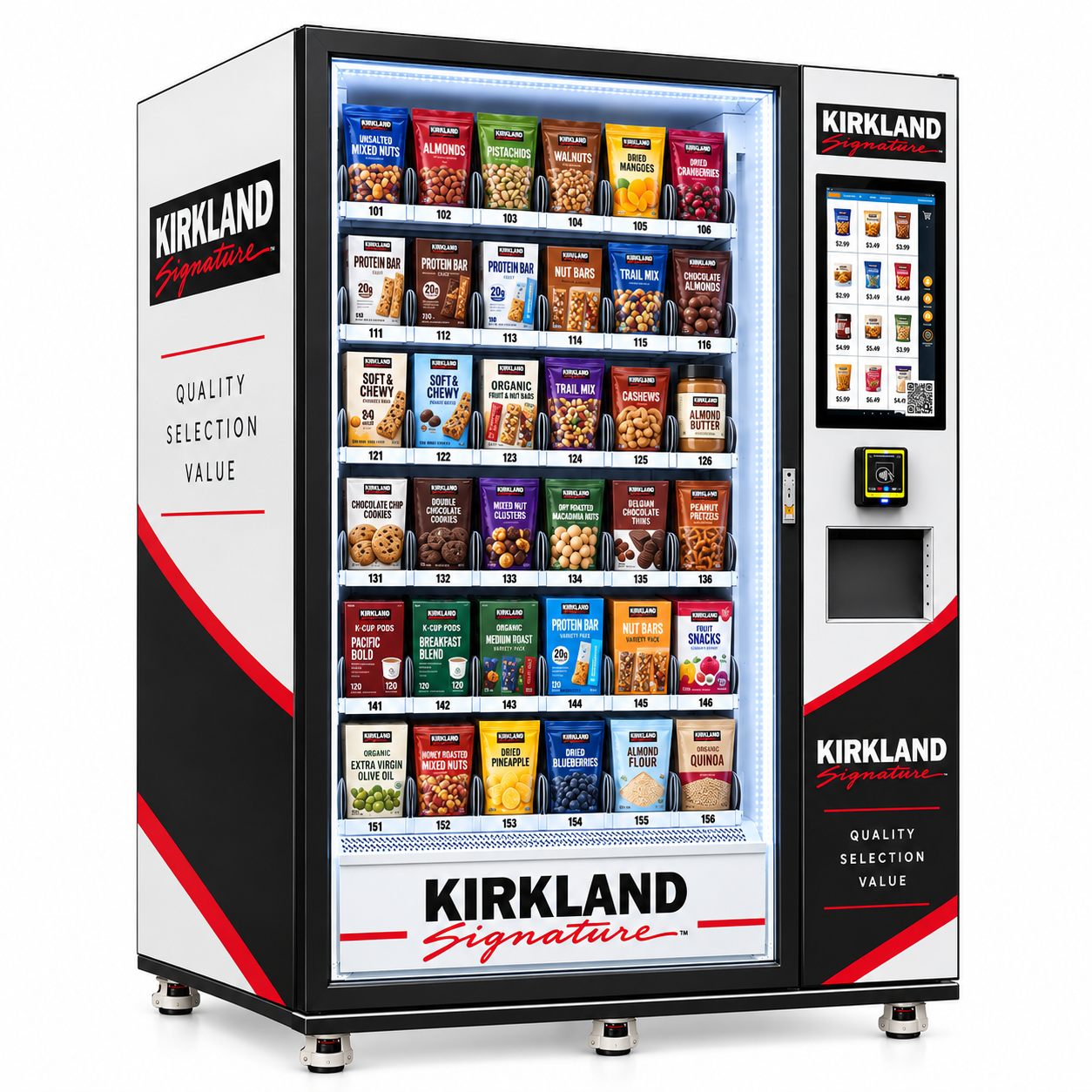
Left perspective / Packaged-goods retail concept
07 / BUYER PROTECTION AND SERVICE
Make support part of the purchase specification.
A dependable ownership plan includes more than the cabinet. Use these service workstreams to define the deliverables and commercial protections you need in the final supply agreement.
Pre-order configuration review
Ask for a written review of the proposed packages, site and payment requirements before approving the machine configuration. Identifying a mismatch early can avoid an unsuitable stock layout or a costly installation change later.
Agree who approves samples and which drawings form the order specification.
Documented acceptance
Create a clear checklist covering appearance, functions, approved packages and complete purchase cycles. A shared acceptance record gives buyer and supplier a concrete reference for resolving outstanding items before handover.
Define test scope, evidence and the treatment of unresolved defects in the agreement.
Operator training plan
Request training on stocking, catalogue mapping, cleaning, routine checks and transaction exceptions. Good handover materials help the buyer's team maintain correct product availability and respond consistently to customer questions.
Confirm format, language, attendees and whether installation support is included or separately priced.
Separate machine service from merchandise care
Agree machine warranty scope, exclusions, repair routes and spare-parts support in writing. Separately assign responsibility for damaged stock, date rotation, product complaints and refunds so each issue has a clear owner.
Food and merchandise handling obligations remain part of the operator's business process.
Technical support and escalation
Agree support channels, operating hours, response expectations and the route from remote diagnosis to on-site action. A structured process can help the operator resolve faults efficiently without promising a response time that has not been contracted.
Identify responsibilities for the equipment, payment terminal and network service separately.
Parts and lifecycle planning
Request a recommended spares list, maintenance guidance and an explanation of software or service fees. Understanding replacement parts and recurring costs helps the buyer evaluate ownership over the planned operating life.
Confirm availability, lead times and costs for the exact supplied model.
08 / LOCATION STRATEGY
Match the purchase occasion to the installation.
Select a placement where the proposed products meet an everyday need and the operating route is practical. Evaluate access hours, site costs, refill travel and customer support before funding the installation.
Workplaces and business parks
An approved workplace may support convenient snacks or selected essentials for a known audience. Choose the range from actual user needs and compare sales with the cost of access, servicing and any existing food or retail provision.
Agree site permissions, permitted products and access arrangements with the property operator.
Residential and mixed-use properties
A permitted common area can provide a convenient purchase point close to residents. Pilot a focused range and assess repeat demand, collection access and the support needed outside normal office hours.
Compare contribution after site charges and the cost of frequent small refills.
Hospitality and serviced accommodation
An approved guest area may suit a limited convenience offer when product quantities and pricing are clear. Stock products appropriate to the environment and ensure visitors can obtain help with a failed purchase.
Verify package suitability and avoid assuming all food products can be stored at ambient temperature.
Retail and service locations
A complementary retail property may create additional purchase occasions for suitable packaged goods. Use the machine to test a specific convenience gap and measure whether sales add to the existing business.
Review competition, audience and incremental contribution rather than footfall alone.
Events and temporary placements
A defined event period can test an assortment with a relevant audience. Include freight, setup, staffing, unsold stock and date-sensitive inventory in the budget so the result reflects the whole project.
Confirm trading permissions, utilities, storage conditions and removal arrangements.
Education and shared facilities
Where site rules permit the range, a shared facility may support repeat convenience purchases. Product eligibility, nutrition policies and customer information should be reviewed with the property before stocking.
A known audience supports testing; it does not establish a guaranteed sales level.
09 / INVENTORY, TRUST AND OPERATING CONTROL
Protect margin between the sale and the refill.
Manage the range as both a customer promise and a working-capital decision. Correct sale units, visible product information and disciplined rotation help protect contribution between replenishment visits.
Product and batch records
Maintain separate records for each product, flavour, net quantity and pack count. Keep supplier and relevant batch information so stock movements can be reconciled and affected goods can be identified when a product issue arises.
Confirm available software fields and define supplementary manual records where needed.
Control dates and tied-up cash
Order to actual demand and use a suitable date-rotation process, including first-expiring-first-out where relevant. Review slow products before dates become a loss and compare a bulk buying discount with the cost of holding excess stock.
Count expected spoilage and markdowns in contribution; low unit purchase cost alone is not profit.
Refill the correct sale unit
Check product, flavour, package quantity and remaining saleable life against the position guide. Inspect seals and package condition before loading, and keep products outside the approved storage requirements out of the range.
Test a representative purchase after material catalogue or position changes.
Resolve complaints consistently
Publish a practical help route for failed delivery, damaged packages and product enquiries. Define evidence, refund responsibility and the process for isolating affected stock so staff can respond without repeated improvisation.
Budget refunds, disposal and customer-service time without counting the same loss twice.
Price and contribution control
Review realised selling price after promotions and the true landed cost of each unit. Add transaction costs and a reasonable returns allowance to understand contribution rather than relying on a headline retail margin.
Separate sales tax collected for authorities from operating revenue as applicable.
Source and store with traceability
Keep purchasing records and relevant batch details, inspect seals and follow each product's storage instructions. Plan how to remove an affected SKU from sale and trace remaining stock if a supplier issues a recall.
Automatic batch tracking and remote sale blocking depend on the agreed software; manual processes may be required.
10 / INVESTMENT AND RETURN
Understand the route from revenue to payback.
Compare illustrative convenience-retail scenarios, then replace every input with your actual assortment and site costs. A high stock turnover can still produce weak profit when landed costs, payment fees, waste and servicing are overlooked.
An illustrative convenience-retail case
Hypothetical USD assumptions: weighted-average retained sale $5; landed product cost $2.60; payment fee 3% or $0.15; waste and support allowance $0.25. Unit contribution is $2 before monthly fixed costs of $600. Assume installed equipment capital of $10,000 and opening stock of $1,000: total initial cash $11,000. These are planning inputs, not equipment quotations, actual Kirkland product margins or sales forecasts.
| Monthly result | 300 sales | 600 sales | 900 sales |
| Net sales | $1,500 | $3,000 | $4,500 |
| Contribution before fixed costs | $600 | $1,200 | $1,800 |
| After fixed costs | $0 | $600 | $1,200 |
| Simple cash recovery | No payback | 18.3 months | 9.2 months |
The decision thresholds
Operating break-even is $600 / $2 = 300 retained sales per month, or 10 per day over 30 trading days. Recovering the illustrative $11,000 within 24 months requires at least 530 monthly retained sales at the same contribution and fixed costs.
Simple cash recovery divides initial equipment and stock funding by positive monthly operating contribution. It excludes financing, income tax, depreciation, ramp-up, changes in working capital, residual value and discounting. A break-even operation does not recover the initial investment.
Use weighted averages based on actual category sales. Include rent, travel, refill labour, software, connectivity, electricity, maintenance and insurance in the appropriate cost inputs. Include waste and unrecovered return costs once; do not subtract both the full returned sale and the same refund allowance.
A bulk purchase discount is useful only when the stock can be sold at adequate contribution before it becomes unsuitable. Compare savings with shelf-life exposure, cash tied up in inventory and additional refill visits. Review downside demand before committing to further machines.
Configuration and service procurement checklist
| Smart elevator delivery | Confirmed for this requested configuration; transfer, sensing and collection controls to be specified for the supplied model. |
|---|---|
| Visible customer interface | The supplied images show an illuminated merchandise window, portrait screen, separate terminal and front pickup opening. Enabled payment and software functions require confirmation. |
| Approved sale units | Each pouch, carton, bottle or other package needs approval for dimensions, weight, transfer behaviour and collection clearance. |
| Stock capacity | To be calculated from approved packages and final layout; visible labels and facings do not establish usable capacity. |
| Delivery performance | Agree test cycles, representative positions, package-condition criteria and handling of incomplete deliveries. |
| Payment configuration | Provider, currencies, services, transaction fees, connectivity and settlement to be confirmed for the destination. |
| Software and connectivity | Catalogue fields, inventory records, remote functions and recurring fees to be specified, not inferred from screen imagery. |
| Dimensions and electrical supply | Final footprint, weight, service clearances, voltage, plug and rated power require model documentation. |
| Environment and protection | Permitted ambient conditions, indoor or outdoor suitability and security features to be confirmed for the actual installation. |
| Service and warranty | Training, documentation, coverage duration, exclusions, response arrangements and spare parts to be agreed in writing. |
| Product information and rotation | Confirm sourcing records, applicable labels, allergens, batch records and shelf-life procedures for the approved assortment. |
11 / BUYER QUESTIONS
Clear answers for a better equipment decision.
Use the question index to explore performance, ownership costs, support arrangements and the conditions behind a realistic return.
What is the main commercial advantage?
The machine can create an additional self-service retail point with a focused assortment and a different staffing pattern from a conventional counter. The benefit depends on relevant demand, site costs, product availability and the servicing plan; it should be measured through a pilot.
Is smart elevator collection included?
Yes. Smart elevator delivery is the confirmed requirement. Ask the final proposal to describe product release, transfer to the platform, movement and collection access, and verify the complete sequence with the actual sealed retail units you will stock.
Can warehouse multipacks be sold through the machine?
Only if the intended sale unit is suitable. An entire multipack may exceed package limits, while individual internal units may lack information required for separate sale. Approve dimensions, labelling and sourcing for the exact customer purchase before stocking.
Will every Kirkland Signature package fit?
No. Products vary substantially in dimensions, weight and package behaviour. Send sealed sale-unit samples for storage, release, elevator and pickup checks. Recheck new package revisions and substitutions before loading them.
Can food and everyday essentials share a range?
Consider only products whose packaging, storage and handling requirements suit the agreed configuration and operating process. Review separation needs, odour, leakage and product information. Do not assume that all food and non-food goods should be combined in one machine.
Is this an official Costco or Kirkland Signature machine?
No official affiliation or endorsement is established by this proposal. Confirm genuine sourcing and the permitted use of brand names and artwork for the intended project. The machine purchase does not include a Costco relationship or a merchandise supply agreement.
How reliable is dispensing?
No tested reliability percentage has been provided. Specify repeatable purchase tests with approved packages and representative positions, agree acceptance criteria and document exceptions. Correct item fulfilment and merchandise condition matter as well as mechanical completion.
Can it operate without staff?
It can support self-service transactions in the agreed configuration, but stocking, cleaning, customer help, returns and maintenance still need assigned responsibilities. Model the actual hours and travel required rather than assuming a labour-free operation.
What service protection should an equipment buyer request?
Ask for a written equipment support scope covering installation guidance, training, fault triage, parts availability, warranty exclusions and response arrangements. Establish merchandise warranty and customer-return handling separately. Exact coverage and timing must be agreed in the proposal.
Can remote inventory tools be provided?
Include the functions you need in the software brief. Remote stock information, alerts, reports and catalogue editing require confirmation of the supplied platform, connectivity and fees; they cannot be assumed from the screen design.
What is the expected payback period?
Use installed equipment cost, opening inventory and actual operating contribution to calculate a scenario. The examples on this page are illustrations, not forecasts. A location with negative contribution has no operating payback under those assumptions.
What costs are easy to overlook?
Include freight, duties where applicable, installation, stock funding, rent, payment fees, software, connectivity, power, insurance, servicing labour and returns. Model financing and tax separately where relevant and avoid counting the same cost twice.
How should dates, waste and recalls be handled?
Define date checks and rotation at each service visit, stop selling unsuitable stock and keep appropriate batch and supplier records. Assign responsibility for complaints and recalls. Include expected waste in the commercial model and confirm which stock controls are available in the software.
Can it trade 24 hours a day?
Only where site access, permissions and the operating arrangements support it. Power, stock availability and technical condition also matter. The machine concept does not establish continuous availability or a guaranteed uptime level.
Does this configuration include refrigeration?
Only smart elevator delivery is confirmed. Refrigeration and temperature monitoring are not established. Select goods compatible with documented storage conditions, or request a separately verified refrigerated configuration before considering chilled products.
What should a buyer send for a proposal?
Send destination, quantity, sealed sale-unit samples, dimensions, weights, storage requirements, product mix and site conditions. Add desired payments, support expectations, operating costs and pilot objectives so the proposal can address both equipment fit and ownership economics.
12 / THE PROCUREMENT BRIEF
Build an everyday retail channel with a clear business case.
Bring the real retail packages, the site economics and the service requirements. A detailed brief supports a more accurate configuration proposal and a more useful investment comparison.
Define the actual merchandise
Provide the approved sale-unit list, quantities, sources, sealed samples and package dimensions. Include storage instructions, label requirements and remaining shelf-life targets for any date-sensitive products.
Kirkland Signature naming does not establish endorsement or supply through a particular retailer.
Define the site economics
Record rent or revenue share, trading hours, relevant visitors and the cost of accessing the site. Include delivery, installation and any property-specific obligations in the initial investment estimate.
Use written site terms and a conservative demand scenario.
Define the technical acceptance
Agree the approved packages, purchase sequence, item mapping and exception tests. Specify the required documentation and evidence so both parties understand what successful handover means.
List measurable requirements without substituting unverified headline performance claims.
Define the support package
Request explicit warranty scope, training, technical support and spares arrangements. Separate included deliverables from optional services and recurring charges so the ownership budget reflects the actual offer.
Support terms should be written into the final proposal and agreement.
Define the pilot review
Set a review period and measure sales by SKU, contribution, stock ageing, waste, returns, downtime and service hours. Decide what evidence would justify changes to the range, relocation or another machine.
Avoid expanding on gross revenue alone.
Request a project proposal
Share destination, quantity, approved product samples, site information and payment requirements with WEIMI. Ask for an itemised equipment and support quotation that can be compared against the same operating assumptions.
Final price, lead time, supply scope and commercial terms are confirmed in the quotation.
Continue your WEIMI visit
Explore the wider WEIMI equipment collection to compare retail formats for a different merchandise brief.
Browse vending equipmentRead the company introduction as you prepare supplier and project discussions.
Learn about WEIMIContinue to the general FAQ for additional company and equipment enquiry information.
Explore general questionsShare the assortment and destination through the contact page to begin a configuration discussion.
Discuss your everyday retail projectKirkland Signature and Costco names identify the proposed merchandise concept. No official endorsement, affiliation or merchandise supply agreement is claimed.