Make the offer visible
Present a focused range of approved, sealed cosmetics and skincare packs. Keep product names, sizes, shades and screen prices aligned so customers know exactly what they are buying.


An iridescent beauty & cosmetics vending machine for the moments between appointments, trips and plans.
Give customers a clear view of your beauty essentials, then let them choose at the screen. For your business, the opportunity is simple: a compact self-service offer with a product mix, refill plan and margin you can actually manage.
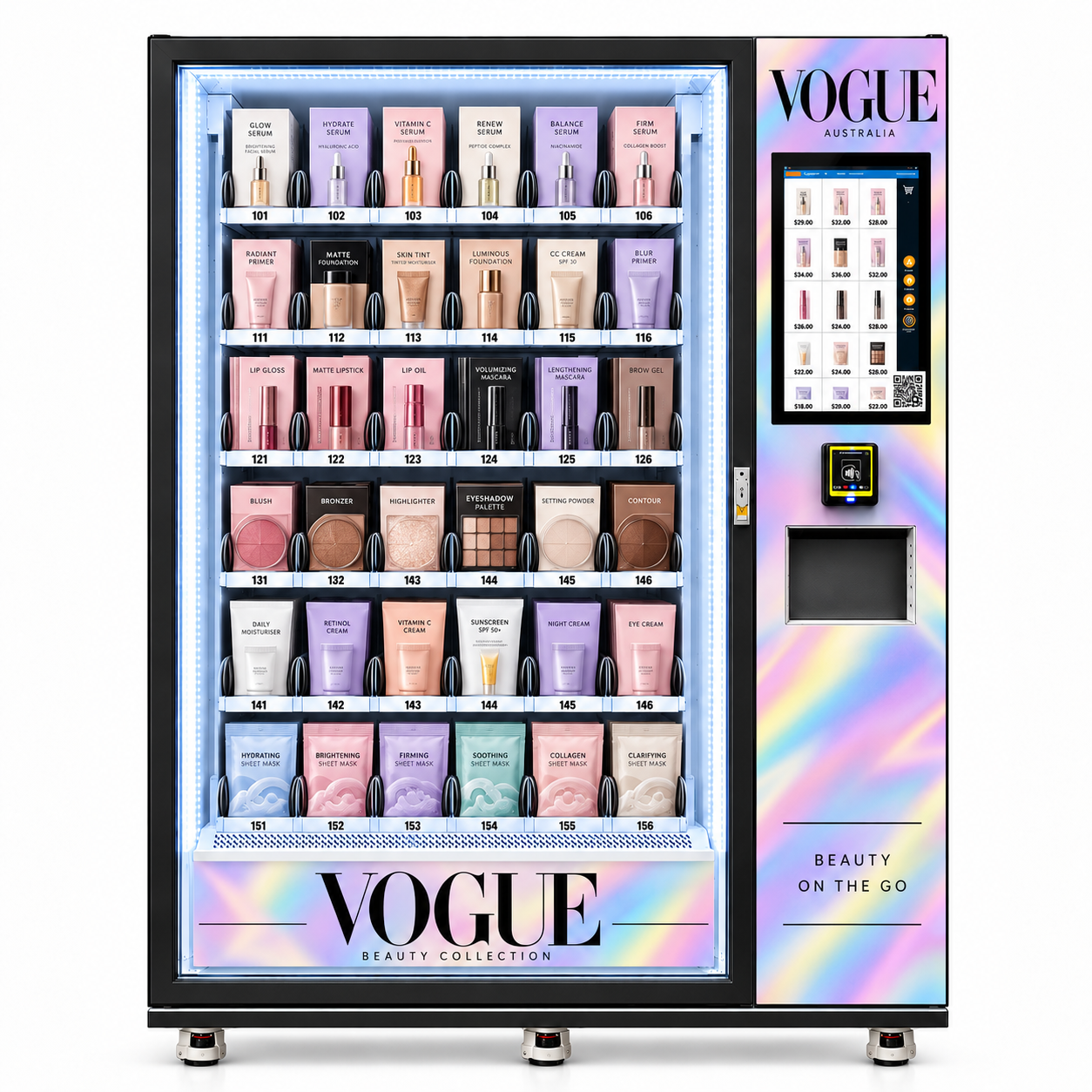
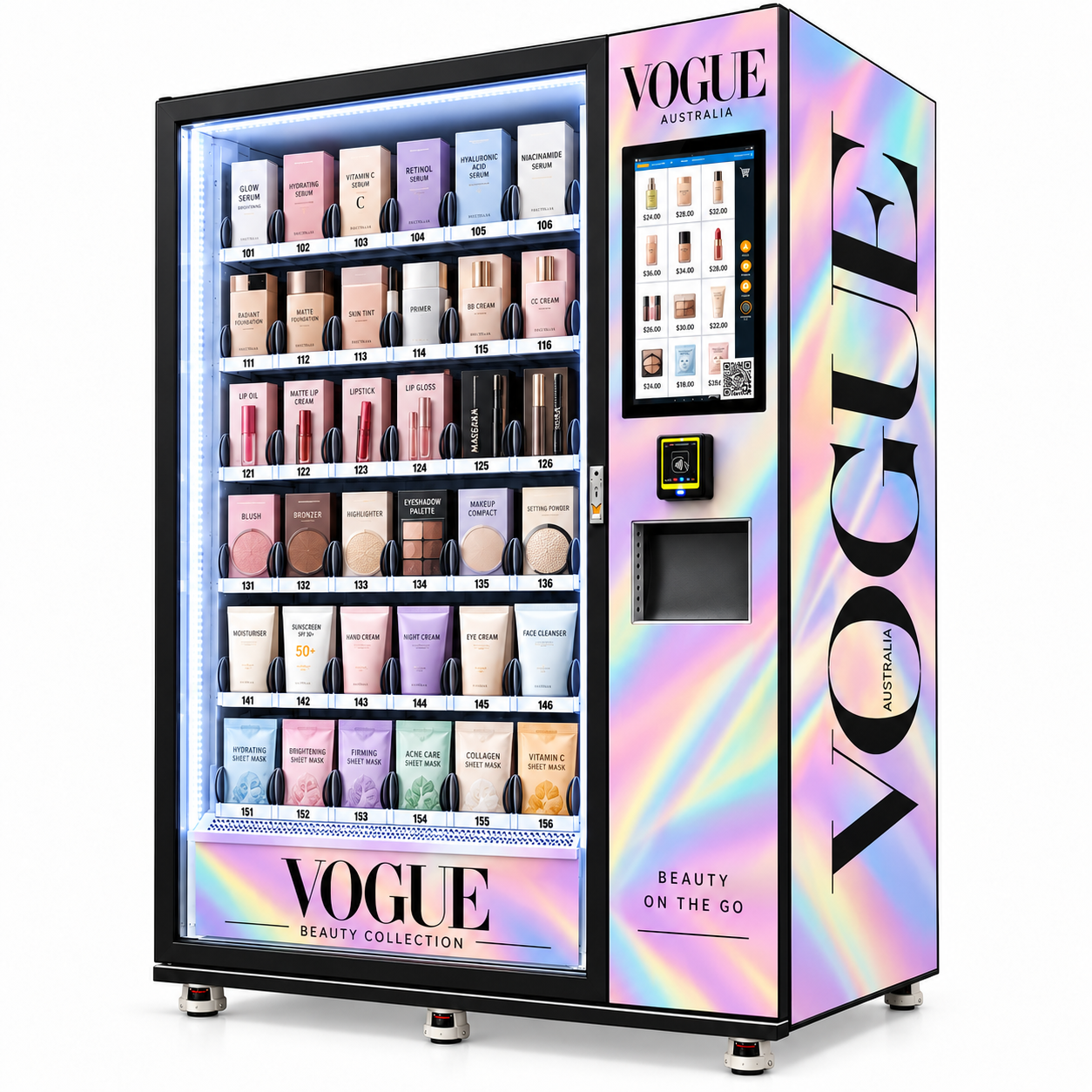
Illustrated cabinet and merchandise. Final machine specifications, software and payment configuration are agreed in your quotation.
The machine gives your assortment a place to sell.
A forgotten lip product, a travel skincare need or an evening touch-up can be a useful reason to stop.
The large illuminated merchandise window lets people see the packs before they use the screen.
Self-service can handle straightforward purchases while your team focuses on replenishment and customer support.
A higher selling price is useful only if it leaves enough after product cost, payment charges, venue fees and servicing.
The supplied artwork combines soft rainbow reflections with a sharp black cabinet frame.
Use the display as your physical menu.
The illustrated selection screen, payment terminal and right-side collection opening create a recognisable sequence for the customer.
Use the iridescent visual direction as a starting point for your own brand artwork, venue messaging and customer support details.
Open each original image for a closer look at the display, side artwork and customer interface.
The pictures show six rows with six front display positions per row. This is a visual layout of 36 positions, not a verified stock capacity. Pack depth, lane configuration and the approved product determine the quantity the machine can hold.
Choose a product family to explore its commercial role and practical fit.
Boxed skincare can give a consistent front face and space for the label.
Check bottle material, cap security, glass protection, pack weight and storage instructions.
Use volume, formula and brand in the screen title.
Foundation, primer and tinted products appear in the renderings.
Test tubes and bottles separately.
Offer a carefully edited shade range matched to your customers.
Lip products and eye cosmetics suit a compact selection, but thin packs can be difficult to retain and dispense without a tested outer pack.
Check minimum pack dimensions, lane guides, centre of gravity and the whole collection path.
Use sealed retail units with unambiguous colour, finish and product names.
Blush, bronzer, powder and eye palettes are pictured.
Validate the actual retail pack through repeated paid test vends and inspect for cracks, loose powder, damaged hinges and opened seals.
Keep the outer packaging and product identification together.
Moisturisers, hand creams and related packs can cover everyday needs near travel, work or leisure destinations.
Read the product storage requirements and compare them with verified machine and site conditions.
Use the correct volume, ingredients and manufacturer instructions where relevant.
Sheet masks and travel formats give the bottom row a colourful offer in the images.
Check support, spacing, sagging, snagging and seal clearance.
State how many items are included.
The visible spirals suggest a lane-based vending arrangement.
That is the practical question to answer before comparing prices on the cabinet. Ask for a sample-based demonstration rather than relying on a generic product category name.
Keep each step obvious.
The customer notices the cabinet and reads the offer.
The pictured portrait screen shows product images and prices.
An independent terminal appears below the screen.
The right-side opening is the illustrated collection point.
A visible support contact lets the buyer report a missing item, pack issue or payment query.
Connected management is most useful when each piece of information changes a decision.
A sales view by product, selection and time period can help you decide which products deserve stock.
Replace a guess such as “the pink packs seem popular” with records of paid units, prices and time periods.
Ask to see sale timestamps, product/selection identifiers, quantities and the method of exporting records.
A supported remote stock view can show estimated remaining inventory and help plan replenishment.
Prepare the right packs before a visit.
Request a demonstration of refill entry, correction, sold-out behaviour and a configurable low-stock alert if offered.
Software counts are only as good as the events and updates behind them.
Product naming, photos, prices and selection mapping are useful management functions to request.
A controlled update process makes it easier to introduce an approved seasonal product or correct a price without creating a mismatch between display and checkout.
Use a spare test listing to show a price/image update.
Remote editing does not make a new pack mechanically suitable.
Connection and fault information, where fitted and included, can help your team decide which issue needs a visit.
A useful alert names the machine, describes the issue and points to an action your team can take.
Demonstrate a disconnected machine and an agreed representative error.
Online status alone does not confirm that every product is saleable or correctly stored.
If the platform supports account roles, use separate permissions for replenishment, pricing, finance and service.
A replenisher may only need stock tasks, while finance needs settlement records.
Show account creation, role changes and the available activity history.
An activity log, two-factor sign-in or API integration should be treated as included only when shown and agreed.
If your project will grow, confirm how the platform organises multiple machines, products and sites.
Compare contribution after site-specific costs.
Demonstrate two machines in the account and show how products, prices and stock stay attached to the right site.
Start with one location you can manage well.
A repeatable visit protects presentation, stock accuracy and customer confidence.
Try your own planning assumptions.
These are editable planning assumptions in the original calculator, shown here as a transparent fixed example for the basic editor. Use one currency and a consistent tax basis.
| Selling price / paid unit | 18.00 |
|---|---|
| Product and inbound cost / unit | 8.00 |
| Payment fee | 2.5% + 0.15 per unit |
| Venue revenue share | 10% |
| Loss and refund reserve / unit | 0.50 |
| Contribution / paid unit | 7.10 |
| Paid units / day · selling days / month | 8 · 30 |
| Monthly revenue | 4,320.00 |
| Monthly fixed operating costs | 450.00 |
| Monthly operating surplus | 1,254.00 |
| Break-even paid units / day | 2.12 (rounded upward) |
| Initial cash investment · simple payback | 9,000.00 · about 7.2 months |
Examples do not establish actual demand or income. Surplus is before tax, finance and depreciation. Simple payback assumes the same surplus continues.
Contribution per unit = price − product/inbound cost − price × payment fee % − fixed payment fee − price × venue share % − reserve per unit. Monthly operating surplus = contribution × paid units per day × operating days − monthly fixed costs.
Break-even units per day = monthly fixed costs ÷ contribution per unit ÷ operating days, when contribution is positive. Simple cash payback = initial cash investment ÷ positive monthly operating surplus. It assumes that surplus continues unchanged; it is not a dated investment forecast.
Keep every value on a consistent tax basis. Recoverable tax, financing, depreciation, working-capital timing and resale value are not modelled. Refunds need consistent treatment: do not count a fully refunded transaction as retained paid revenue and then charge the whole refund again as a reserve.
Fixed fees here are allocated per sold unit. If a transaction can contain several units, use the effective fee per unit from actual payment records. Add subscriptions or minimum merchant charges to monthly fixed costs.
Move the demand slider to compare a softer month with your current profit assumptions.
Using the example above, 168 paid units yield an operating surplus of 742.80 after 450.00 fixed costs. That is 511.20 less than the base month. At zero sales, the same fixed costs leave a loss of 450.00.
Estimate stock needs for one product using its own sales rate.
At 1.2 paid units per day, seven days until refill and a two-day demand buffer, the target is 11 usable units. With five already available, the suggested addition is six units. At a landed cost of 8.00 per unit, that addition ties up 48.00 in stock.
Target = round up(daily paid units × [days to refill + buffer days]). Addition = max(0, target − usable stock). Check approved lane capacity, storage conditions and remaining shelf life before loading.
Open a venue brief to compare the customer need, operating conditions and commercial question.
Guests may want a familiar, sealed product when shops are closed or a bag is missing something.
Travel sizes, approved skincare packs and a small range of familiar essentials are candidates.
Check lobby access, hotel opening arrangements, power, data and who responds overnight.
The iridescent cabinet can sit naturally within a beauty or fashion environment.
Consider familiar bestsellers, convenient small packs or an authorised brand selection.
Review rent, revenue share, permitted categories, retail operating hours and promotional restrictions.
Members may value a small, practical offer before or after an activity.
Hand care, travel skincare and selected sealed essentials may be candidates.
Choose a dry, suitable indoor position away from splashes and excessive humidity.
A clear selection can serve staff, residents or visitors who want a quick purchase without leaving the building.
Start with everyday needs and a modest number of variants.
Agree building access, delivery procedures, support signage and power/data responsibility.
A self-service point can complement an existing beauty business where customers already recognise the product range.
An authorised, consistent product assortment can keep repeat purchases straightforward.
Agree how screen prices relate to the venue’s other sales channels.
The cabinet’s finish can suit a planned beauty event.
Use a narrow assortment with approved packs and readable prices.
Check loading access, floor suitability, installation, connectivity, security, transport and collection after the event.
Use this table when comparing quotations.
| Item | Current evidence | Confirm in your quotation |
|---|---|---|
| Product type | Beauty, cosmetics and skincare vending machine concept. | Final model number and mechanical configuration must be stated in the order. |
| Visual finish | Iridescent pastel wrap with black cabinet framing. | Confirm final artwork, finish sample, material, print areas and the branding you are authorised to use. |
| Merchandise display | Illuminated window with six rows and six front positions per row in the supplied renderings. | This shows 36 display positions, not certified SKU count, stock capacity or an exact factory lane specification. |
| Dispensing layout | Spiral-style elements are visible around the products. | Confirm the actual drive, lane spacing, shelves, supported weights, guides and collection path. |
| Customer screen | Portrait-oriented product browsing screen shown on the right. | Screen diagonal, resolution, controller, software language and accessibility details are not supplied. |
| Payment equipment | Separate payment terminal pictured below the screen. | Confirm terminal model, supported payment methods, country, currency, merchant onboarding and all fees. |
| Collection opening | Right-side rectangular opening below the payment terminal. | Confirm delivery path, access dimensions, sensing and recovery procedures with actual packs. |
| Product capacity | No verified total unit capacity supplied. | Request capacity by approved pack and lane. |
| Dimensions & weight | Not supplied with the images. | Request crated and uncrated dimensions, mass, service clearance and access requirements before approving the site. |
| Electrical requirements | Voltage, rated input and measured energy use are not supplied. | Confirm local supply, earthing, plug, protective requirements and realistic energy consumption. |
| Storage conditions | No temperature-control performance is verified by the images. | Match actual ambient or controlled conditions to every cosmetic product. |
| Connectivity | Not identifiable from the images. | Confirm supported network options, signal requirements, offline behaviour and data/SIM responsibility. |
| Management platform | WEIMI’s beauty equipment category describes remote inventory. | Confirm stock, sales, alerts, catalog editing, accounts and exports specifically included for this model and software plan. |
| Outdoor suitability | No outdoor, ingress or corrosion rating supplied. | Plan a suitable indoor location unless a documented configuration expressly covers the intended environment. |
| Product protection | No specific anti-impact system or guaranteed glass/compact compatibility verified. | Ask for sample-based dispensing tests and acceptance conditions for delicate cosmetics. |
| Service & warranty | No model-specific warranty, response time or included spares list supplied. | Put coverage, term, exclusions, labour, shipping, support channels and spare-parts availability in writing. |
| Approvals & documents | No model-specific certificates supplied. | Request documentation applicable to the delivered build and destination. |
Use the checklist to review the practical jobs before installation.
POINTS REVIEWED
A short, agreed acceptance plan answers practical questions about the actual machine and your own products.
Load the least stable, most fragile or most awkward complete sale unit.
Choose the product on the fitted interface, verify the final price, pay through the chosen terminal and collect the correct intact retail unit.
Ask how declines, cancellations, interrupted connections and delivery failures are handled.
Record an opening count, add the approved pack, update stock and reconcile a physical count.
If the quoted platform includes this feature, change a test listing and show the matching item, image, price and selection at the machine.
Have the operating staff find the right manual, machine identifier, support contact and escalation route.
A well-defined support package protects time and operating continuity.
Start with the actual retail packs and location.
Review the cabinet layout, final print files, selected colours and access clearances before confirming production.
Request the manuals and training needed for loading, stock updates, cleaning, purchase checks and first-line issue reporting.
Agree the warranty term, covered parts, exclusions and claim process for the ordered machine.
Ask for routine maintenance instructions, recommended spare parts and availability for components relevant to your build.
Clarify account ownership, subscription renewals, updates, data export and the support route for remote management and connectivity issues.
A measured start gives you useful evidence before committing to a broader rollout.
Plain answers to common buying questions, with links to the relevant planning tools and machine details.
The supplied images show beauty and cosmetic retail packs: serums, complexion products, lip and eye products, compacts, creams, sheet masks and travel formats.
Explore the detail ↗Possibly, with a suitable configuration and approved packaging, but the pictures alone do not establish compatibility.
Explore the detail ↗A payment terminal is pictured.
Explore the detail ↗WEIMI’s beauty equipment category describes remote inventory.
Explore the detail ↗Accuracy depends on the controller’s event handling and the operator’s refill and adjustment records.
Explore the detail ↗Profit depends on paid demand, selling price, landed product cost, payment charges, the venue agreement, stock losses and operating work.
Explore the detail ↗The response depends on the fitted controller, sensing, payment integration and refund process.
Explore the detail ↗Send the destination, venue type, confirmed site constraints, preferred payment methods and complete retail pack samples or measurements.
Explore the detail ↗The best next conversation starts with your actual assortment and site.
List the exact products, sizes, variants and complete sale packs.
Name the country, venue type, location conditions and access hours.
Request the machine configuration, payment setup, software scope, artwork, shipping, installation, training and warranty as itemised lines.
For a skincare-led assortment, review WEIMI’s skincare equipment category alongside the pack and storage requirements described here.
Explore skincare vending machines ↗