


01Relevant occasions
Meet the gifting moment
Position an approved floral offer near a genuine gifting or home-decoration occasion.
Measure retained purchases and useful opening hours instead of relying only on pedestrian counts.
ANTHOS / THE FLOWER ATELIER
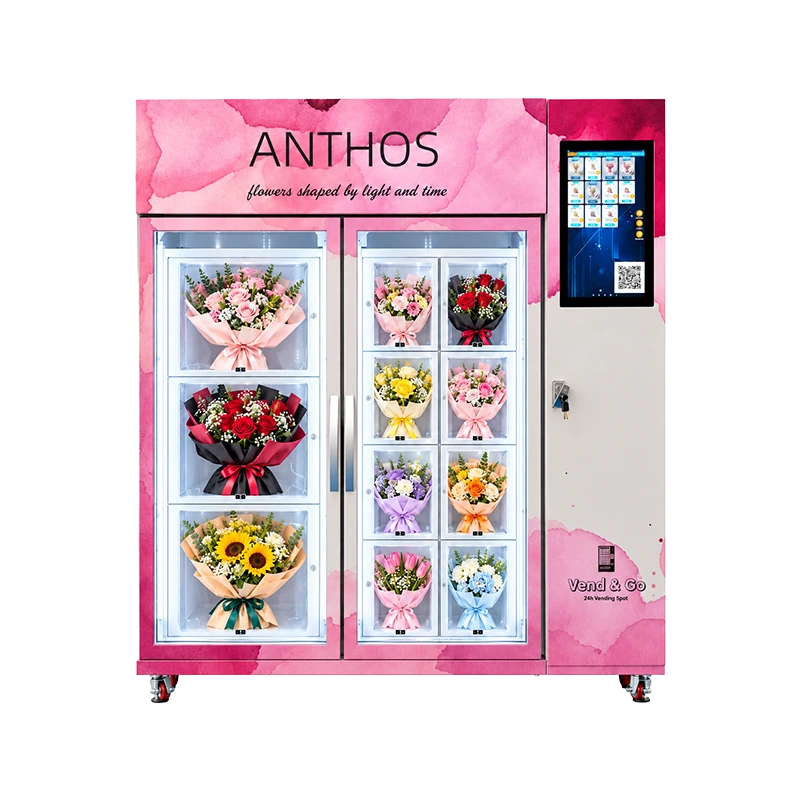
Bring a considered floral collection to an approved retail location. Watercolor-pink artwork, illuminated glazed display areas and a portrait selection screen create a distinctive concept for finished bouquets.
Evaluate additional gifting occasions, suitable opening hours and a replenishment route that fits the team. Compare contribution after stems, packaging, florist labour, quality losses and site costs.
Visible bouquet presentation
Approved package and retrieval testing
Florist-led care and stock rotation
Written training, warranty and support scope
Confirm climate control, capacity, collection mechanics, dimensions and payment services in the final proposal. No fixed freshness period or guaranteed return is implied.
Discuss your floral project →ANTHOS / THE AUTOMATED FLOWER ATELIER
Flower Vending Machine — a watercolor retail concept for florists and equipment buyers who want to connect beautiful presentation with a practical ownership plan.
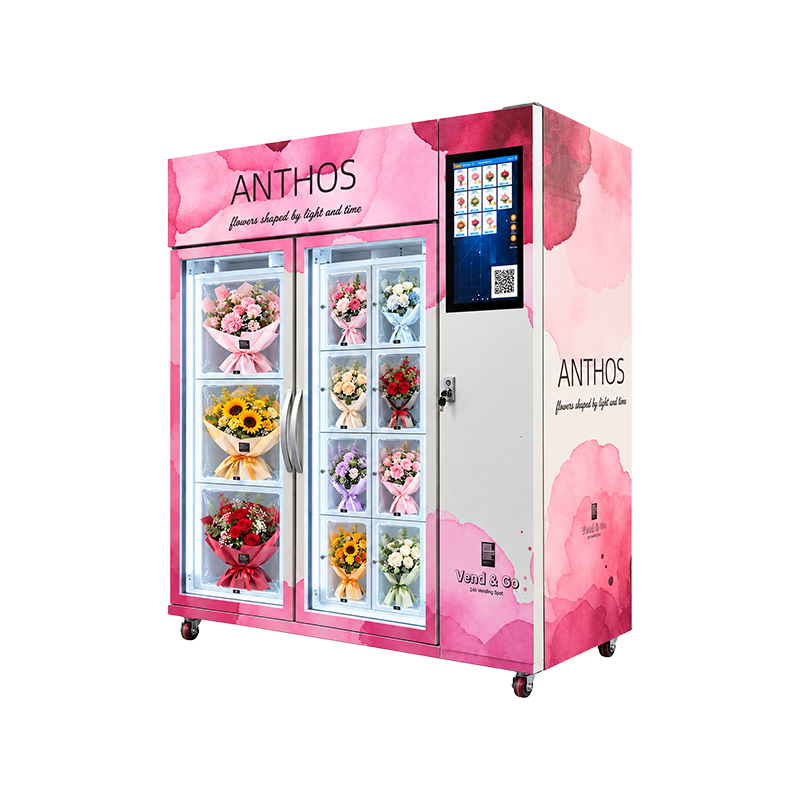
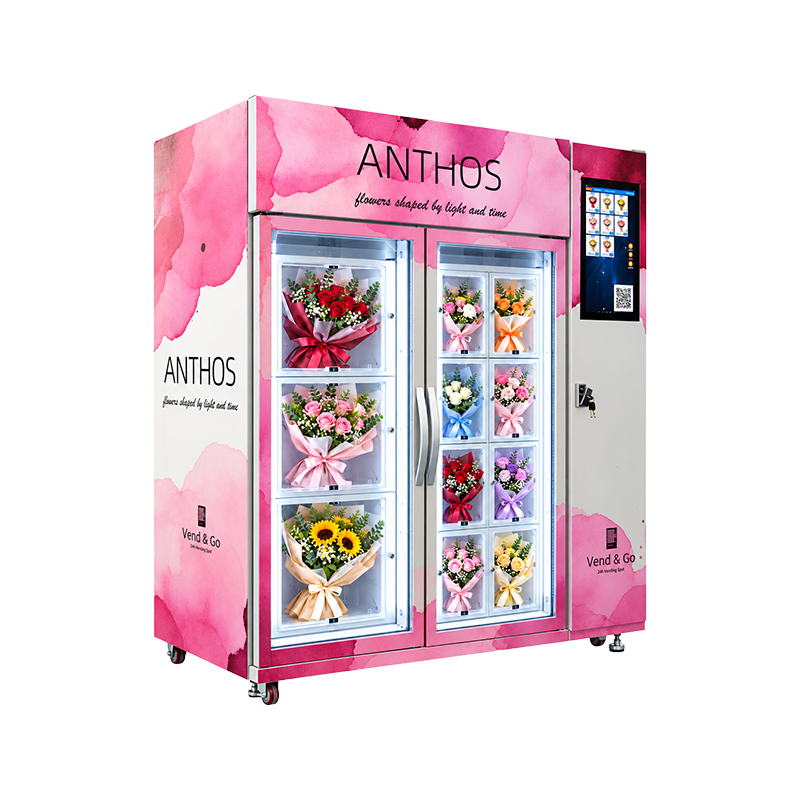
The cabinet diptych
The references show illuminated glazed display areas, varied bouquet sizes and a portrait screen. The cabinet illustration is a visual brief; confirm the final mechanics, climate specification and approved bouquet layout before ordering.
Reference note: files 659.png and 661.png are identical. They are represented by one right-perspective image; 660.png provides the left perspective.
The opportunity
Give a considered bouquet a place in a customer's everyday journey. Evaluate the machine as an additional retail point with a practical florist-led operating plan.
Position an approved floral offer near a genuine gifting or home-decoration occasion.
Measure retained purchases and useful opening hours instead of relying only on pedestrian counts.
Self-service can offer purchases during the hours permitted by the location.
Stock, venue access, power and customer assistance still determine whether the service is available.
The references present wrapped arrangements behind illuminated glazing.
A visible finished product can help communicate colour, scale and presentation before checkout.
An existing florist may combine bouquet preparation and machine replenishment with an established team.
Include preparation, transport and customer-service time when comparing this channel with counter sales.
One installation can test a new venue, buying occasion or price architecture.
Set review dates for contribution, waste, stockouts and servicing effort before funding another site.
Pink watercolor panels and ANTHOS typography give the concept a soft floral identity.
Approve final artwork, brand permissions and the actual cabinet finish before production.
The bouquet edit
Build a range that is easy to understand and practical to replenish. The following are merchandising briefs, not a promise that every bouquet will fit.
A modest arrangement can serve a spontaneous thank-you or a small personal treat.
Calculate stem cost, wrap, labour and waste allowance separately for this price point.
A fuller arrangement may suit birthdays, congratulations and planned gifts.
Approve the complete wrapped diameter and height; the stems alone do not establish compartment fit.
A coherent seasonal palette can make a small range feel deliberate.
Coordinate substitutes and images so the displayed product remains consistent with what the customer receives.
Use a simple size description and accurate finished-bouquet photography.
Avoid implying the same stem count or bloom size across natural seasonal variation without a defined policy.
Wrap, ribbon, protective sleeves and any water container change the package footprint.
Test the complete retail unit, including how a customer lifts it without snagging petals or ribbon.
Start with a limited number of approved arrangements and review demand by occasion.
Expand variety only when sales, replenishment frequency and quality control support the added complexity.
The purchase ritual
A flower purchase should feel clear and considered. Agree the delivery or access mechanism with the supplier; exterior references do not establish how individual compartments open.
The customer sees the arranged bouquets and the selection screen.
Check reflections, lighting, access and the readability of labels at the proposed location.
The catalogue identifies the bouquet, price and relevant product description.
Photographs and stock positions should match the actual arrangement, including permitted substitutions.
The customer completes payment through the configured service.
QR artwork does not verify a particular wallet or payment provider; confirm currency, fees and settlement.
The machine provides the agreed route to the selected bouquet.
Confirm door logic or transfer operation, item mapping and what happens when collection is interrupted.
The customer removes the complete bouquet through the approved opening.
Test reach, grip, packaging clearance and gentle removal with representative full-size arrangements.
Provide appropriate care guidance and a practical help route.
Assign responsibility for damaged goods, failed transactions and product-quality complaints before launch.
The performance notes
Turn appearance into acceptance criteria. Ask the supplier to demonstrate the final arrangement, customer journey and service access with your real products.
Measure height, diameter, base shape and total weight of each prepared arrangement.
Confirm shelf and opening dimensions from drawings, then test insertion and removal with actual samples.
Map each screen entry to the arrangement or approved stock position it represents.
Test all relevant selections and catalogue changes; a visually similar bouquet is not automatically an acceptable substitute.
Evaluate the full customer collection sequence and bouquet condition afterwards.
Agree how incomplete access, delayed collection and wrong-item reports are detected or investigated.
For a refrigerated floral project, request the exact climate-control specification.
Validate product-appropriate conditions, refill recovery and ambient limits; no cooling range is confirmed by these images.
Check the display under actual site lighting and assess reflections on the glazing.
Confirm lighting hardware and consider species-specific exposure needs with the florist; illumination alone does not guarantee freshness.
Approve electrical supply, floor support, delivery route and maintenance access.
Confirm cabinet dimensions and weight. Visible castors do not establish easy relocation or approved outdoor operation.
The florist's field notes
Care routines, suitable stock depth and replenishment timing matter alongside the equipment. The machine does not replace florist judgement.
Use a defined finishing standard for wrap, ribbon, stem protection and any hydration packaging.
Keep the finished unit aligned with the tested size and collection method.
Choose storage and presentation conditions suitable for the actual floral mix.
Agree conditions with knowledgeable suppliers; a single temperature or holding period is not suitable for every arrangement.
Check visible condition, package integrity and the suitability of each remaining bouquet.
Use a documented removal or markdown rule and do not leave unsuitable goods on sale.
Record preparation or receipt dates and relevant sourcing details.
Reconcile stock loaded, sold, removed and returned; confirm what the supplied software can record.
Use actual sales by day and occasion to adjust production and visits.
Seasonal peaks require inventory planning, but increasing stock can also increase leftovers and handling work.
Define a cleaning and inspection routine appropriate to the cabinet and merchandise.
Follow the equipment manual for water, drainage and electrical areas; do not infer a drainage system from the rendering.
The location collection
Compare the full economics of each site. A beautiful cabinet needs relevant customers, appropriate installation conditions and workable access for replenishment.
A permitted retail location can place bouquets near an existing buying journey.
Compare visibility, competing flower offers, rent and the incremental nature of sales.
An approved hotel or visitor setting may suit a gift or room-decoration purchase.
Agree guest access, product-help responsibilities and restocking windows with the property.
A suitable common area can support a convenient bouquet purchase close to home.
Test actual repeat demand and the cost of servicing a smaller local audience.
A permitted indoor location may serve customers travelling to an occasion.
Review dwell time, portability, access rules and the practical care of flowers in that environment.
An approved site may provide occasional gifting demand for colleagues or events.
Avoid assuming daily demand from a large population; pilot the assortment against real purchasing behaviour.
A florist may use a nearby installation to test a complementary service point.
Combine routes where practical and account for possible displacement of existing shop sales.
The ownership ledger
Use the ledger below to compare suppliers and define what is included. Benefits depend on the agreed scope, not an assumed support promise.
Review samples, site requirements, the proposed bouquet range and payment services.
Keep approved drawings and sample acceptance records with the quotation.
Agree functional tests, appearance checks and evidence of successful collection.
Record outstanding issues and the process for remedy before final acceptance.
Cover stocking, catalogue mapping, routine checks and customer exceptions.
Confirm training language, format and which activities need a qualified technician.
Define warranty duration, exclusions, claim evidence and repair responsibility.
Keep merchandise condition and bouquet refund policies separate from the machine warranty.
Agree support channels, operating hours and the route to on-site assistance.
Specify response expectations in the contract; no guaranteed turnaround has been provided.
Request parts availability, lead times, maintenance guidance and recurring fees.
Compare ownership costs over the planned service life, including access and technician travel.
The commercial workbook
Use a transparent model that includes florist labour and unsold stock. The examples are hypothetical USD inputs, not a machine quotation or a promise of return.
Use realised revenue after discounts and returned sales consistently.
Separate tax or other collected amounts that do not belong in operating revenue.
Include stems, wrap, ribbon, hydration packaging and direct preparation labour.
A stem purchase price alone understates the cost of the saleable arrangement.
Allow for expected unsold stock, markdowns and unrecovered support costs.
Do not count the same refunded sale or discarded bouquet twice in the model.
Include rent or commission, refill travel, paid labour, power and insurance.
Allocate costs consistently between per-sale charges and monthly fixed expenses.
Budget equipment, freight, installation, setup and opening stock.
Keep a practical cash reserve for ramp-up and seasonal changes in stock funding.
Compare actual contribution, quality losses and service hours after the pilot.
Define when to change the range, relocate or pause expansion rather than relying on gross sales alone.
THE FLORIST'S WORKBOOK / HYPOTHETICAL USD
Example inputs: retained bouquet sale $35; prepared bouquet cost $18 including direct florist labour; payment fee 3% or $1.05; expected waste and support allowance $2.95. Contribution per retained sale is $13 before fixed monthly operating costs of $900.
Assume installed equipment capital of $9,000 and opening stock of $600: $9,600 initial funding. These figures are planning assumptions, not supplier prices or verified florist margins.
| Monthly result | 60 sales | 100 sales | 150 sales |
| Net sales | $2,100 | $3,500 | $5,250 |
| Variable contribution | $780 | $1,300 | $1,950 |
| After fixed costs | -$120 | $400 | $1,050 |
| Simple cash recovery | No payback | 24.0 months | 9.1 months |
Operating break-even is $900 / $13 = 69.23 retained sales, rounded up to 70 per month. Recovering $9,600 within 24 months requires 100 monthly retained sales under the same constant assumptions.
Simple recovery divides initial cash by positive operating contribution. It excludes financing, income tax, depreciation, ramp-up, changing working capital, residual value and discounting. Use actual trading days, not assumed continuous availability, to set daily targets.
The next chapter
Bring the flowers, the site and the operating requirements together. A specific brief makes the equipment discussion more useful.
Provide finished samples, photographs, package dimensions and weight.
Describe the seasonal mix and how substitutions will be communicated.
Share destination, placement, access hours and installation constraints.
Confirm electrical supply, delivery access and any climate requirements.
Define product information, payment methods and the intended collection experience.
Agree handling for unavailable stock and incomplete transactions.
Document preparation, inspection, rotation and cleaning responsibilities.
Specify who handles customer complaints and merchandise-quality decisions.
Request included training, warranty, parts and support arrangements.
Separate optional work and recurring charges from the equipment price.
Set review dates and targets for contribution, quality and operating effort.
Use the resulting evidence to guide the next purchasing decision.
THE ENQUIRY DESK
Expandable notes keep the page quiet while making procurement details easy to reach. If an editor strips disclosure behaviour, retain the answer text in a visible block.
A refrigerated configuration and its temperature range have not been verified from the supplied images. If required, request model documentation and a product-appropriate acceptance test before ordering.
Ask WEIMI about this →The references show three larger display positions and eight smaller positions. This is a visible concept layout, not confirmed usable capacity. Final capacity depends on internal dimensions and the complete wrapped bouquets.
Ask WEIMI about this →Confirm the actual compartment-access or transfer system with the supplier. Exterior handles, glazing and screen thumbnails do not establish independent door control, an elevator or the final collection sequence.
Ask WEIMI about this →Only when their complete retail dimensions and retrieval requirements are approved. Test each finished arrangement with its wrap, ribbon and any water container.
Ask WEIMI about this →No fixed holding time is established. Floral condition depends on species, incoming quality, preparation, storage, handling and rotation. Set a florist-led inspection and removal policy.
Ask WEIMI about this →Ask for the available artwork and cabinet customisation scope. Approve the final design and rights to any names, imagery or logos. The ANTHOS reference is a concept identity, not proof of a commercial affiliation.
Ask WEIMI about this →No merchandise supply or opening-stock quantity has been confirmed. Separate the equipment quotation from flower sourcing, preparation labour and recurring stock investment.
Ask WEIMI about this →The screen shows a QR graphic, but actual methods require destination-specific configuration. Confirm provider, currency, fees, settlement and successful or interrupted transaction handling.
Ask WEIMI about this →Request the exact catalogue, inventory, alerts and reporting functions required. They depend on the supplied platform, connectivity and service fees.
Ask WEIMI about this →Only if the actual equipment, site permissions and operating plan support those conditions. Exterior artwork does not establish weather protection or uninterrupted availability.
Ask WEIMI about this →Written acceptance criteria, training, warranty scope, clear fault escalation and parts arrangements provide a defined ownership plan. Obtain the actual terms before purchasing.
Ask WEIMI about this →Calculate a scenario from installed cash cost and positive operating contribution after flower preparation, quality losses and site expenses. The examples here are illustrations, not forecasts.
Ask WEIMI about this →